
American Bittern Identification Guide
A secretive, streaky brown marsh heron that freezes bill-skyward to vanish into reeds, best located by its odd, pumping 'oonk-a-chunk' call.
Read the full American Bittern encyclopedia entry →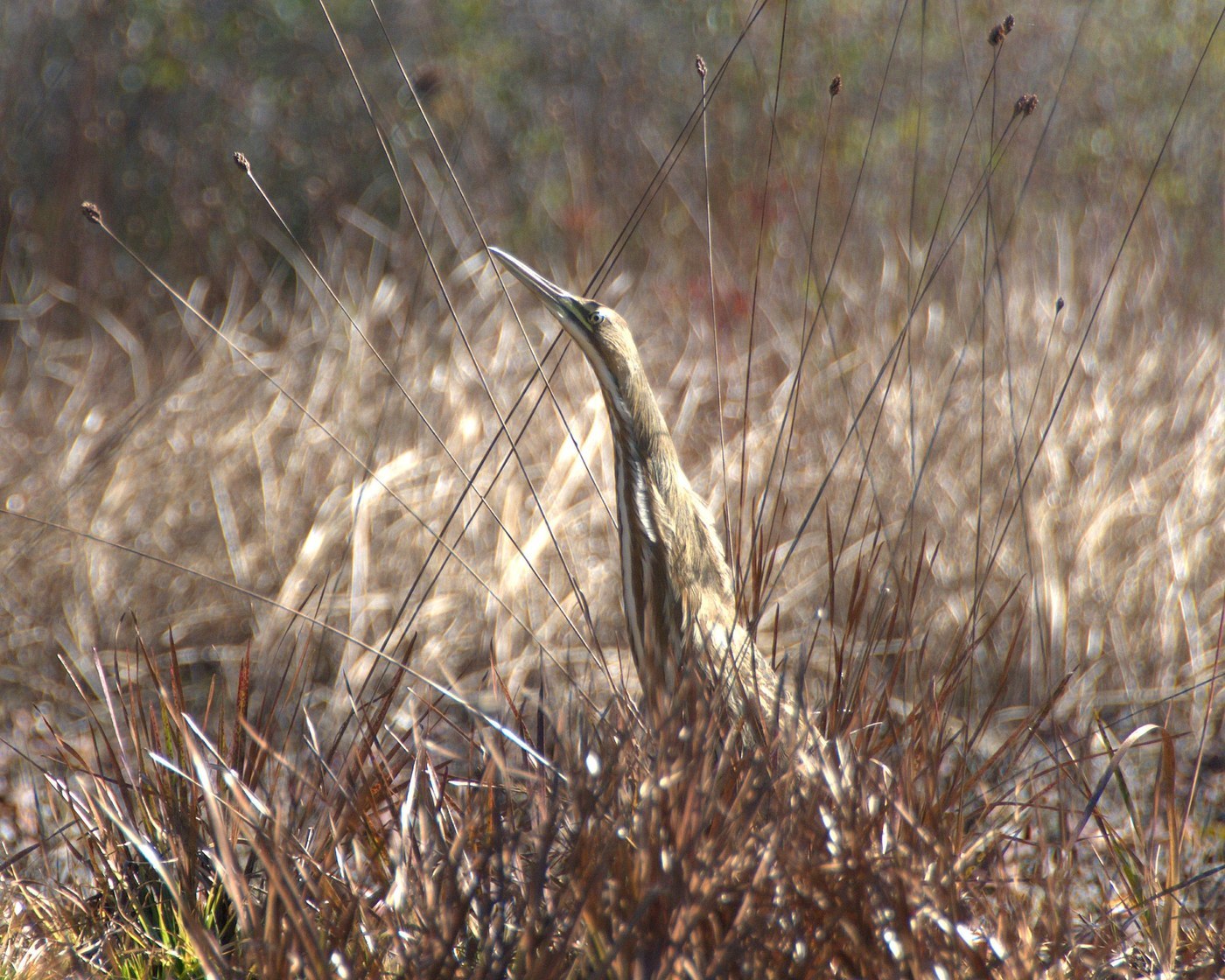
Key Field Marks
- Size: Medium-sized, stocky heron, about 60–85 cm (24–33 in) tall, with a relatively short, thick neck for a heron.
- Plumage: Warm brown overall, densely streaked with buff, dark brown, and white on the neck and underparts — excellent camouflage against dried marsh vegetation.
- Neck stripe: A bold, dark blackish stripe runs down the side of the neck — one of the best field marks at rest.
- Bill: Long, stout, straight, yellowish, dagger-shaped.
- In flight: Shows contrasting dark blackish primaries and outer wing against paler brown coverts — a useful mark on a flushed bird, along with a shorter, more hunched neck than typical herons.
- Behavior mark: When alarmed, freezes in an upright "bittern stance" with bill pointed straight up, swaying gently with the reeds to blend in.
Separating Similar Species
- Least Bittern: Much smaller and more compact, with contrasting buffy/pale wing patches obvious in flight, and lacks the American Bittern's bulk and heavy streaking pattern.
- Immature night-herons (Black-crowned, Yellow-crowned): Bulkier and more thickly built, with coarser white spotting rather than fine streaking, a shorter and stouter bill, and typically show a more upright, larger-headed profile without the bittern's cryptic vertical-freeze posture.
Habitat, Range & Season
Breeds in freshwater and brackish marshes, wet meadows, and bogs with tall emergent vegetation (cattails, sedges) across much of Canada and the northern/central United States in spring and summer. Winters in marshes, wet fields, and coastal wetlands across the southern United States, Mexico, and parts of the Caribbean and Central America. Highly secretive and solitary; easily overlooked even where present.
Behavior & Voice
Almost entirely solitary, hunting by standing motionless or stalking slowly at the edge of vegetation for fish, frogs, insects, and small mammals. Most active at dusk, dawn, and night. Its extraordinary booming call — produced by inflating the esophagus — is one of the most distinctive sounds of a healthy marsh.
- Song: A deep, resonant, pumping "oonk-a-chunk" or "pump-er-lunk," repeated several times, often compared to the sound of an old hand water pump. Given mainly by males during the breeding season, typically at dawn or dusk.
Frequently asked questions
Why does the American Bittern point its bill straight up?
This 'freeze' posture, with the streaked neck and breast aligned vertically, camouflages the bird among upright reeds and cattails, making it very hard to spot even at close range.
What does an American Bittern sound like?
It gives a deep, pumping 'oonk-a-chunk' or 'pump-er-lunk' call, often likened to an old-fashioned hand water pump, usually heard at dawn or dusk in breeding marshes.
How is American Bittern different from Least Bittern?
American Bittern is much larger and bulkier with dense brown streaking, while Least Bittern is small and compact with obvious pale buffy wing patches visible in flight.
Where is the best place to find an American Bittern?
Look (and especially listen) in freshwater marshes and wet meadows with tall emergent vegetation like cattails, particularly at dawn or dusk during the breeding season.