
Amazonian Motmot Identification Guide
A green, rufous-bellied Amazon basin motmot best known for its long racket-tipped tail, which it swings side to side like a pendulum.
Read the full Amazonian Motmot encyclopedia entry →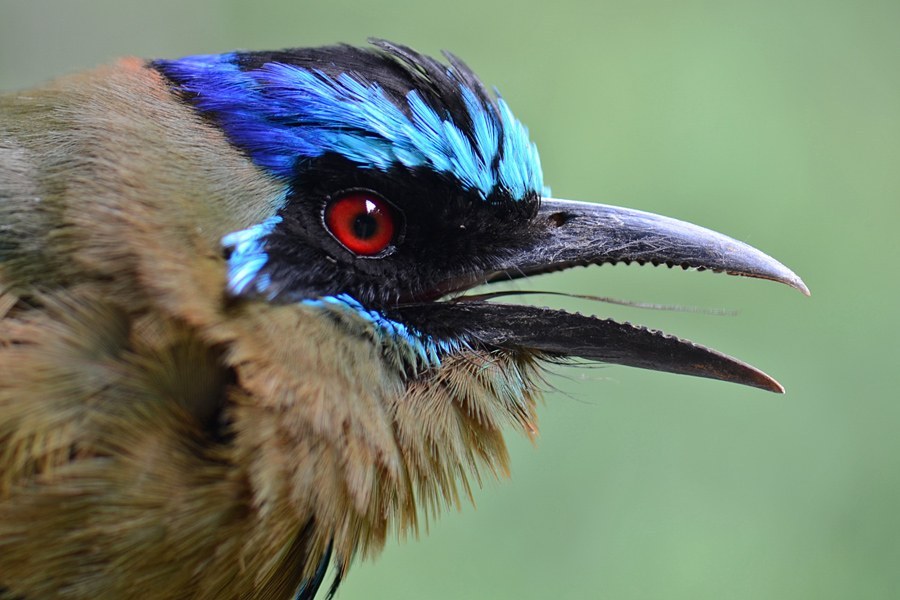
Key Field Marks
- Size: Medium-large, about 38–43 cm (15–17 in) including the long tail.
- Head pattern: Black mask through the eye bordered above by a turquoise-blue browline, with a blue-black crown patch on the crown.
- Body: Green upperparts and wings; underparts vary from olive-green on the throat/breast to rich rufous on the lower breast and belly (extent varies by subspecies across the Amazon basin).
- Tail: Long, graduated, and green-blue, ending in distinctive bare-shafted "rackets" near the tip — a hallmark of motmots.
- Bill: Black, moderately long, slightly decurved, with fine serrations along the cutting edge.
- Signature behavior: Swings the tail slowly and rhythmically side to side like a pendulum while perched — one of the most reliable ways to notice the bird in the first place.
Separating Similar Species
- Whooping Motmot (Momotus subrufescens) and other former "Blue-crowned Motmot" relatives: These were split from Amazonian Motmot; ranges are largely allopatric (Amazonian Motmot occupies the Amazon basin interior), so location is often the best clue where ranges approach each other.
- Broad-billed Motmot (Electron platyrhynchum): Smaller, with a visibly broader bill, a blue chin patch, and a shorter tail without as pronounced a racket gap.
- Rufous Motmot (Baryphthengus martii): Larger, with entirely rufous underparts (no green on breast) and a proportionally shorter tail.
Habitat, Range & Season
A bird of Amazonian lowland and foothill humid forest across much of the Amazon basin in South America, from Colombia and Venezuela south through Peru, Bolivia, and Brazil. It favors the forest interior, mid-story, and edges, including secondary growth and forest borders. It is non-migratory and can be found year-round in the same territories, which pairs hold and defend.
Behavior & Voice
Sits quietly and motionless for long periods on a mid-story perch, making it easy to overlook despite its size — often the swinging tail or its low, hooting call gives it away. Sallies out to catch large insects and also eats fruit. Often first detected by voice rather than sight.
- Song: A low, resonant, owl-like double hoot, "hoo-doo" or "oo-doo," repeated at intervals, mainly at dawn and dusk.
- Calls: Also gives harsher, rattling notes when alarmed.
Frequently asked questions
Why does the Amazonian Motmot swing its tail?
The pendulum-like tail-wag is thought to function as a signal — possibly to communicate alertness to predators or in territorial/pair communication — and is one of the most distinctive behavioral clues to identifying any motmot.
How do motmots get the racket-tipped tail?
The racket tips form because the barbs along part of the tail feather shaft are weakly attached and wear away or are preened off, leaving bare shaft before the terminal 'racket' of feather.
What is the difference between the Amazonian Motmot and the former 'Blue-crowned Motmot'?
Blue-crowned Motmot was split into several species, including Amazonian Motmot and Whooping Motmot; they are best separated by range, since Amazonian Motmot is restricted to the Amazon basin interior.
Is the Amazonian Motmot easy to see in the wild?
It can be inconspicuous because it perches still for long periods, so listening for its low hooting call is often more productive than scanning visually.