
Amazon Kingfisher Identification Guide
A large, all-green Neotropical kingfisher with a heavy black bill, told from its smaller and larger green relatives by size, bill proportions, and breast pattern.
Read the full Amazon Kingfisher encyclopedia entry →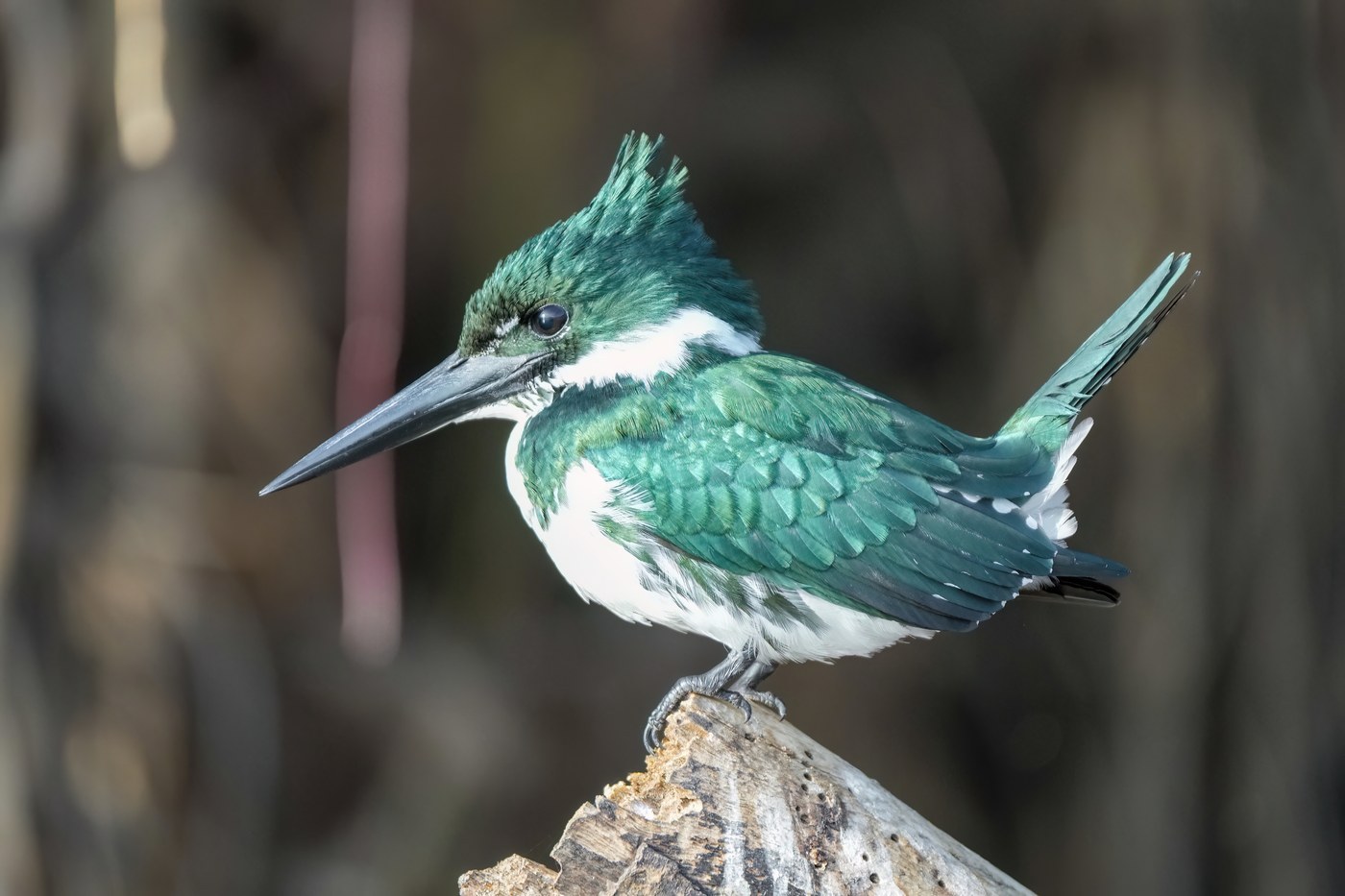
Key Field Marks
- Size: A large kingfisher, roughly 28–30 cm (11–12 in) long — bigger than Green Kingfisher, smaller than Ringed Kingfisher.
- Upperparts: Glossy dark bottle-green head, back, and wings with fine white spotting on the wing coverts (visible at close range).
- Underparts: White belly; males show a broad, solid rufous-chestnut breast band. Females lack the solid band and instead show a narrower, greenish, spotted or broken breast band.
- Bill: Notably large, long, and heavy — proportionally bigger and more massive than in Green Kingfisher, a useful mark even at a distance.
- Legs: Short and dark, as in all kingfishers.
- Crest: Shaggy, ragged crest raised when alert or agitated.
Separating Similar Species
- Green Kingfisher (Chloroceryle americana): Much smaller and daintier, with a thinner bill and more extensive white spotting on the wings and tail. Male's breast band is narrower and more rufous-orange; overall the bird looks "toy-sized" next to an Amazon Kingfisher.
- Ringed Kingfisher (Megaceryle torquata): Noticeably larger and bulkier, with a blue-gray (not green) crown and back, and both sexes show a solid rufous belly extending up onto the breast.
- Green-and-rufous Kingfisher (Chloroceryle inda): Underparts are entirely rufous (no white), and it favors shaded, sluggish forest streams rather than open rivers.
Habitat, Range & Season
Found year-round along wooded rivers, streams, lagoons, and mangrove-lined waterways from southern Mexico through Central America and much of South America east of the Andes, south to northern Argentina. It is a lowland species, generally below 1,200 m, and is a permanent resident — no strong migratory movements are known. Look for it perched low over water on snags, roots, or overhanging branches.
Behavior & Voice
Solitary and somewhat wary, often diving away from a perch well before an observer gets close. Hunts by plunge-diving for small fish and aquatic invertebrates from a low perch or occasionally hovers briefly before diving. Flight is fast and direct, low over the water.
- Call: A sharp, dry "tek" or "check," often given singly as the bird flushes.
- Flight call: A harsher rattling chatter, softer and less strident than the loud rattle of Ringed Kingfisher.
Frequently asked questions
How do I tell an Amazon Kingfisher from a Green Kingfisher?
Size and bill are the quickest clues: Amazon Kingfisher is noticeably larger with a much heavier, longer bill. Green Kingfisher is small and delicate with more extensive white spotting in the wings.
What is the easiest way to sex an Amazon Kingfisher?
Look at the breast band: males show a solid, broad rufous-chestnut band across the upper breast, while females show a narrower, incomplete, greenish or spotted band.
Where is the best place to look for Amazon Kingfishers?
Scan low perches — snags, roots, and overhanging branches — along wooded rivers, streams, and lagoons in lowland Central and South America; it rarely strays far from water.
Is the Amazon Kingfisher migratory?
No, it is essentially a year-round resident throughout its Neotropical range, with no significant seasonal migration documented.