
Alpine Swift Identification Guide
A large, fast-flying swift with a white belly and throat separated by a brown breast band, noticeably bigger than the Common Swift.
Read the full Alpine Swift encyclopedia entry →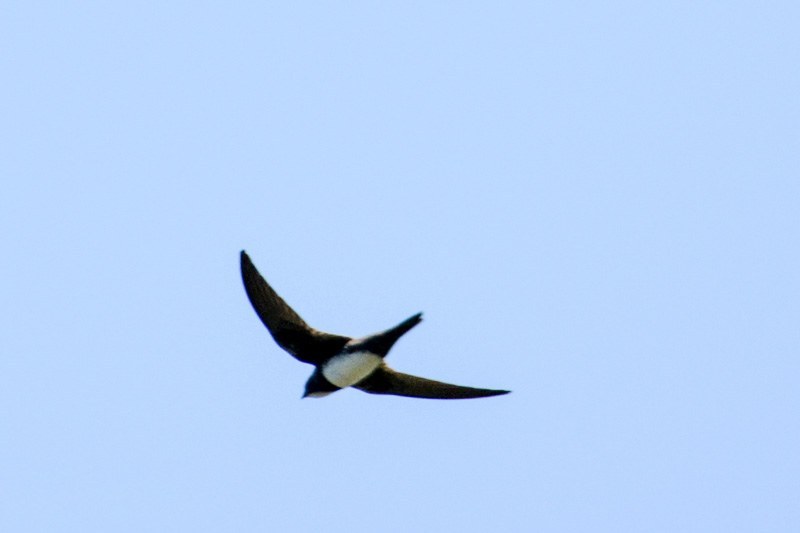
Key Field Marks
- Size: Large for a swift, about 20–22 cm long with a wingspan of roughly 54–60 cm — distinctly bigger than the Common Swift.
- Plumage: Brown upperparts; white throat and white belly separated by a brown breast band, a pattern unique among the swifts likely to be seen across most of its range.
- Shape: Long, swept-back, sickle-shaped wings and a slightly forked tail, giving a powerful, streamlined silhouette in flight.
- Flight: Extremely fast and strong, often flying very high; capable of remaining airborne continuously for extended periods.
Behavior
- An aerial specialist that feeds, drinks, and even mates in flight, rarely landing except at the nest.
- Nests colonially in crevices on cliffs and, increasingly, on tall buildings and towers.
- Often gives loud, screaming calls while flying in fast group chases around nesting cliffs or buildings.
Separating It From Similar Species
- Common Swift is much smaller and appears entirely dark except for a small pale throat patch, lacking the Alpine Swift's white belly and contrasting breast band.
- Pallid Swift is also smaller and lacks the white belly, appearing overall paler brown than Common Swift but still much darker-bodied than Alpine Swift.
- Alpine Swift's larger size and obvious white belly make it relatively easy to pick out from mixed swift flocks once seen well, though its speed and height can make brief views challenging.
Where and When to See It
- Range: Breeds across mountainous and cliff regions of southern Europe, parts of Asia, and Africa; many populations migrate to sub-Saharan Africa for winter.
- Habitat: Cliffs, gorges, and mountain faces for nesting, though foraging flights range widely over varied terrain, including towns and lowlands; also uses tall buildings as nest sites in some cities.
- Season: Spring and summer in temperate breeding areas; present year-round in parts of its African wintering range.
Voice
- A loud, trilling, screaming twitter, often given by groups of birds chasing each other in fast, low passes around cliffs or buildings.
Frequently asked questions
How do I tell an Alpine Swift from a Common Swift?
Alpine Swift is noticeably larger, with a white belly and throat separated by a brown breast band, while Common Swift is smaller and appears almost entirely dark with only a small pale throat patch.
Where does the Alpine Swift nest?
It nests colonially in crevices on cliffs and gorges, and increasingly on tall buildings and towers in some urban areas.
Does the Alpine Swift migrate?
Yes, most populations that breed in Europe and parts of Asia migrate to sub-Saharan Africa for the winter, though some African populations are resident year-round.
What is distinctive about how the Alpine Swift flies?
It is an extremely fast, powerful flier capable of staying airborne for extended periods, often flying very high and covering large distances while foraging for aerial insects.