
African Pygmy Falcon Identification Guide
Africa's smallest raptor, a tiny black-and-white falcon with false eye-spots on its nape and a strong association with weaver nests.
Read the full African Pygmy Falcon encyclopedia entry →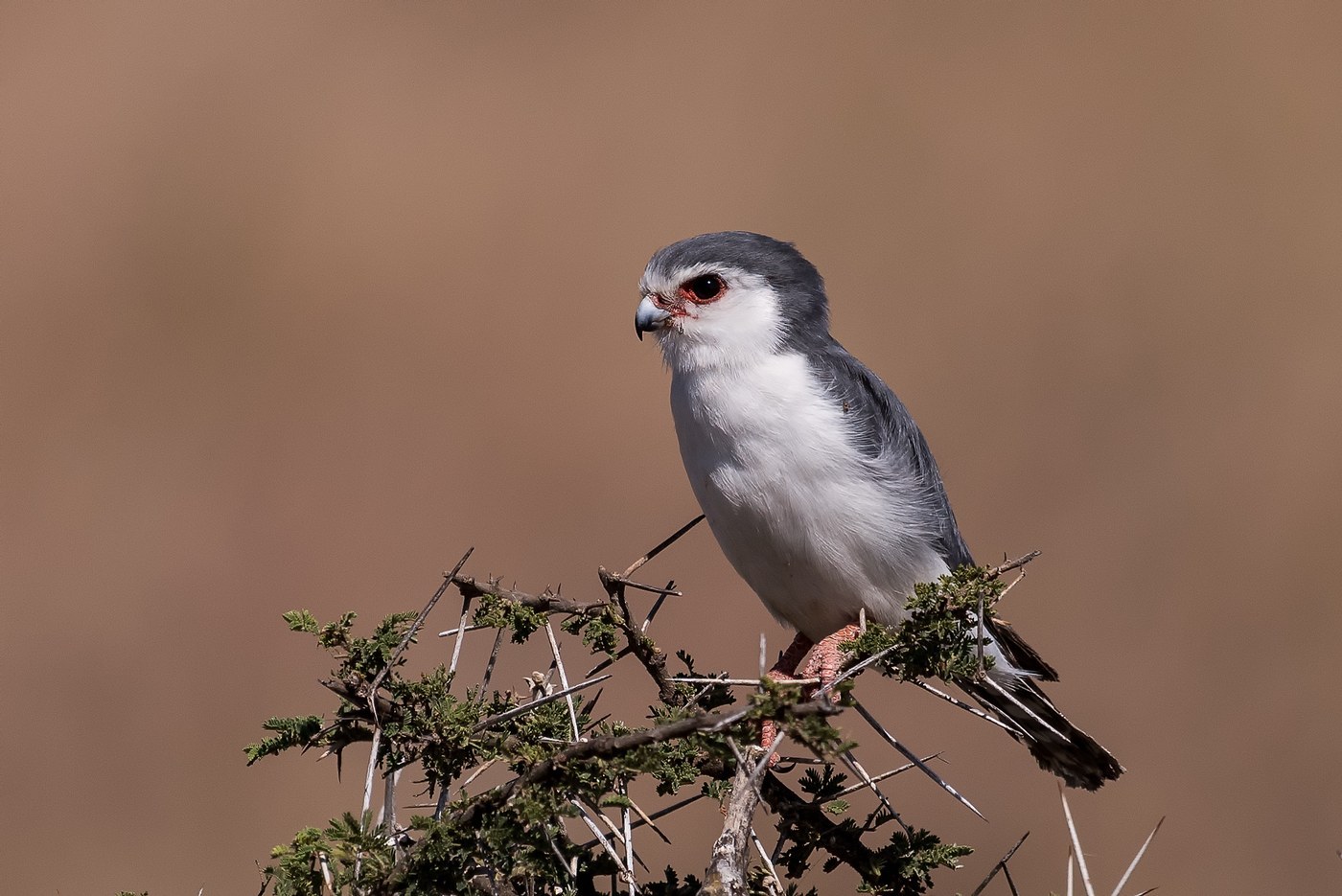
Key Field Marks
- Size: Roughly 19–20 cm, about the size of a shrike — the smallest raptor on the African continent.
- Plumage: White underparts and face, black wings spotted with white, and a short black-tipped tail.
- Back color differs by sex: Males have a pale grey back; females have a chestnut/rufous back, an easy way to sex birds in the field.
- Nape spots: Two white “false eye” spots on the back of the head, which may help deter predators by mimicking a face.
- Bare parts: Bright red-orange cere (base of bill) and legs, contrasting with the black bill tip.
Behavior
- Perches conspicuously and upright on treetops, dead branches, fence posts, or utility wires, often bobbing or pumping its tail.
- Hunts by dropping onto prey from a perch, taking insects, lizards, small rodents, and occasionally small birds.
- Strongly associated with the large communal nests of sociable weavers in southern Africa (and buffalo-weaver nests in East Africa), using old nest chambers for roosting and breeding.
Separating It From Similar Species
- Small shrikes can suggest a pygmy falcon at a glance but have a hooked-tipped but more slender bill without the falcon's strongly hooked, notched bill, and lack the red cere/legs.
- True falcons of similar plumage pattern are much larger; size alone (tiny, stocky, big-headed) combined with the weaver-nest association usually clinches the identification.
Where and When to See It
- Range: Dry savanna, thornveld, and semi-arid scrub across parts of eastern and southern Africa.
- Season: Resident and non-migratory; present year-round wherever suitable habitat and host weaver colonies occur.
- Habitat cue: Scanning active sociable weaver colonies (large haystack-like communal nests) is one of the most reliable ways to find this species in southern Africa.
Voice
- A shrill, chattering “kik-kik-kik” given from perches, especially near the nest or when alarmed.
Frequently asked questions
How can I tell a male from a female African Pygmy Falcon?
Check the back color: males have a plain grey back, while females have a chestnut or rufous back. Both sexes share white underparts and black-spotted wings.
Why does the African Pygmy Falcon nest with weavers?
It regularly takes over unused chambers in the large communal nests built by sociable weavers (or buffalo weavers in East Africa), using them for both roosting and breeding rather than building its own nest.
What do the white spots on the back of its head mean?
These are thought to be false eye-spots that may help confuse or deter predators approaching from behind.
Is the African Pygmy Falcon really the smallest raptor in Africa?
Yes, at around 19–20 cm long it is the smallest bird of prey found on the African continent.