African Penguin Identification Guide
The only penguin species that breeds in Africa, recognized by its black facial mask, single chest band, and unique spot pattern.
Read the full African Penguin encyclopedia entry →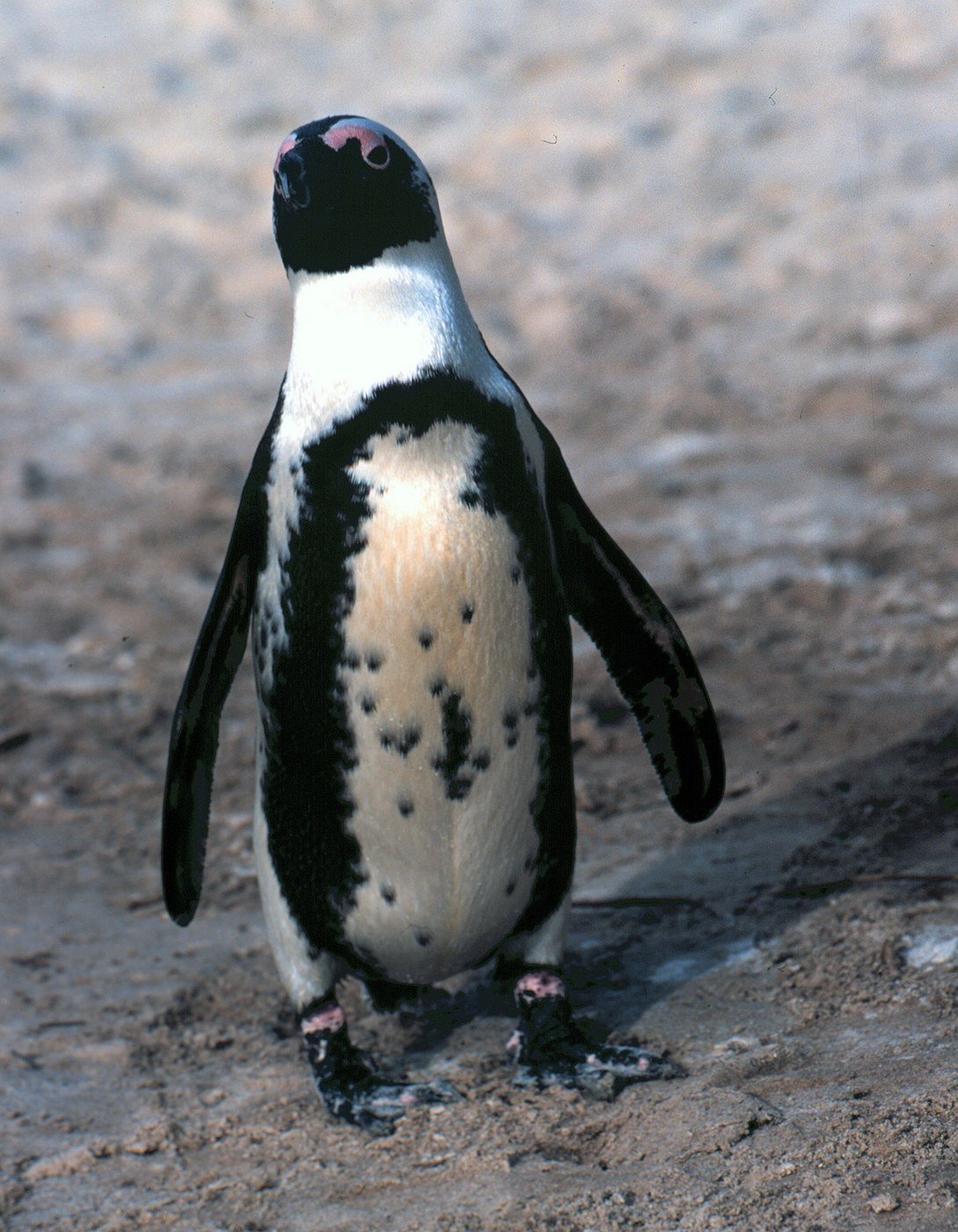
Key Field Marks
- Size: About 60–70 cm tall, 2–3.6 kg; a medium-sized, stocky penguin.
- Head and face: Black face and crown with a pink patch of bare skin above each eye, used for heat regulation and visibly flushed pink in warm weather.
- Body pattern: White underparts crossed by a single black band that runs from the breast down the flanks to the legs (a key mark separating it from look-alike penguins).
- Unique markings: Irregular black spots scattered on the white breast and belly — the pattern is unique to each individual, like a fingerprint.
- Juveniles: Plain blue-grey above and white below with no facial markings or chest band; these develop gradually over about two years as the bird molts into adult plumage.
Behavior
- Highly social, colonial nester that breeds in burrows or under vegetation/rocks on offshore islands and a few protected mainland sites.
- Porpoises through the water while swimming and travels in tight groups (“rafts”) at sea.
- Produces a loud, braying donkey-like call at colonies, which earned it the old nickname “jackass penguin.”
Separating It From Similar Species
- African Penguin is the only penguin species regularly found in Africa, so confusion with other species is uncommon.
- Vagrant Magellanic or Humboldt Penguins (both native to South America) are extremely rare outside their normal range but show a double black band across the chest, versus the African Penguin's single band.
Where and When to See It
- Range: Coastal South Africa and Namibia, breeding on offshore islands and select mainland colonies.
- Best-known accessible sites: Boulders Beach and Stony Point in South Africa offer close views of mainland breeding colonies.
- Season: Present year-round at breeding colonies, though breeding timing varies by site; numbers at any given colony can shift seasonally as birds move between foraging and breeding areas.
Voice
- Loud, harsh braying calls, often given in bouts at the colony, especially around dusk and during social displays.
Frequently asked questions
What is the easiest way to identify an African Penguin?
Look for the single black band across the white chest and belly, a black-and-white facial pattern with pink skin patches above the eyes, and irregular black spots on the underparts.
Why do African Penguins have pink patches above their eyes?
These are areas of bare skin used for thermoregulation; they flush pinker as blood flow increases to help the bird cool down in warm conditions.
Can African Penguin chicks be identified the same way as adults?
No — juveniles lack the black facial mask and chest band entirely, appearing plain blue-grey above and white below until they molt into adult plumage over about two years.
Where is the best place to see African Penguins in the wild?
Protected mainland colonies such as Boulders Beach and Stony Point in South Africa, as well as several offshore islands along the South African and Namibian coasts.
African Penguin identified by the community
Recent African Penguin sightings identified with Bird Identifier.