
African Paradise Flycatcher Identification Guide
A glossy blue-black-headed flycatcher with rich chestnut plumage and, in males, spectacularly long tail streamers.
Read the full African Paradise Flycatcher encyclopedia entry →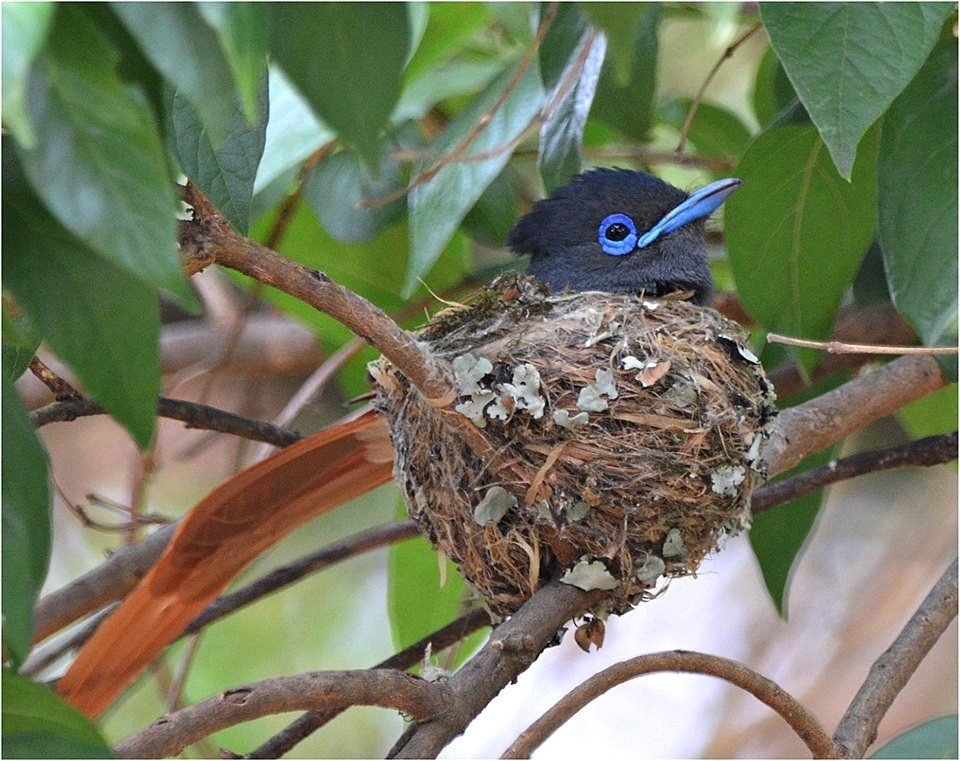
Key Field Marks
- Size: Body 17–21 cm; adult males add long, ribbon-like central tail streamers that can push overall length past 30 cm.
- Head: Glossy blue-black with a slight peak or crest, contrasting pale blue-grey bill and blue eye-ring.
- Body: Rich chestnut/rufous back, wings, and tail; pale grey underparts.
- Sexes: Males carry the long tail streamers and the glossiest black hood; females and immatures have shorter tails, duller brownish (not glossy black) heads, but share the rufous back and tail.
- Rare white morph: In parts of its range a small proportion of males are white-backed instead of chestnut, with the same black head and long tail streamers.
Behavior
- Highly active, acrobatic aerial feeder — sallies out from a perch to snatch flying insects and returns, often flicking the tail and fanning it in flight.
- Usually seen singly or in pairs foraging in the mid- to upper canopy of trees; joins mixed-species foraging flocks at times.
- Frequently calls while foraging, making it easier to locate than to see clearly in leafy canopy.
Separating It From Similar Species
- Blue-mantled Crested Flycatcher: Has a more obvious crest and a blue-grey mantle rather than chestnut; lacks the long straight tail streamers.
- Rufous-vented Paradise Flycatcher (limited range overlap): Told apart mainly by underpart color and range; check local field guide range maps where both occur.
- Female/immature African Paradise Flycatchers can be confused with other rufous-backed flycatchers, but the combination of a blue-grey bill, blue eye-ring, and rufous tail is diagnostic.
Where and When to See It
- Range: Widespread across sub-Saharan Africa in forest, woodland, riparian thicket, and well-treed gardens.
- Movements: Many populations are intra-African migrants or partial migrants, becoming more common in a given area during the wet season when they breed.
- Habitat: Favors shaded woodland interior and forest edge with a dense mid-canopy; also visits gardens and parks with mature trees.
Voice
- A sweet, whistled song used by males, often given from cover.
- A harsh, scolding “zwit-zwit-zwit” or chattering alarm call is frequently the first clue to its presence.
Frequently asked questions
How do I tell a male from a female African Paradise Flycatcher?
Males have long, ribbon-like tail streamers and a glossier, deeper black head; females and immatures have short tails and a duller, browner (not glossy black) head, though both sexes share the chestnut back.
Are all African Paradise Flycatchers chestnut-colored?
Most are, but a rare white morph exists in some populations where the back, wings, and tail are white instead of chestnut while the black head and tail streamers remain the same.
What habitat is best for finding this species?
Look in woodland and forest edge with a shaded mid-canopy, along wooded riverbanks, or in gardens and parks with tall mature trees.
Does the African Paradise Flycatcher migrate?
Many populations move seasonally within Africa, becoming more numerous locally during the wet/breeding season rather than making long intercontinental journeys.