
African Openbill Identification Guide
A dark, glossy wetland stork named for the distinctive gap between its upper and lower mandibles, a specialized adaptation for extracting freshwater snails.
Read the full African Openbill encyclopedia entry →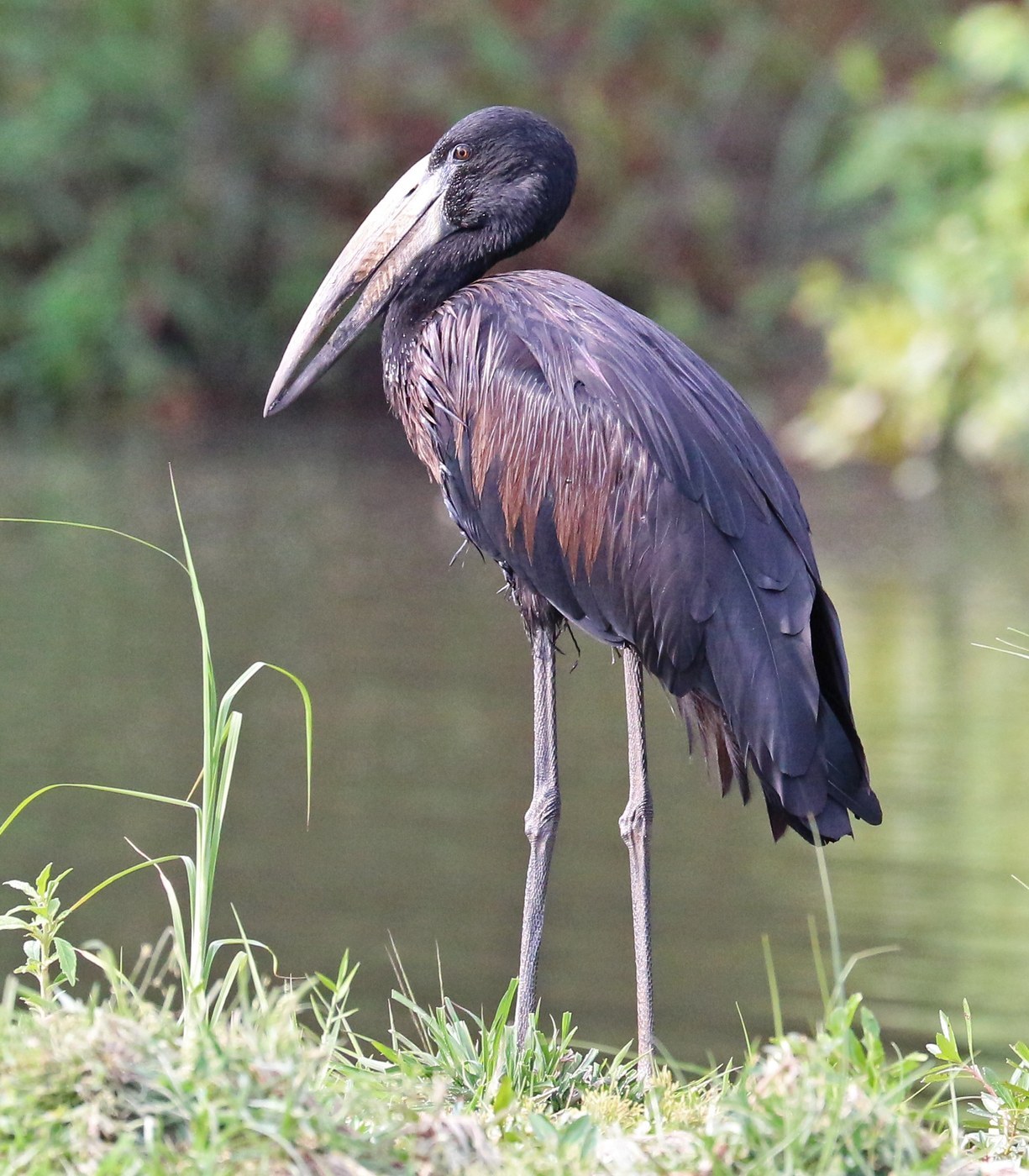
Key Field Marks
- Medium-sized stork, about 80-94 cm (31-37 in) long, with an overall blackish appearance
- Plumage appears dull blackish-brown at rest but shows an iridescent green or purple gloss in good light, especially on the wings
- Distinctive bill shape: when closed, the mandibles touch only at the tip and base, leaving a visible open gap in the middle — the source of the name "openbill"
- Long, dark legs and a fairly long neck typical of storks
- Juveniles are duller brown, without the strong iridescent sheen of adults, and the bill gap may be less pronounced
How to Separate It From Similar Species
- Asian Openbill: shares the same distinctive gapped bill shape but has much paler, greyish-white body plumage with black flight feathers, and occurs only in South and Southeast Asia, so ranges never overlap with the African species.
- Other dark African storks (such as Abdim's Stork or Woolly-necked Stork) have normally closing, straight bills without the diagnostic gap, along with different patterns of white on the body or neck.
- The unique gapped bill, visible even at a distance in profile, makes the African Openbill straightforward to identify once the bill shape is seen clearly.
Where & When to See It
- Resident and locally nomadic across sub-Saharan Africa, favoring wetlands, marshes, seasonally flooded grasslands, lakeshores, and rice paddies.
- Movements are driven largely by water levels and the availability of its main prey, freshwater snails, so flocks may appear and disappear from an area seasonally.
- Often forms large flocks, particularly at productive wetlands and around breeding colonies.
Voice & Behavior Cues
- Largely silent away from breeding colonies; at nesting colonies, birds communicate mainly through bill-clattering displays rather than vocal calls.
- Highly specialized diet consisting almost entirely of large freshwater snails, which it extracts from the shell using the gap in its bill as a specialized tool, along with mussels and other mollusks.
- Soars well on thermals, often seen circling high with other storks and large waterbirds.
- Nests colonially in trees near wetlands, frequently alongside herons, egrets, and other storks.
Frequently asked questions
Why does the African Openbill have a gap in its bill?
The gap between the mandibles is a specialized adaptation that helps the bird grip and extract freshwater snails and mussels from their shells, its primary food source.
How do you tell an African Openbill from an Asian Openbill?
Both share the same distinctive gapped bill, but African Openbill has dark, glossy blackish plumage while Asian Openbill is pale greyish-white with black flight feathers; the two also occur on different continents.
What does the African Openbill eat?
Almost exclusively freshwater snails and mussels, extracted from their shells using its specially shaped bill.
Where does the African Openbill live?
In wetlands, marshes, flooded grasslands, and lakeshores across sub-Saharan Africa, moving locally in response to water levels and snail abundance.