
African Harrier-Hawk Identification Guide
A long-legged, grey raptor known for its bare, mood-flushing yellow-to-red facial skin and unusually flexible double-jointed legs used to raid crevices and nest holes.
Read the full African Harrier-Hawk encyclopedia entry →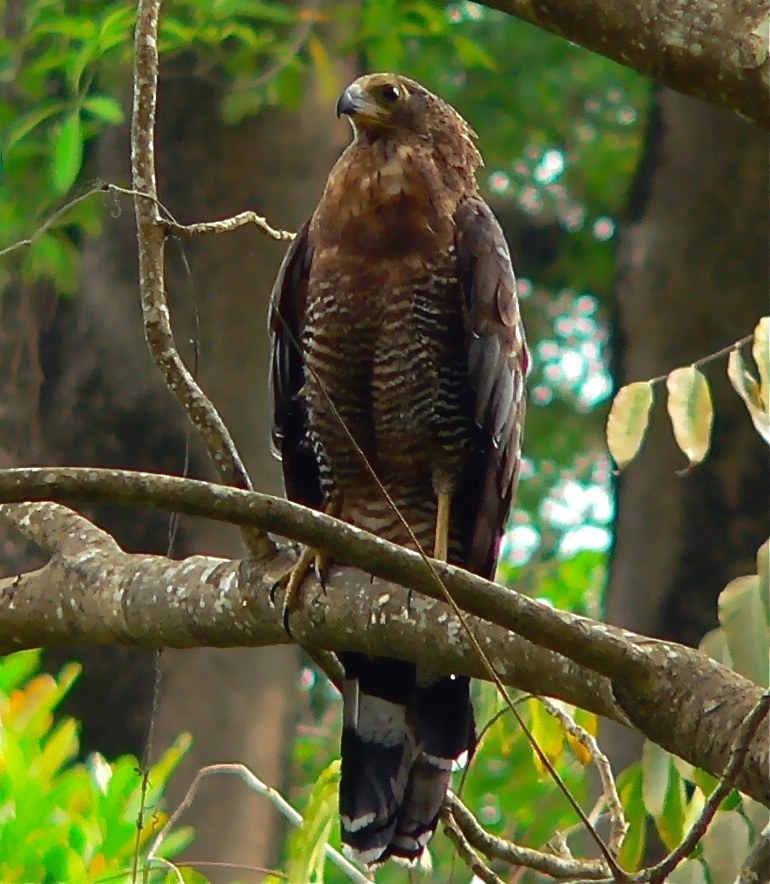
Key Field Marks
- Medium-large raptor, about 60-66 cm (24-26 in) long, with long wings, a long tail, and notably long, bare legs
- Overall pale grey head, back, and breast, finely barred grey-and-white belly, and blackish flight feathers and tail with a single broad white tail band
- Bare, featherless facial skin from the bill to the eye, capable of flushing from dull yellow to bright red-orange when the bird is excited or aggressive
- Small, slim head and a relatively small, weak-looking bill for a raptor of its size
- Long, double-jointed legs that can bend both forward and backward at the "knee" (intertarsal joint), an adaptation unique among raptors
How to Separate It From Similar Species
- Chanting Goshawks (Eastern and Western): show bright red-orange legs and cere but a feathered face without the bare, color-changing skin patch, and lack the long, flexible legs of the Harrier-Hawk.
- Gymnogene (an old name for this species) is sometimes confused with pale morphs of other hawks, but the bare face and slow, wobbly flight with shallow wingbeats are distinctive.
- In flight, the combination of long broad wings, a long tail with one broad white band, and a slow, harrier-like flight with the wings held in a shallow V helps confirm identification.
Where & When to See It
- Resident across most of sub-Saharan Africa in a wide range of wooded habitats, including forest edge, savanna woodland, and even wooded suburban areas, generally avoiding only the driest desert regions.
- Non-migratory, holding permanent territories.
- Often seen climbing methodically over cliff faces, palm trunks, or through tree crevices rather than in typical raptor soaring flight.
Voice & Behavior Cues
- Gives a shrill, whistled call, often a thin "kee-ee" or wailing whistle, mainly during display flights.
- Uses its unusually flexible double-jointed legs and long toes to reach into tree cavities, palm fruit clusters, crevices, and weaver bird nests to extract nestlings, eggs, and insects — a foraging technique unlike any other raptor.
- Flight is slow and somewhat unsteady, with shallow, floppy wingbeats interspersed with glides, quite different from the powerful flight of true hawks and eagles.
- Frequently seen clambering along cliffs or clinging to trunks in a woodpecker-like fashion while searching for prey.
Frequently asked questions
What is the most distinctive feature of the African Harrier-Hawk?
Its bare, featherless facial skin, which can flush from pale yellow to bright red when the bird is agitated, combined with unusually long, flexible double-jointed legs.
How does the African Harrier-Hawk find its food?
It uses its long, flexible legs to reach into tree holes, crevices, and hanging nests to extract nestlings, eggs, and insects, a foraging method unique among raptors.
How can you tell it apart from a chanting goshawk?
Chanting goshawks have fully feathered faces and bright red-orange legs and cere, while the African Harrier-Hawk has bare, color-changing facial skin and much longer, more flexible legs.
Where does the African Harrier-Hawk live?
Across most of sub-Saharan Africa in forest edge, savanna woodland, and even wooded suburban habitats, avoiding only the driest deserts.