
African Grey Hornbill Identification Guide
A slender, long-tailed savanna hornbill told by its grey-brown plumage and a dark, down-curved bill marked with a pale cream stripe or patch at the base.
Read the full African Grey Hornbill encyclopedia entry →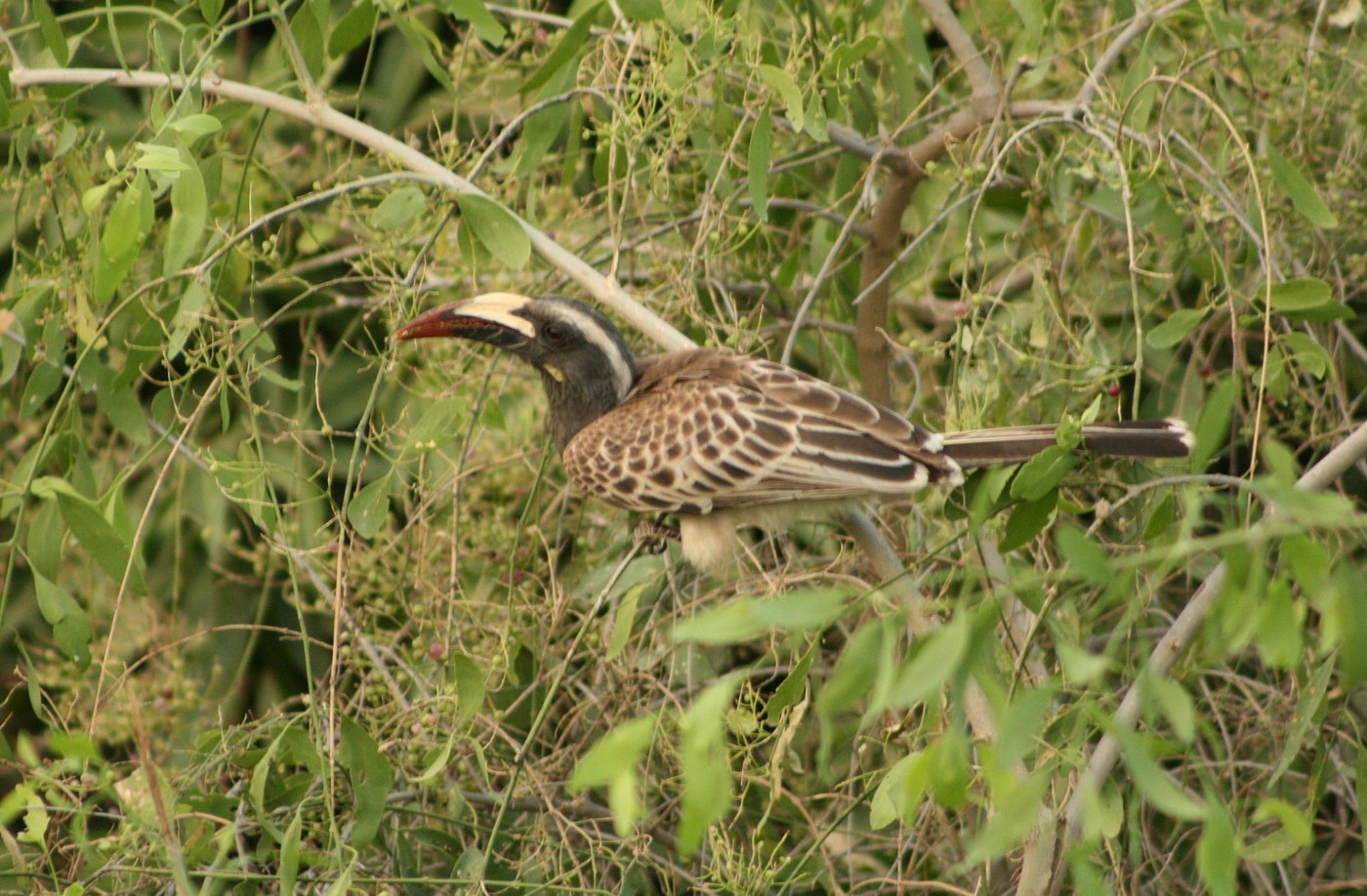
Key Field Marks
- Medium-sized hornbill, about 46-51 cm (18-20 in) long including a long, graduated tail
- Grey-brown head, back, and breast; whitish belly and a whitish stripe down the back visible in flight
- Long, down-curved bill; males show a mostly dark bill with a distinct pale cream to yellowish patch or stripe at the base of the upper mandible, while females have a smaller, more uniformly dark bill
- Pale, narrow eyebrow-like stripe above the eye
- Long tail often held cocked, tipped with white outer feathers visible in flight
How to Separate It From Similar Species
- Red-billed Hornbill: has an all-red or orange-red bill rather than dark with a cream patch, and more contrasting black-and-white spotted plumage.
- Southern Yellow-billed Hornbill: shows a large, entirely bright yellow bill, quite different from the African Grey Hornbill's dark bill with limited pale markings.
- Crowned Hornbill: darker overall with a mostly red bill with a yellow tip, and found more in forest edge and thicket rather than open savanna.
- Overall drab grey-brown coloration paired with the two-toned dark-and-cream bill pattern is the most reliable way to separate this species from Africa's more colorfully billed small hornbills.
Where & When to See It
- Widespread resident of dry savanna, open woodland, and thornbush across sub-Saharan Africa, from Senegal east to Ethiopia and south to South Africa.
- Non-migratory, though some local movements occur in response to rainfall and fruiting patterns.
- Often seen in pairs or small family groups perched in the open on bare branches or flying between trees with a distinctive undulating flight.
Voice & Behavior Cues
- Song is a series of piping, whistled notes, often accelerating and rising, "pheet-pheet-pheet," frequently delivered from an exposed perch.
- Flight is strongly undulating with audible whooshing wingbeats typical of hornbills.
- Feeds on insects, small reptiles, and fruit, foraging both in trees and occasionally on the ground.
- Like other hornbills, nests in a tree cavity that the female seals herself into with mud and droppings, leaving only a narrow slit through which the male passes food during incubation.
Frequently asked questions
How do you identify an African Grey Hornbill?
Look for a slender grey-brown hornbill with a long tail and a mostly dark, down-curved bill showing a pale cream patch or stripe at the base, especially obvious in males.
How does the African Grey Hornbill differ from the Red-billed Hornbill?
African Grey Hornbill has a mostly dark bill with a pale patch, while Red-billed Hornbill has an entirely red or orange-red bill and more strongly spotted plumage.
What does the African Grey Hornbill eat?
A mix of insects, small reptiles, and fruit, foraged both in trees and on the ground.
Where does the African Grey Hornbill live?
In dry savanna, open woodland, and thornbush habitats across much of sub-Saharan Africa.