
African Fish Eagle Identification Guide
A striking white-headed, chestnut-bodied eagle of African lakes and rivers, instantly recognizable by its ringing call and bald eagle-like plumage pattern.
Read the full African Fish Eagle encyclopedia entry →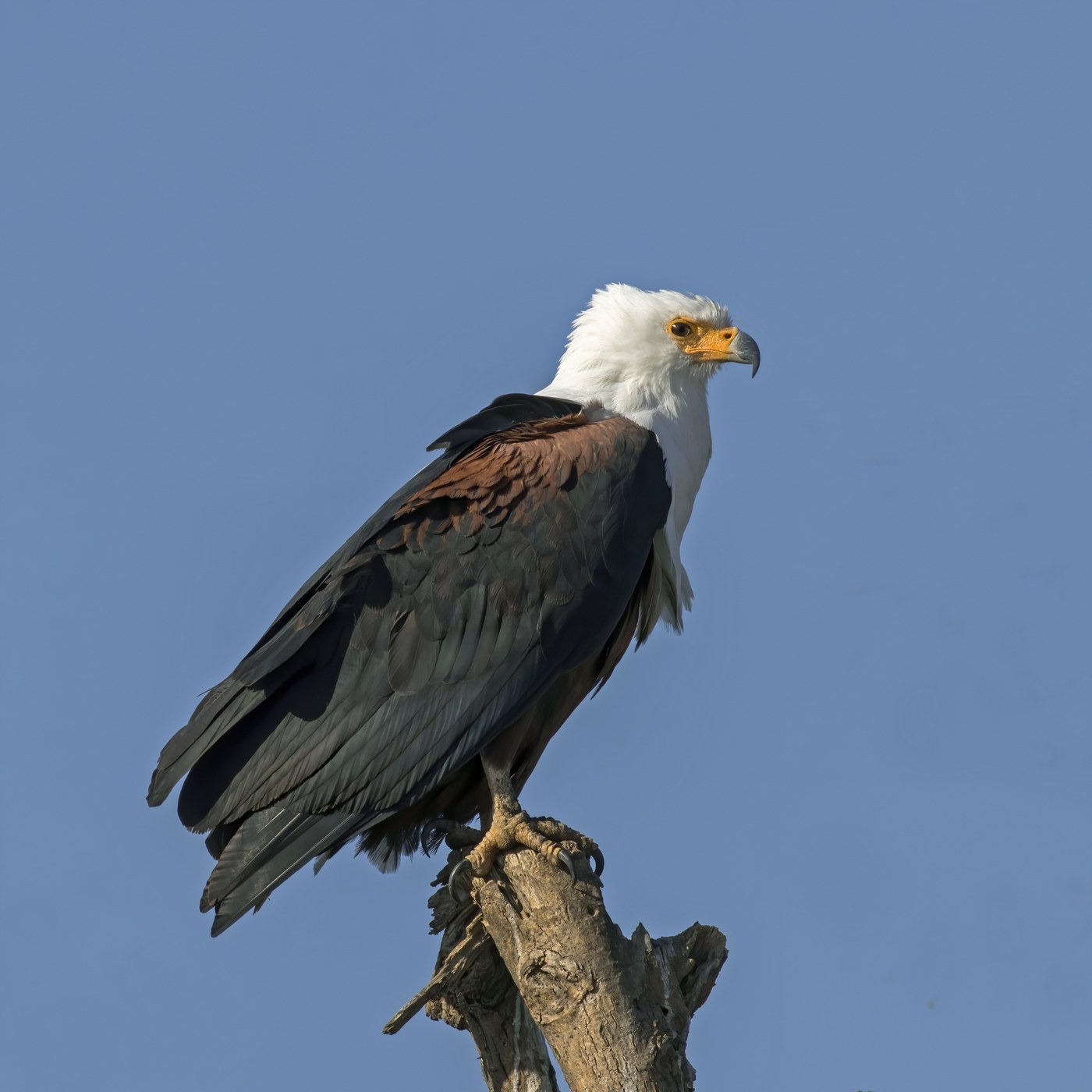
Key Field Marks
- Large eagle, about 63-75 cm (25-30 in) long, with a heavy build and broad wings
- Clean white head, neck, upper breast, and tail contrasting sharply with a rich chestnut body and shoulders
- Black flight feathers on the wings
- Bright yellow face skin (cere) and yellow eyes; large, strongly hooked black bill
- Yellow legs and feet with powerful, spiny-soled talons adapted for gripping slippery fish
- Juveniles are mottled brown overall and take about four to five years to acquire full adult plumage
How to Separate It From Similar Species
- Bald Eagle: superficially similar white head/tail and dark body pattern, but Bald Eagle has a dark brown (not chestnut) body and occurs only in North America — ranges never overlap.
- Palm-nut Vulture: much smaller and mostly white overall, with bare pink-orange facial skin and black in the wings, lacking the solid chestnut body of the Fish Eagle.
- Tawny Eagle and other brown eagles: lack the crisp white head/tail and chestnut body combination entirely.
- Immature birds can be confused with other large brown raptors, but the heavy build, association with water, and eventual whitening of the head with age help confirm identity.
Where & When to See It
- Resident throughout sub-Saharan Africa wherever there is a reliable body of water — large lakes, rivers, reservoirs, coastal lagoons, and wetlands.
- Non-migratory; pairs hold permanent territories along waterways and are often seen perched conspicuously in tall trees overlooking water.
- One of the most widespread and recognizable large raptors across the continent, often considered symbolic of African wetlands.
Voice & Behavior Cues
- Famous for its loud, far-carrying, ringing "yelp" call — a distinctive "wee-ah, hyo-hyo-hyo" often given with the head thrown back, frequently used to represent "the sound of Africa" in film and media.
- Feeds mainly on fish, swooping low over water to snatch prey from just below the surface with its talons.
- Pairs often duet, calling back and forth, and perform spectacular aerial talon-grappling displays during courtship.
- Also opportunistically takes waterbirds, carrion, and will pirate food from other birds such as herons and storks.
Frequently asked questions
How do you identify an African Fish Eagle?
Look for a large eagle with a clean white head, neck, and tail, a chestnut body, black flight feathers, and bright yellow facial skin, always found near water.
What does the African Fish Eagle sound like?
It gives a loud, ringing, far-carrying "yelp" call, often delivered with the head thrown back, widely recognized as an iconic sound of the African bush.
How is the African Fish Eagle different from the Bald Eagle?
Both share a white head and tail, but the African Fish Eagle has a chestnut (not dark brown) body and lives only in sub-Saharan Africa, while the Bald Eagle is found only in North America.
What does the African Fish Eagle eat?
Mainly fish caught by swooping low over water, though it also takes waterbirds, carrion, and steals food from other birds.