
Acorn Woodpecker Identification Guide
A boldly patterned, clown-faced woodpecker of oak woodlands, easily told by its white eyes, red cap, and noisy, sociable colonies that store acorns in granary trees.
Read the full Acorn Woodpecker encyclopedia entry →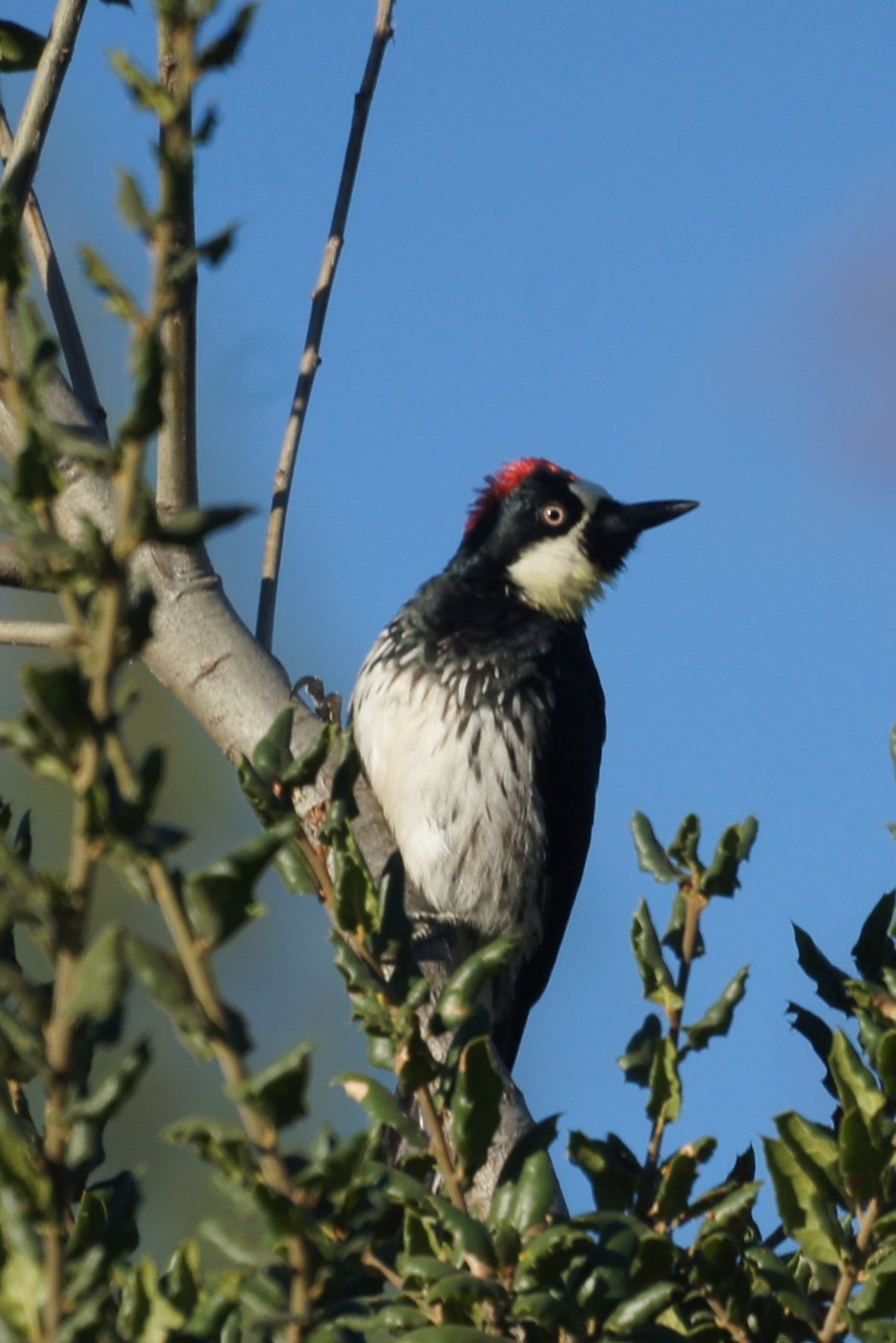
Key Field Marks
- Medium-sized woodpecker, about 21 cm (8.3 in), with a striking "clown face" pattern
- Glossy black back, wings, and breast; white belly and rump patch and white wing patches conspicuous in flight
- Bold white forehead and cheek patch, black band through the eye, black bib on the throat/chest
- Males show a solid red crown from forehead to nape; females have a black band separating the white forehead from the red rear crown
- Pale, staring white to yellowish-white eyes
How to Separate It From Similar Species
- Lewis's Woodpecker: has a dark, glossy greenish-black head and back, a pinkish-red belly and face wash, and lacks the bold white-and-black clown-face pattern; also flies with slow, crow-like flaps rather than typical undulating woodpecker flight.
- Red-headed Woodpecker: entirely solid red head (not just a cap) with a sharp border to a white body and black back, quite different from Acorn Woodpecker's face pattern.
- Golden-fronted and Red-bellied Woodpeckers: show barred black-and-white backs and lack the bold white face and eye pattern of Acorn Woodpecker.
- No other North American woodpecker combines a white face, black eye-line, red cap, and pale eye.
Where & When to See It
- Resident year-round in oak and oak-pine woodlands across California, the Southwest (Arizona, New Mexico), and locally into western Texas, ranging south through Mexico and Central America to Colombia.
- Strongly tied to oaks; colonies maintain traditional "granary trees" (or utility poles) riddled with thousands of holes, each stuffed with a single acorn for winter storage.
- Non-migratory; colonies remain on the same territory for generations.
Voice & Behavior Cues
- Extremely vocal and conspicuous, giving loud, raucous "waka-waka-waka" or "ja-cob, ja-cob" calls, often in noisy group chatter.
- Highly social, cooperative breeder living in extended family groups that jointly defend granaries, incubate eggs, and feed young.
- Often seen perched upright on dead snags or utility poles, sallying out to catch flying insects in addition to gathering and storing acorns.
- Flight is bouncy and undulating, flashing large white wing patches.
Frequently asked questions
What makes an Acorn Woodpecker easy to identify?
Its bold black-and-white clown-like face pattern, pale staring eyes, and (in males) a solid red cap make it unmistakable among North American woodpeckers.
How do male and female Acorn Woodpeckers differ?
Males have a solid red crown reaching the white forehead, while females show a black band separating the white forehead from the red on the back of the crown.
Why do Acorn Woodpeckers drill holes in trees?
They create "granary trees" riddled with holes, each stuffed with a single acorn, to store food for winter — a behavior unique among North American woodpeckers.
Where do Acorn Woodpeckers live?
In oak and oak-pine woodlands from California and the Southwest through Mexico and Central America to Colombia, wherever oaks are common.