Order: Passeriformes; Family: Sturnidae
European Starling
Sturnus vulgaris
A medium-sized, chunky songbird with a short tail and long, slender beak. Known for its aggressive social behavior, mimicry, and impressive aerial displays called murmurations.
Explore European Starling in the encyclopedia →Identify your own birds.
Get a report just like this from any photo or call, free.
Plumage & appearance
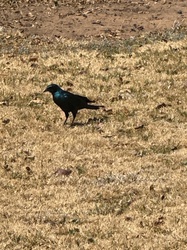
Adults in breeding plumage are iridescent black with green and purple sheens and yellow bills. In winter, plumage is heavily spotted with white or buff, and bills turn dark. Juveniles are a uniform dull brown with a dark bill.
Key field marks
Short, square tail; long, pointed yellow bill (spring); iridescent black plumage with speckles; triangular wings in flight.
Size & weight
Length: 7.5-9.1 in (19-23 cm); Wingspan: 12.2-15.7 in (31-40 cm); Weight: 2.1-3.5 oz (60-100 g).
Voice — call & song
A complex mix of whistles, clicks, rattles, and expert mimicry of other birds, mechanical sounds, or human speech.
Diet & foraging
Omnivorous; feeds on insects (cranefly larvae, beetles), seeds, fruits, and discarded human food. Often probes the ground with its bill.
Habitat
Disturbed areas, urban settings, parks, gardens, and farms. Avoids deep forests and arid deserts.
Migration & movement
Resident to short-distance migrant. Populations in colder northern climates move south for the winter.
Nesting & breeding
Cavity nesters that use natural hollows, woodpecker holes, or human structures. Clutch size: 4-6 eggs. May have 2 broods per season.
Similar species
Common Grackle (larger, longer tail), Brown-headed Cowbird (shorter bill, different shape), or Red-winged Blackbird (different bill shape and wing markings).
Ecological significance
Significant as an invasive species in North America where they compete with native cavity-nesters for sites. They also act as insect controllers but can be pests in agricultural areas.
Conservation status
Least Concern (Population stable globally, though declining in parts of its native European range).
Observation tips
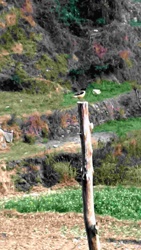
Easily observed in suburban gardens, parks, and agricultural fields. Look for them in large, noisy flocks on lawns or utility wires.
Interesting facts
All European Starlings in North America (now numbering over 200 million) are descended from 100 birds released in New York's Central Park in the early 1890s by a group wanting to introduce all birds mentioned in Shakespeare's plays.
More like this