
Wood Pigeon Identification Guide
Europe's largest and most familiar pigeon, a bulky grey bird with a white neck patch and white wing-bar, common in woodlands, parks, and gardens.
Read the full Wood Pigeon encyclopedia entry →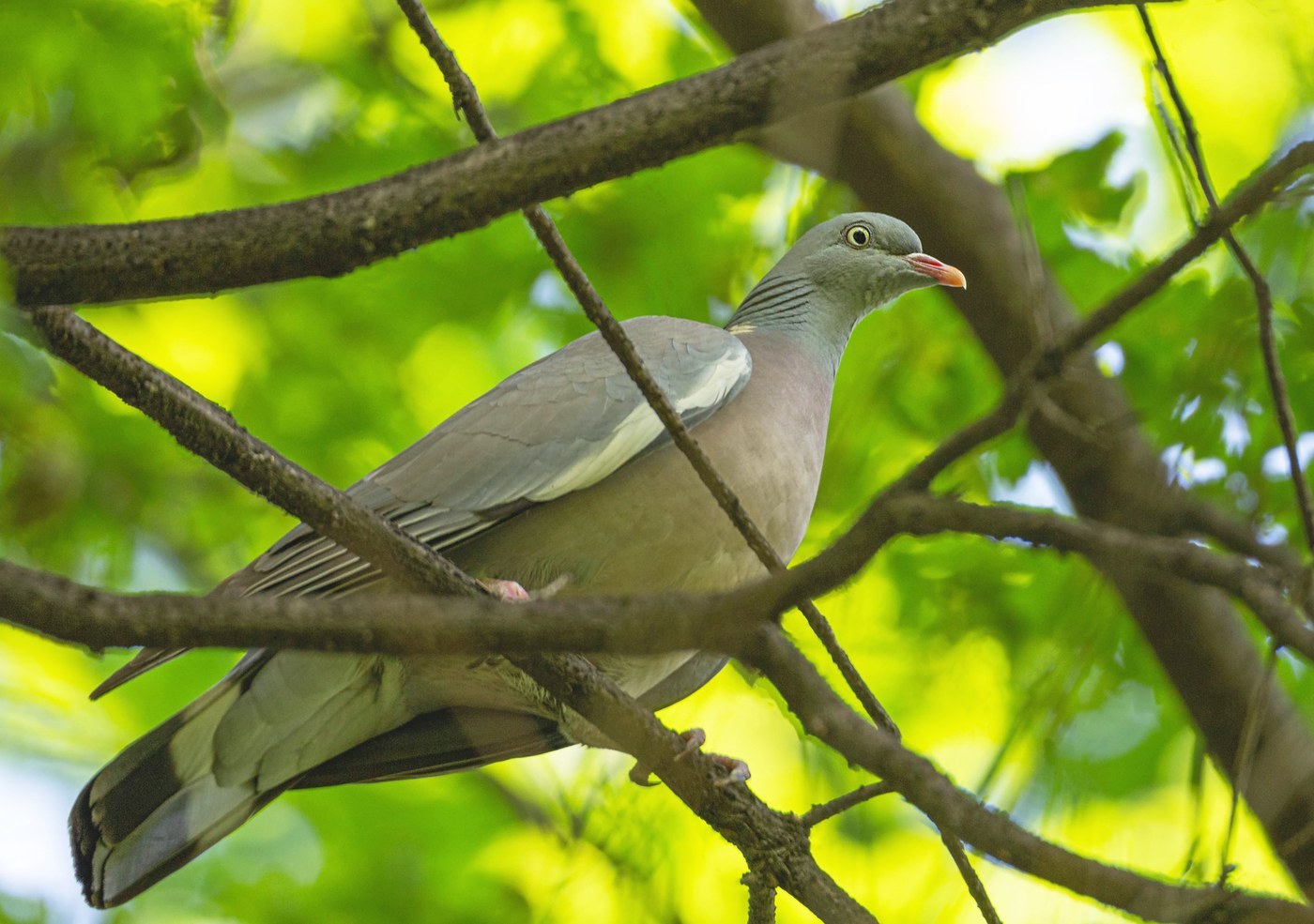
Key Field Marks
- Size & shape: A large, heavy-bodied pigeon (about 40–42 cm), noticeably bigger and bulkier than a Feral Pigeon or Stock Dove.
- Plumage: Blue-grey overall with a pinkish-grey breast, a glossy green-and-purple sheen on the neck, and a bold white patch on each side of the neck (absent in juveniles).
- In flight: A conspicuous white bar across the upper wing is diagnostic, along with dark wingtips and a fast, clattering takeoff.
- Bill & eye: Yellow-tipped pinkish bill with a whitish cere; pale yellow eye.
- Behavior: Feeds on the ground in flocks on farmland, crops, and lawns; noisy wing-clapping display flight in spring involving a steep climb, wing clap, and gliding descent.
Separating It From Similar Species
- Stock Dove is smaller, lacks the white neck patch and white wing bar, has a dark eye, and shows only short black wing bars.
- Feral Pigeon (Rock Dove descendant) is smaller and more variable in color, typically lacking the clean grey plumage, white neck patches, and bold white wing bar.
- Collared Dove is much smaller, sandy-buff colored, with a thin black half-collar on the nape.
Where and When to Look
- Habitat: Extremely adaptable — woodlands, farmland, hedgerows, parks, and gardens, including city centers across much of its range.
- Range: Widespread and common throughout Europe, extending into North Africa and western Asia.
- Season: Resident across most of its range, though northern and eastern populations move south in winter, sometimes forming large migratory flocks.
- Best viewing: Look and listen in almost any wooded or suburban habitat; large winter flocks gather in farmland to feed on grain, oilseed rape, and clover.
Voice
- A soft, rhythmic five-note coo, often rendered as "coo-COO-coo, coo-coo," repeated steadily and one of the most familiar woodland sounds across its range.
- Wings make a loud clattering noise on takeoff, a useful non-vocal identification clue.
Frequently asked questions
What is the easiest mark to identify a Wood Pigeon?
Look for a large grey pigeon with a white patch on each side of the neck and a bold white bar across the wing in flight — both features are absent in similar-looking pigeons.
How is a Wood Pigeon different from a Stock Dove?
The Wood Pigeon is larger, has white neck patches and a broad white wing bar, and a pale eye; the Stock Dove is smaller, lacks the white neck patch, and has a dark eye and only short black wing bars.
What does a Wood Pigeon sound like?
A soft, repetitive five-note cooing, often described as "coo-COO-coo, coo-coo," plus a loud wing-clatter when it takes off suddenly.
Where do Wood Pigeons live?
They are found in woodlands, farmland, parks, and gardens across Europe, North Africa, and western Asia, and are common even in city centers.