
White-browed Robin-Chat Identification Guide
A striking orange-breasted African songbird with a bold white eyebrow and a rich, mimicry-filled song, often heard before it is seen skulking in thickets.
Read the full White-browed Robin-Chat encyclopedia entry →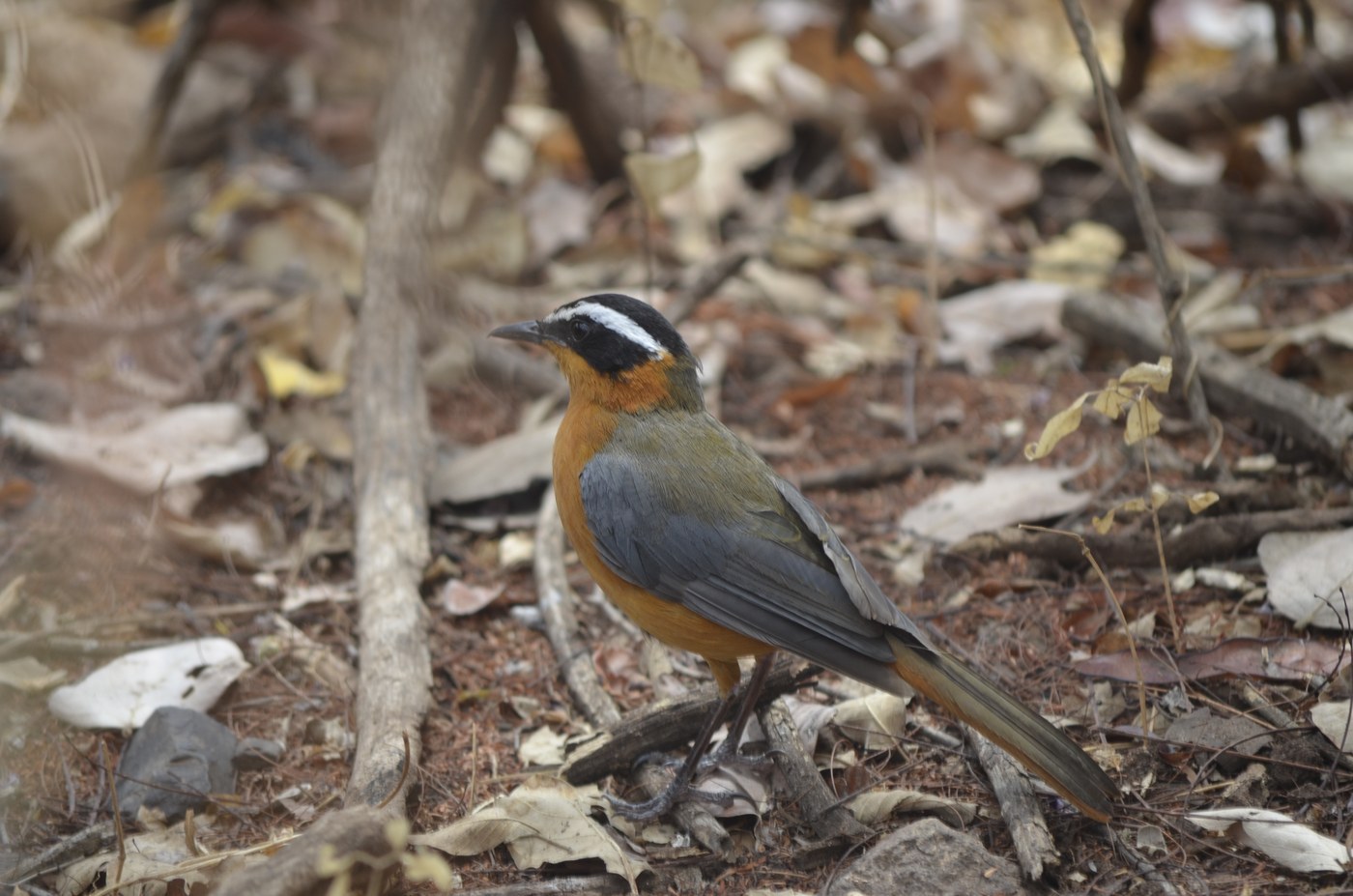
Key Field Marks
- Medium-sized, thrush-like songbird, about 20-22 cm (8-8.7 in), with a bold white eyebrow stripe contrasting against a black mask.
- Bright orange throat, breast, and underparts, a gray back, and an orange tail with black central tail feathers.
- Sexes look alike.
Separating It From Similar Species
- Red-capped Robin-Chat: Shows an orange or rufous crown/cap rather than the gray crown of White-browed Robin-Chat, and lacks the same crisp white eyebrow contrast.
- Cape Robin-Chat: Also has a whitish eyebrow but shows a grayer, less vividly orange breast and occupies a different, more southerly range.
- Snowy-headed Robin-Chat: Has a mostly white crown/cap rather than gray, distinguishing it readily from White-browed Robin-Chat.
Habitat, Range & Season
- Found in dense thickets, forest edge, riverine woodland, and well-vegetated gardens.
- Occurs across East and Central Africa, from South Sudan and Ethiopia south through Uganda, Kenya, Tanzania, to Zambia, Malawi, and Mozambique.
- Resident year-round throughout its range.
Voice
- An accomplished songster and mimic, weaving imitations of other birds' calls into a rich, melodious, warbling song.
- Frequently sings from cover at dawn and dusk, making voice a key tool for detection even when the bird itself is hidden.
Behavior
- Often skulking in dense vegetation but can be surprisingly bold, especially around gardens and human habitation where it may become quite tame.
- Forages mostly on or near the ground in leaf litter, hopping with frequent tail-flicking while searching for insects.
Frequently asked questions
What is the key field mark of White-browed Robin-Chat?
A bold white eyebrow stripe contrasting with a black mask, combined with bright orange underparts and a gray back.
How do you tell White-browed Robin-Chat from Red-capped Robin-Chat?
White-browed Robin-Chat has a gray crown, while Red-capped Robin-Chat has an orange or rufous crown/cap.
Why is White-browed Robin-Chat often heard rather than seen?
It tends to skulk in dense thickets and sing from cover, especially at dawn and dusk, and it is a talented mimic that incorporates other birds' calls into its rich song.
What habitat does White-browed Robin-Chat prefer?
Dense thickets, forest edges, riverine woodland, and well-vegetated gardens across East and Central Africa.