
Variegated Fairywren Identification Guide
A small, long-tailed Australian songbird whose breeding male combines an electric-blue crown and chestnut shoulder patch with a black throat.
Read the full Variegated Fairywren encyclopedia entry →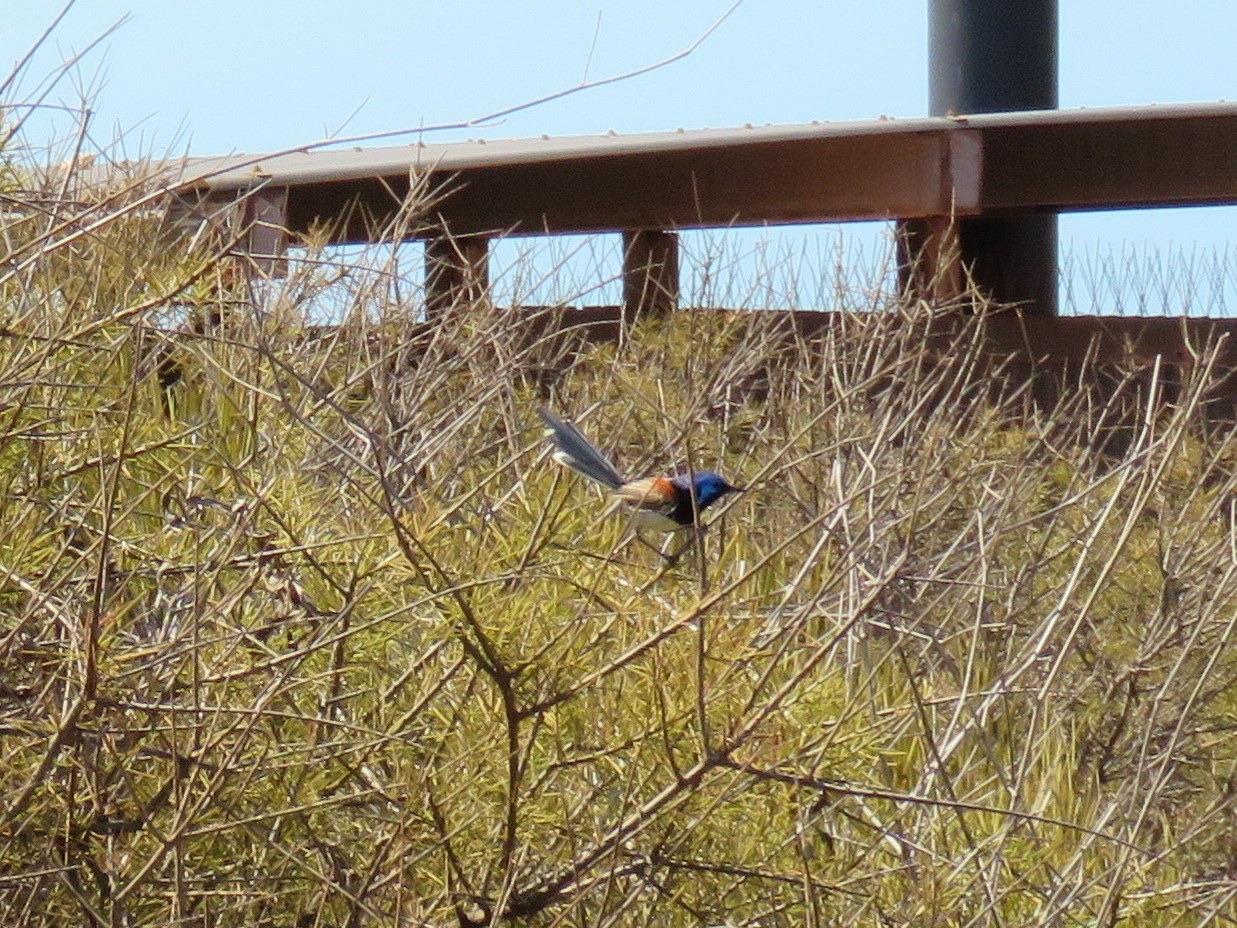
Key Field Marks
- Tiny, long-tailed bird (about 14 cm including tail) that holds its cocked tail upright and hops actively through low vegetation.
- Breeding males show a bright blue crown, ear coverts, and mantle, a black throat, breast, and eye-line, and a distinctive chestnut patch on the shoulder (lesser coverts) that separates it from several similar fairywrens.
- Non-breeding males, females, and juveniles are mostly plain grayish-brown above and paler below, with females and immatures showing a rufous-chestnut wash around the lores/eye area (a "chestnut mask") and a pale bluish-gray tail.
- Bill is black in breeding males and dull brownish-horn in females and non-breeding birds.
Similar Species
- Red-backed Fairywren: breeding male has a red/orange back patch instead of blue crown and back, with an all-black head, easily separated from Variegated's blue crown.
- Purple-backed Fairywren (often treated as a subspecies group of Variegated Fairywren in some treatments): shows a purplish rather than blue back/crown in some populations; where treated as distinct, range and subtle color tone help separate them.
- Blue-breasted Fairywren: breeding male shows blue extending onto the breast rather than a black breast, and lacks the chestnut shoulder patch.
- Splendid Fairywren: breeding male is entirely blue (no black throat/breast panel or chestnut patch), making it readily distinguished from Variegated.
- Female/immature fairywrens are notoriously similar across species; the rufous lores combined with range is often the best clue for Variegated Fairywren.
Habitat, Range & Season
- Widespread across much of mainland Australia except the far southwest and southeast, occupying dry scrub, heath, mallee, spinifex, and woodland with dense low cover.
- Resident year-round, living in small cooperative family groups that defend a permanent territory.
- Most active early morning and late afternoon, staying low in dense shrubby or grassy cover and making short, whirring flights between patches of vegetation.
- Breeding activity is tied to rainfall and food availability more than a strict calendar season, typical of many Australian arid-zone birds.
Voice
- Song is a thin, high-pitched, reeling trill typical of fairywrens, often given by a group member while the flock forages.
- Calls include sharp, high "tsit" contact notes used to keep the family group in touch while moving through dense cover.
Frequently asked questions
What distinguishes a male Variegated Fairywren from other blue fairywrens?
The combination of a blue crown and mantle, black throat and breast, and a chestnut patch on the shoulder is diagnostic; species like Splendid Fairywren lack the black breast panel and chestnut patch entirely.
How do you identify a female Variegated Fairywren?
Females are plain brownish overall with a distinctive rufous-chestnut patch around the lores (eye area) and a pale bluish-gray tail, though female fairywrens are best confirmed by range since several species look alike.
Where does the Variegated Fairywren live?
It is widespread across dry scrub, heath, and woodland through much of mainland Australia, generally avoiding the wetter far southwest and southeast corners of the continent.
Do Variegated Fairywrens live in groups?
Yes, like other fairywrens they live in small cooperative family groups that defend a shared territory year-round, often with helper birds assisting in raising young.