
Turquoise-browed Motmot Identification Guide
A dazzling Central American motmot known for its brilliant turquoise brow stripe and pendulum-swinging racket tail.
Read the full Turquoise-browed Motmot encyclopedia entry →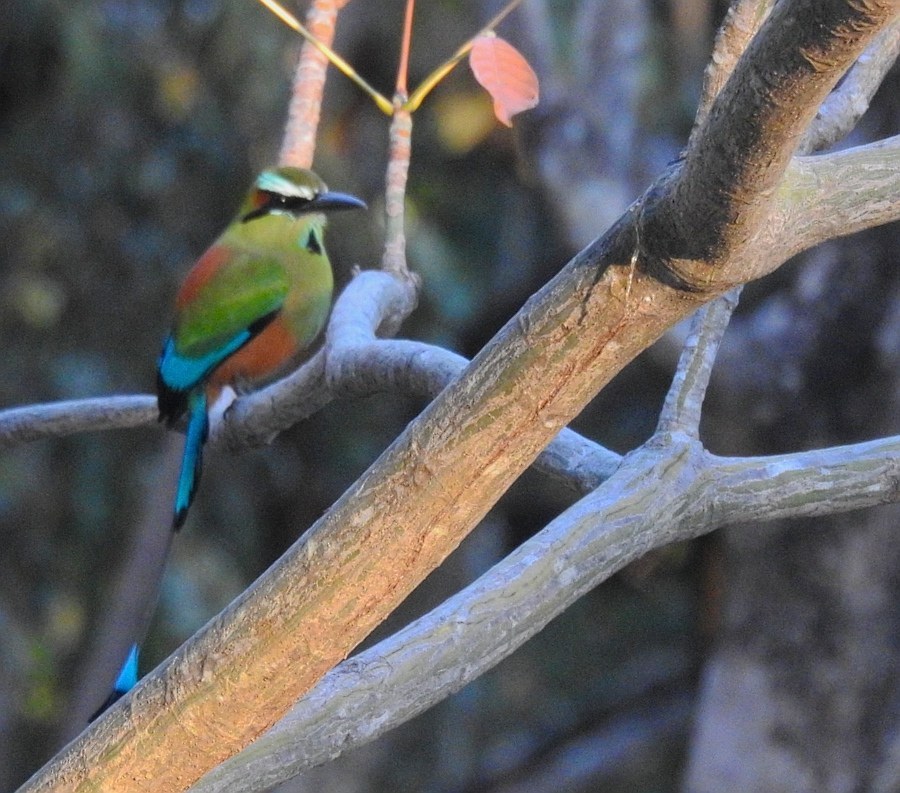
Key Field Marks
- Medium-sized, long-tailed bird (about 34 cm including tail) with a chunky build and slightly downcurved, serrated bill.
- Vivid turquoise-blue stripe above the eye contrasts with a black mask and rufous-tinged crown.
- Throat and upper breast are turquoise-green fading to cinnamon-buff on the belly, with a small black spot on the lower throat/breast.
- Back and wings are olive-green to turquoise; the diagnostic feature is the long tail with two elongated central feathers ending in bare shafts and turquoise-blue "racket" tips.
- Perches upright and habitually swings its tail sideways like a pendulum, especially when alert or communicating.
Similar Species
- Blue-crowned Motmot: lacks the pale turquoise brow stripe, has a solid blue crown and less contrasting facial pattern; ranges overlap only marginally.
- Russet-crowned Motmot: has a rufous crown instead of black-and-turquoise face pattern, and lacks the sharply defined brow stripe.
- No other motmot in its range combines the pale turquoise supercilium with the black facial mask and racket tail as boldly.
Habitat, Range & Season
- Resident from southern Mexico (Yucatan Peninsula especially) south through Belize, Guatemala, Honduras, El Salvador, Nicaragus, and Costa Rica.
- Favors dry to semi-humid forest edge, scrubby woodland, limestone sinkholes (cenotes), plantations, and gardens; often nests in earthen banks, road cuts, and cenote walls.
- Present year-round; no long-distance migration, though some local elevational movement occurs.
- Frequently seen perched conspicuously on wires, fence posts, or low open branches, sallying out to catch insects and small reptiles.
Voice
- Gives a low, nasal, froglike "croak" or "wenk" note, often repeated, along with soft grunting calls.
- Generally quiet compared to many tropical birds; the tail-swinging display is often a more reliable cue to its presence than vocalizations.
Frequently asked questions
Why does the Turquoise-browed Motmot swing its tail?
It pendulum-swings its racket-tipped tail sideways as a visual signal, likely used to communicate alertness or deter predators and to signal to mates.
How can I tell a Turquoise-browed Motmot from a Blue-crowned Motmot?
Look at the crown and face: Turquoise-browed has a black mask with a bright turquoise brow stripe, while Blue-crowned has a solid blue cap without that contrasting pale stripe.
Where is the best place to see a Turquoise-browed Motmot?
The Yucatan Peninsula of Mexico, especially around cenotes and Maya ruin sites, is one of the most reliable areas, along with dry forest habitats throughout Central America.
Does the Turquoise-browed Motmot migrate?
No, it is a non-migratory resident throughout its Central American range, though individuals may shift locally between seasons in response to food availability.