
Spotted Dove Identification Guide
A widespread Asian dove readily identified by the bold black-and-white spotted patch on its hindneck, distinguishing it from other slim, long-tailed doves.
Read the full Spotted Dove encyclopedia entry →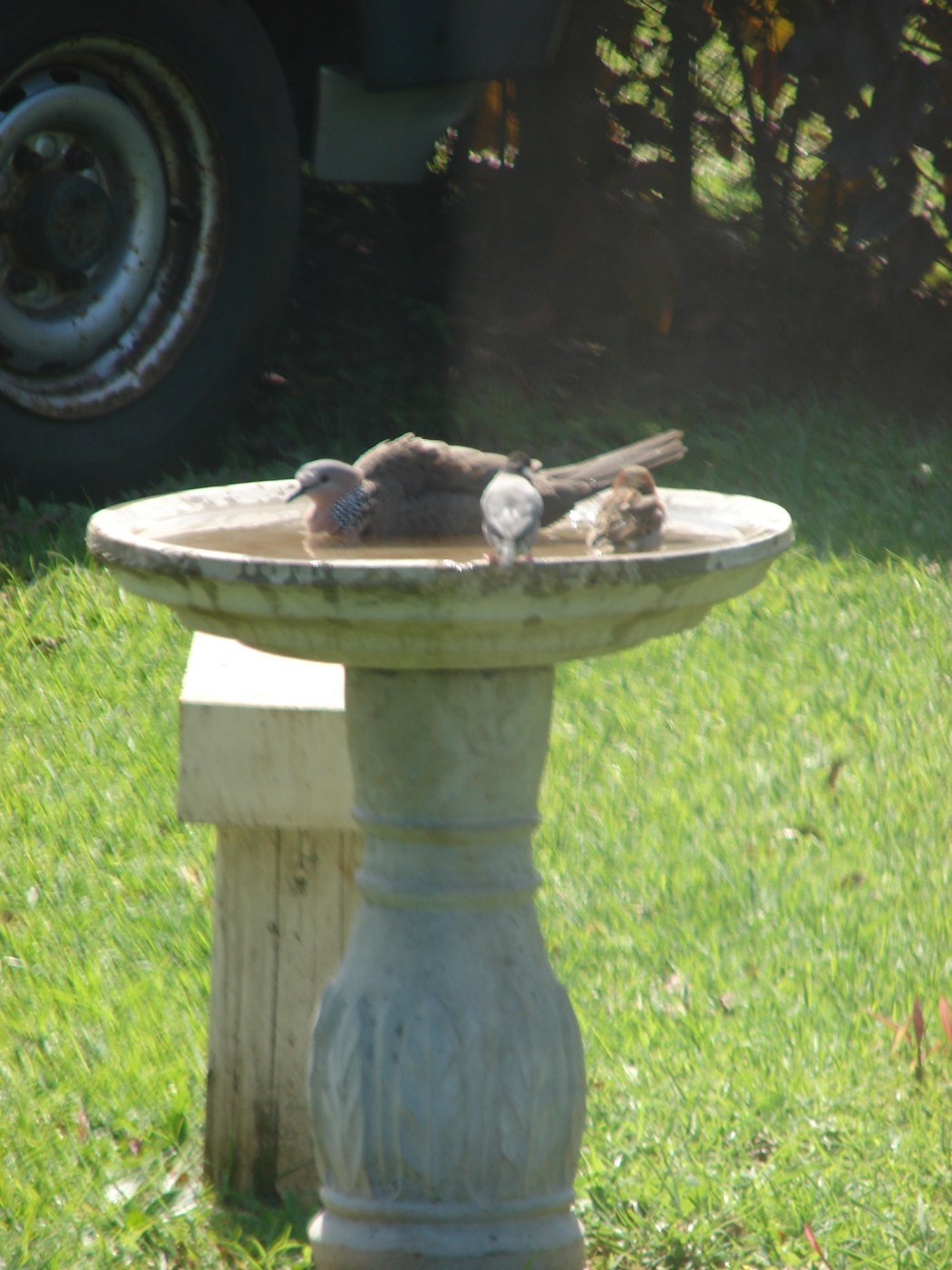
Key Field Marks
- Size & shape: Medium-sized, slender dove, about 12 inches (30 cm) including a fairly long, graduated tail.
- Plumage: Pinkish-brown to gray-brown body overall; back and wings show fine dark scaling/edging on a brown ground color; underparts paler pinkish-gray.
- Key mark: A bold black patch heavily spotted with white covers the sides and back of the neck (hindneck/nape), clearly visible at rest and easy to see even at a distance — this "spotted collar" gives the species its name.
- Tail: Long and graduated with white corners/tips visible especially in flight or when fanned.
- Behavior: Often seen singly, in pairs, or small groups feeding on the ground in open areas; flushes with a clatter of wings; frequently perches on wires and rooftops in urban and suburban settings.
Separating It From Similar Species
- Eurasian Collared-Dove — paler, sandier gray-buff overall with a thin, solid black-and-white half-collar (no spotting) low on the hindneck, and lacks the scaled back pattern.
- Mourning Dove (where introduced ranges might be confused) — much plainer, unspotted, with a pointed tail and black spots on the wings rather than a neck collar.
- Laughing Dove — smaller, with a rosy breast and a finer, less bold black-and-rufous speckled patch confined to the upper breast/throat rather than a solid black-and-white nape patch.
- The bold black patch densely spotted white on the nape, combined with a scaled brown back, is diagnostic for Spotted Dove.
Habitat, Range & Season
Native across South and Southeast Asia from India and Sri Lanka through China and into Indonesia and the Philippines. Highly adaptable, thriving in open woodland, farmland, parks, and urban/suburban areas; introduced and now established in parts of Australia, Hawaii, and California (Los Angeles basin) among other places. Resident (non-migratory) throughout its range, including introduced populations.
Voice
A soft, rhythmic, repeated cooing, often rendered as "coo-COO-croo" or a bubbling "krrr-KROO-kroo," with a distinctive laughing or chuckling quality compared to the flatter cooing of Eurasian Collared-Dove.
Frequently asked questions
What is the single best field mark for Spotted Dove?
The bold black patch densely spotted with white on the sides and back of the neck, visible at close to moderate range.
How is it different from the Eurasian Collared-Dove?
Eurasian Collared-Dove has a thin, solid black half-collar without white spotting and a plainer, sandier body, while Spotted Dove has a scaled brown back and a bold spotted (not solid) neck patch.
Is the Spotted Dove native to North America?
No, it is native to South and Southeast Asia but has been introduced and become established in places such as the Los Angeles area of California and Hawaii.
What habitats does it favor?
Open woodland, farmland, parks, gardens, and urban and suburban areas, where it is often quite tame.