
Spangled Cotinga Identification Guide
A jewel-like Amazonian canopy bird whose male is brilliant turquoise-blue with black spangling and a deep maroon throat, usually spotted sitting motionless high in emergent trees.
Read the full Spangled Cotinga encyclopedia entry →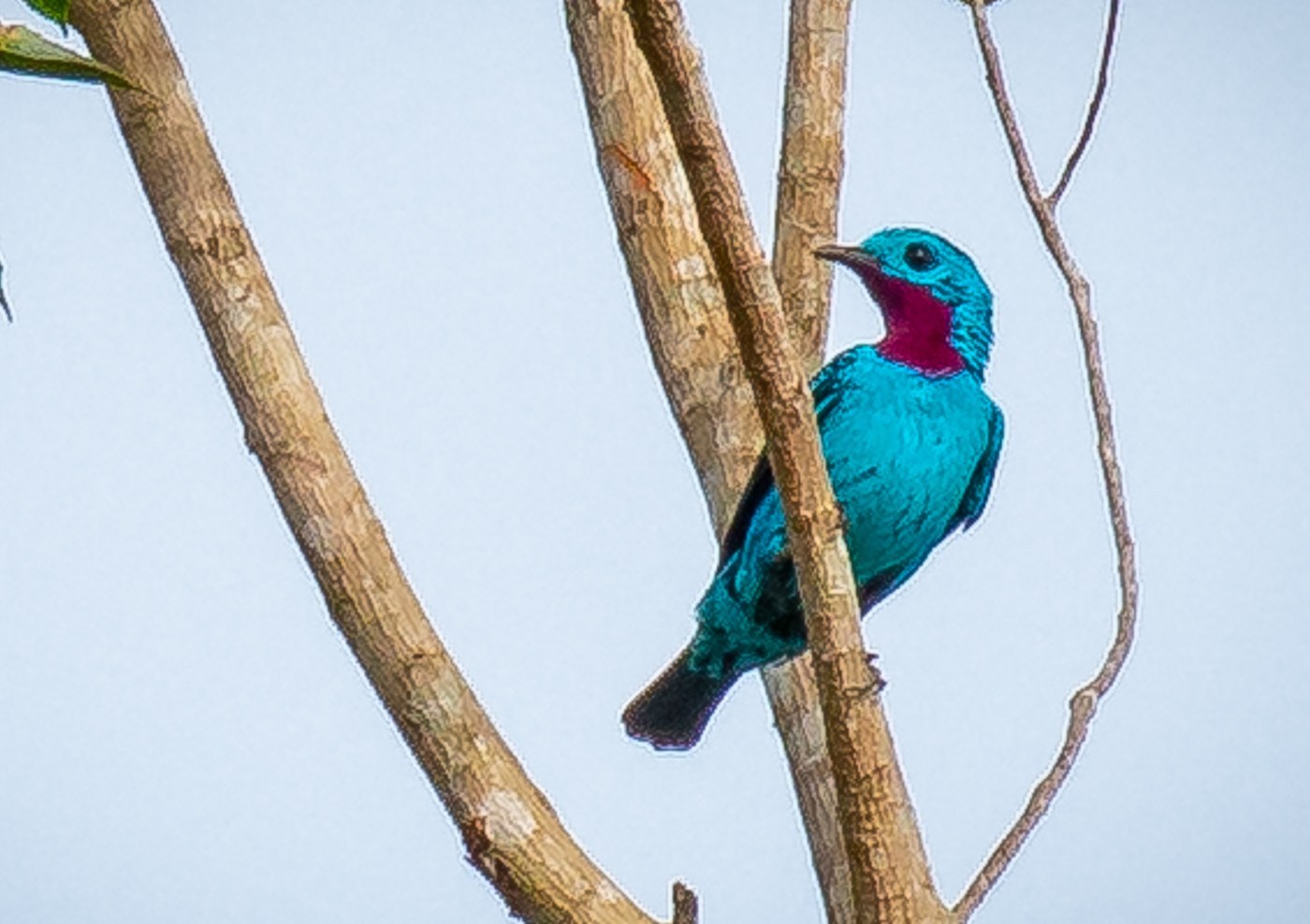
Key Field Marks
- Size & shape: A compact, chunky-bodied cotinga about 20 cm long, with a short tail, short legs, and a relatively large head — typical of fruit-eating canopy cotingas.
- Male plumage: Brilliant turquoise-blue overall, with fine black scalloped spangling across the body giving a scaled, sparkling appearance, and a deep maroon-purple throat patch that stands out sharply against the blue.
- Female plumage: Much duller and cryptic — grey-brown overall with a dark, scaly scalloped pattern on the underparts, providing good camouflage; lacks any blue or maroon.
- Bill: Short, broad-based bill typical of fruit-eating cotingas, adapted for plucking fruit rather than catching insects.
- Posture: Typically sits upright and motionless for long periods on an exposed high perch, making it easier to spot despite its canopy habits once located.
Separating It From Similar Species
- Plum-throated Cotinga male is also blue with a purple throat patch but shows a more solidly blue body with less obvious black spangling/scalloping compared to the finely scaled pattern of Spangled Cotinga.
- Purple-breasted Cotinga male has a much larger area of purple extending over the breast (not just a throat patch), with blue restricted mostly to the head, back, and rump.
- Banded Cotinga shows blue with dark barring/banding across the underparts in a different pattern and has a different, more restricted range (Atlantic Forest of Brazil rather than Amazonia).
- Females of all these cotinga species look quite similar (dull, scaly brown) and are much harder to identify to species; range and any accompanying male are the most reliable clues.
Where and When to See It
Spangled Cotingas are residents of humid lowland Amazonian rainforest, favoring the canopy and emergent trees of terra firme forest, forest edge, and várzea (seasonally flooded) forest across the Amazon Basin, including parts of Venezuela, the Guianas, Brazil, Peru, Ecuador, and Colombia. They are present year-round with no significant migration, and are most reliably found by scanning exposed dead branches and emergent treetops, often from canopy towers or forest edge clearings, since they perch still and can otherwise be easy to overlook against the sky.
Voice
Generally quiet and inconspicuous vocally; occasional weak, thin, buzzy calls are given but the species is not known for a loud or frequent song, so visual detection — scanning high perches for a flash of turquoise — is usually more productive than listening.
Frequently asked questions
How do I tell a Spangled Cotinga from a Plum-throated Cotinga?
Spangled Cotinga shows fine black scalloped spangling across its turquoise-blue body, giving a scaled appearance, whereas Plum-throated Cotinga has a more solidly blue body with less obvious spangling; both share a purple/maroon throat patch.
Why are female cotingas so much harder to identify than males?
Female cotingas across several species are dull grey-brown with a similar scaly, scalloped pattern for camouflage while nesting, lacking the bright diagnostic colors of males, so they are best identified by range or when a male is present nearby.
Where in the canopy should I look for a Spangled Cotinga?
Scan exposed dead branches and emergent treetops above the main canopy in humid lowland Amazonian forest — the birds perch still for long periods, so patience scanning high, bare perches pays off.
Is the Spangled Cotinga a vocal bird?
No, it is generally quiet, giving only occasional weak, thin, buzzy calls, so it is usually located by sight rather than by song.