
Scarlet-rumped Tanager Identification Guide
A common Central American tanager, jet black overall except for a glowing scarlet rump patch that flashes as it moves.
Read the full Scarlet-rumped Tanager encyclopedia entry →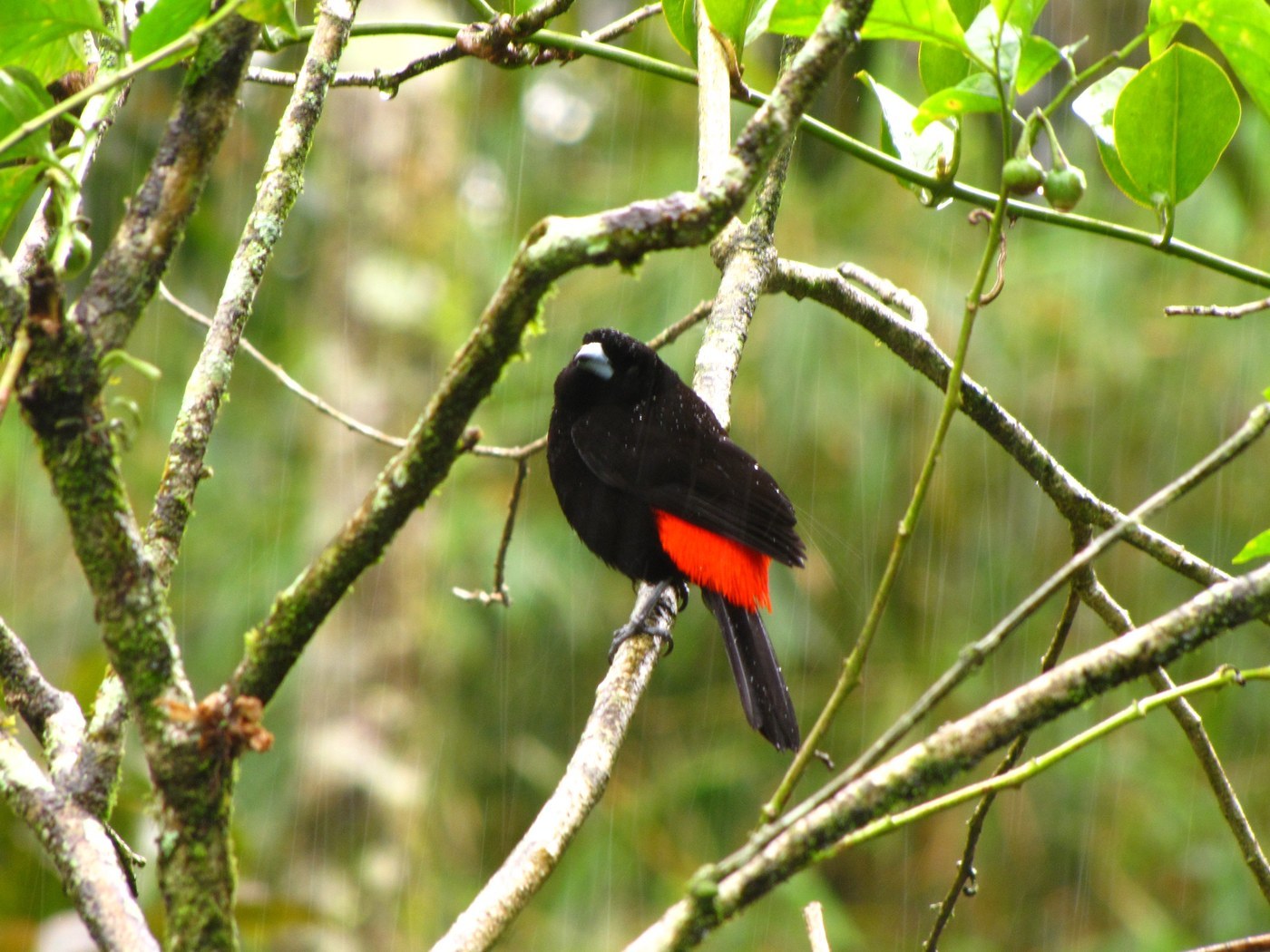
Key Field Marks
- Size & shape: A medium-sized tanager, about 17–18 cm, with a fairly stout, pale-based bill.
- Male plumage: Mostly glossy black with a bright, glowing scarlet or orange-red rump patch that is very conspicuous, especially in flight; bill shows a pale silvery-blue base.
- Female plumage: Olive-brown overall with a duller orange-red or dusky-orange rump — much less bright than the male but the rump patch is still a useful clue.
- Behavior in the field: Often first noticed as a black bird with a flash of red at the base of the tail as it flits through foliage.
Separating It From Similar Species
- This species includes forms sometimes treated separately as Passerini's Tanager (Caribbean slope) and Cherrie's Tanager (Pacific slope) — both share the same black-body/red-rump pattern and are best told apart by range rather than plumage.
- Compared with other black tanagers, the combination of a solidly black body and a sharply contrasting bright rump (not the whole underside) is diagnostic.
- Female Summer or Hepatic Tanagers lack any contrasting rump patch and are more uniformly reddish or olive.
Habitat, Range & Season
- Found from southern Mexico through Central America to western Panama and northwestern Colombia (depending on taxonomy used), in forest edge, second growth, shrubby clearings, and gardens from lowlands to mid-elevations.
- Common and conspicuous resident, often in pairs or small family groups; frequently visits fruit feeders and gardens.
Behavior
- Feeds on small fruits and berries, gleaned from shrubs and trees at low to mid heights, and also takes insects.
- Forms loose social groups and is often one of the most easily seen tanagers in gardens and edge habitats within its range.
Voice
- Call is a sharp, dry "chip" or "chuk," often repeated.
- Song is a husky, warbled series of notes, less musical than many other tanagers.
Frequently asked questions
What is the easiest field mark for a Scarlet-rumped Tanager?
A glossy black bird with a bright scarlet or orange-red rump patch that flashes conspicuously, especially when the bird flies or flicks its tail.
Are Passerini's and Cherrie's Tanagers the same as Scarlet-rumped Tanager?
Yes, they were traditionally treated as one species, Scarlet-rumped Tanager, and some classifications still lump them; where split, they are distinguished mainly by range (Caribbean versus Pacific slope) rather than plumage differences.
How do I identify a female Scarlet-rumped Tanager?
Look for an olive-brown body with a duller orange-red rump patch — less vivid than the male's but still the key diagnostic feature.
What habitat is best for finding Scarlet-rumped Tanagers?
Forest edges, second growth, shrubby clearings, and gardens at low to middle elevations throughout Central America.