
Rose-crowned Fruit Dove Identification Guide
A small, jewel-colored dove of Indo-Pacific rainforest canopies, told by its grey head with a rosy-pink crown patch, yellow-green breast band, and maroon belly.
Read the full Rose-crowned Fruit Dove encyclopedia entry →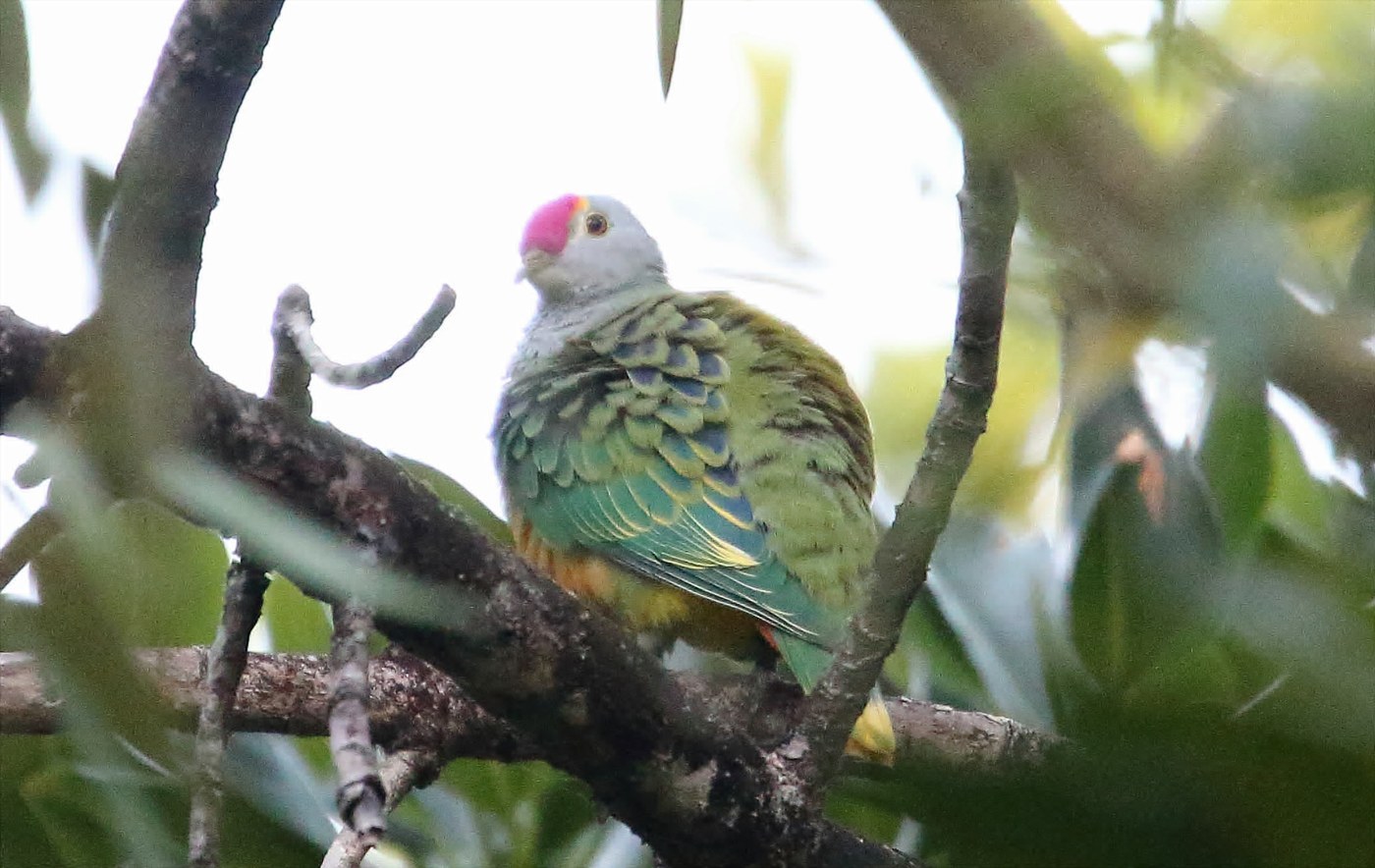
Key Field Marks
- Size & shape: A small, compact dove around 20–23 cm, typical of the colorful Ptilinopus fruit-doves.
- Head: Pale grey with a small but distinctive rose-pink or lilac crown patch.
- Body: Green upperparts and wings; a yellow-green band crosses the upper breast; the belly shows a deep purple-maroon patch; undertail coverts are yellow.
- Bill: Small and pale-tipped, typical of fruit-doves.
- Sexes: Similar in appearance, though females can show a slightly duller crown patch.
Separating It From Similar Species
- Superb Fruit Dove: Male Superb has a much more extensive purple crown, an orange nape band, and a different, more solidly colored underparts pattern; female Superb is largely green and lacks the pink crown, differing structurally from Rose-crowned.
- Banded Fruit Dove and other regional fruit-doves: differ in range and in the extent/color of the breast band and belly patch; check local range maps, as several similar fruit-doves are geographically separated.
- General rule: the combination of grey head + small rose crown patch + maroon belly patch is diagnostic within its range.
Where and When to Find One
- Range: Coastal eastern and northern Australia, the Lesser Sunda Islands, and parts of the New Guinea region, with several recognized subspecies varying slightly in plumage tone across this range.
- Habitat: Rainforest, monsoon forest, vine thickets, and mangroves, especially where fruiting fig trees are present.
- Season: Largely resident, though some populations show local seasonal movements tracking fruit availability.
Voice
- A deep, resonant, repetitive cooing, often rendered as a series of "hoo... hoo-hoo" notes that accelerate and rise in pitch. Birds are frequently detected by voice from the canopy well before being seen, as they sit still and are easily overlooked among foliage while feeding on fruit.
Frequently asked questions
What is the easiest way to identify a Rose-crowned Fruit Dove?
Look for a grey head with a small rosy-pink crown patch, a yellow-green breast band, and a maroon belly patch on an otherwise green-bodied dove.
How do you tell a Rose-crowned Fruit Dove from a Superb Fruit Dove?
Male Superb Fruit Doves have a larger purple crown and an orange nape band that Rose-crowned lacks; the two species' overall head and underparts patterns differ enough to separate with a clear view.
Where does the Rose-crowned Fruit Dove live?
It is found in rainforest and monsoon forest along coastal eastern/northern Australia, the Lesser Sunda Islands, and the New Guinea region.
Why are Rose-crowned Fruit Doves hard to see despite their bright colors?
Their green plumage blends into leafy canopy, and they sit motionless while feeding on fruit, so they are usually located first by their distinctive deep cooing calls.