
Red-billed Oxpecker Identification Guide
An African savanna bird that clings to large mammals like buffalo and giraffe, identified by its all-red bill, yellow eye-ring, and habit of clambering over its hosts picking off ticks.
Read the full Red-billed Oxpecker encyclopedia entry →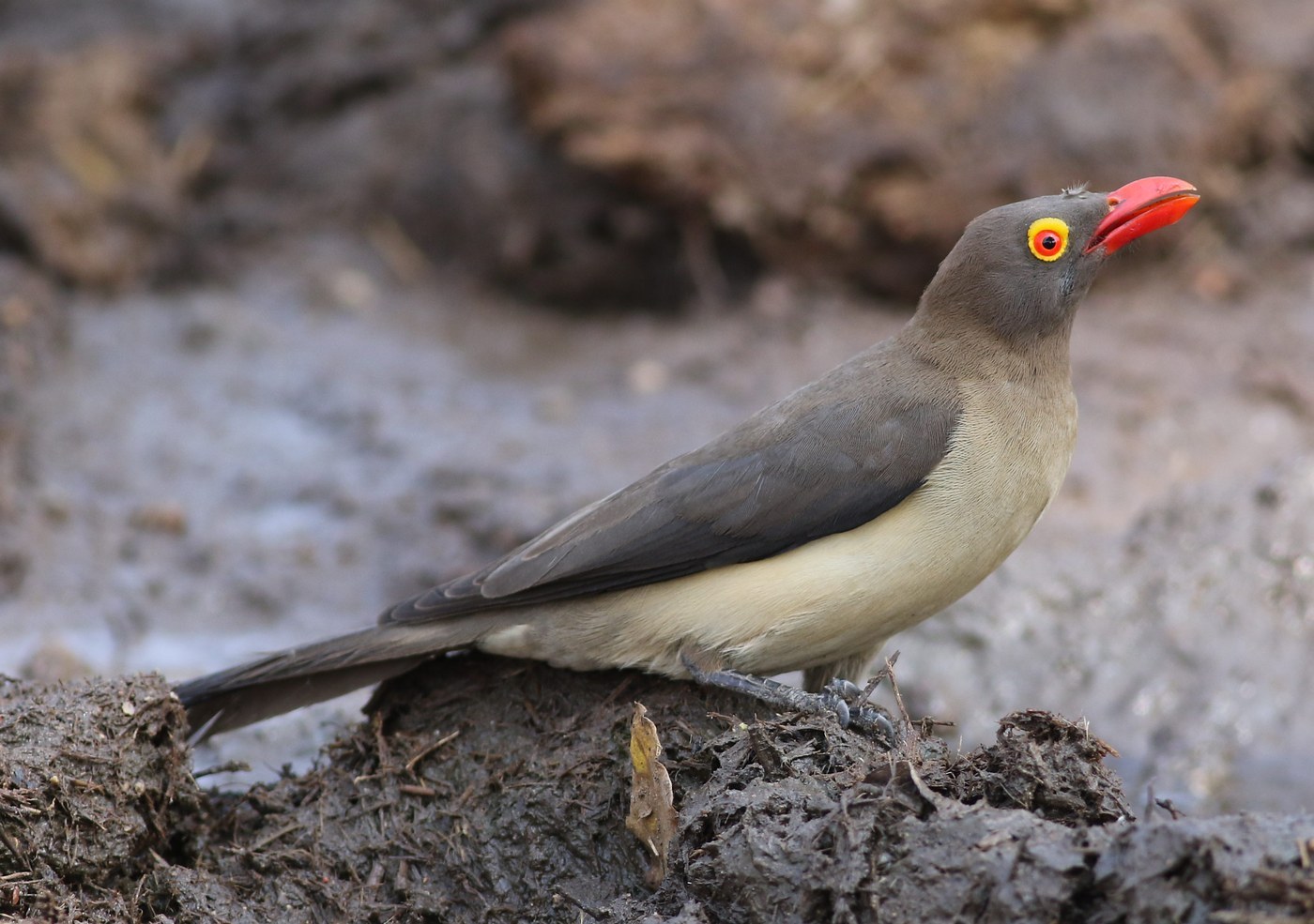
Key Field Marks
- Size & shape: A slim, medium-small starling relative about 20 cm long, with a stiff, pointed tail used for bracing against a host animal's body, much like a woodpecker uses its tail on a tree.
- Plumage: Olive-brown upperparts and pale buffy underparts, fairly plain and unremarkable at a distance.
- Bill: Entirely bright red — this all-red bill is the key mark separating it from the similar Yellow-billed Oxpecker.
- Eyes: Distinctive red iris surrounded by a bare, bright yellow eye-ring, giving a staring expression visible at close range.
- Feet: Strong, sharply clawed feet adapted for clinging to a host animal's hide.
- Behavior: Almost always seen clinging to or clambering over large mammals rather than perched in vegetation.
Separating It From Similar Species
- Yellow-billed Oxpecker is very similar in shape and behavior but has a bicolored bill — yellow at the base and red only at the tip — and typically shows a paler, more contrasting rump patch; the Red-billed Oxpecker's bill is uniformly red with no yellow base.
- Away from a host animal, oxpeckers can superficially resemble starlings in flight, but their stiff, clinging posture on mammals and unique bill/eye-ring combination make confusion unlikely once a good view is obtained.
Habitat, Range & Season
Resident throughout sub-Saharan Africa's savanna, woodland, and grassland where populations of large wild or domestic grazing mammals occur, from East Africa south through much of southern Africa. Closely tied to the distribution of host animals such as buffalo, giraffe, rhinoceros, various antelope, and cattle, and largely absent from areas where large mammal populations have been depleted. Non-migratory, present year-round wherever suitable hosts are found.
Behavior & Voice
Spends nearly all its time on the bodies of large mammals, climbing and clinging with sharp claws and a braced tail while gleaning ticks, other external parasites, and sometimes blood and wound tissue from the host's skin. Often forages in small groups on a single animal, moving methodically over the head, ears, neck, and body. Nests in tree cavities lined with hair plucked from host mammals. The call is a hissing, chirring "chss chss" or sharp chattering, frequently given as birds fly between hosts.
Frequently asked questions
What is the most reliable way to identify a Red-billed Oxpecker?
Look for an entirely red bill (no yellow base) combined with a red eye surrounded by a bright yellow eye-ring, on a bird clinging to a large mammal such as buffalo or giraffe.
How do I tell a Red-billed Oxpecker from a Yellow-billed Oxpecker?
The Red-billed Oxpecker has an all-red bill, while the Yellow-billed Oxpecker's bill is bicolored, yellow at the base and red only at the tip.
Why is the Red-billed Oxpecker almost always seen on other animals?
It forages almost exclusively on the bodies of large mammals, using strong claws and a stiff tail to cling on while gleaning ticks and other parasites from the host's skin.
Where in Africa can I see Red-billed Oxpeckers?
They occur throughout sub-Saharan savanna and grassland habitats with large grazing mammals, from East Africa south through much of southern Africa.