
Red-billed Chough Identification Guide
A glossy black crow relative with a long, curved red bill and red legs, known for its buoyant, acrobatic flight over coastal cliffs and mountain terrain.
Read the full Red-billed Chough encyclopedia entry →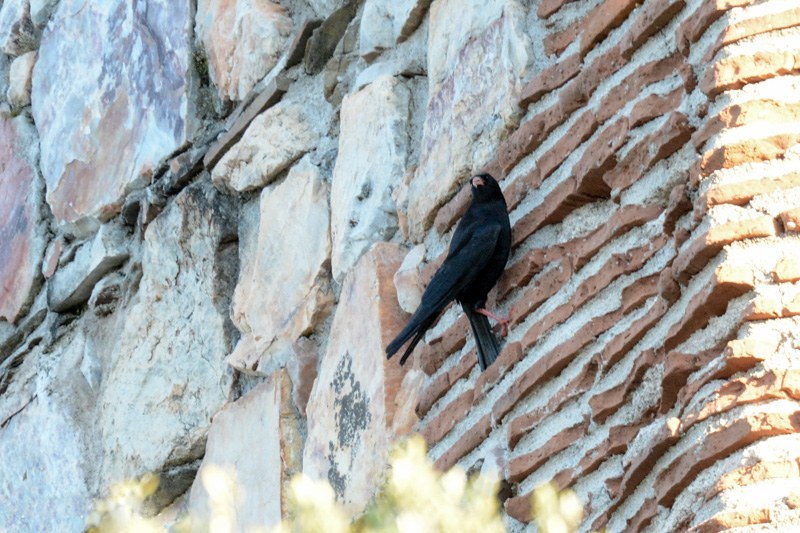
Key Field Marks
- Size & shape: A medium-sized corvid about 39–40 cm long, with broad, deeply fingered wings, a fairly long tail, and a notably slim, long-necked profile compared to other crows.
- Plumage: Entirely glossy black with a purplish-blue or greenish sheen in good light.
- Bill: Long, slender, and distinctly downcurved, bright red in adults — the key feature separating it from all other black corvids.
- Legs: Bright red, matching the bill.
- Flight: Buoyant and highly acrobatic, with deep, springy wingbeats and frequent soaring, tumbling, and diving display flight, especially in windy conditions along cliffs.
Separating It From Similar Species
- Alpine Chough is very similar in shape and glossy black plumage but has a shorter, straighter, yellow bill (not red) and slightly duller, more orange-red legs; the two species can occur together in mountain habitat.
- Carrion Crow / Rook are both larger, bulkier corvids with straight black bills and black legs, lacking the chough's slender build, curved red bill, and red legs entirely.
- Flight style is a useful supporting clue: choughs fly with more buoyant, tumbling aerobatics than the more direct, flapping flight typical of crows and rooks.
Habitat, Range & Season
Resident along rugged sea cliffs, coastal grassland, and mountain regions across parts of western Europe (including the British Isles' Atlantic coasts), the Alps, southern Europe, North Africa, and eastward through parts of Central Asia and the Himalayas. Favors short-cropped grassland and cliff-top pasture where it can probe for invertebrates, and nests in cliff crevices, caves, and old buildings. Non-migratory, present year-round, though some populations shift to lower elevations in winter.
Behavior & Voice
Forages by probing short turf and cliff-top pasture with its curved bill for invertebrates such as leatherjackets and ants, often walking rather than hopping. Highly social outside the breeding season, gathering in flocks that perform dramatic aerial displays together, especially in strong coastal or mountain winds. The call is a loud, ringing, distinctive "chee-ow" or "chow," quite different from the harsher calls of crows, and often the first clue to a chough's presence.
Frequently asked questions
What is the single best way to identify a Red-billed Chough?
Look for glossy black plumage combined with a long, downcurved red bill and red legs — no other black corvid in its range shares this exact combination.
How do I tell a Red-billed Chough from an Alpine Chough?
The Red-billed Chough has a longer, curved red bill and red legs, while the Alpine Chough has a shorter, straighter yellow bill and duller red legs; their calls also differ, with the Alpine Chough giving a higher, more whistled note.
Where can I see a Red-billed Chough?
Look on rugged coastal cliffs and short grassland in western Europe (including parts of Wales, Ireland, and Cornwall), the Alps, southern Europe, North Africa, and mountainous parts of Asia.
What does a Red-billed Chough eat and how does it forage?
It probes short turf and cliff-top pasture with its curved bill for invertebrates such as ants and insect larvae, typically walking across the ground while feeding.