
Rainbow Pitta Identification Guide
A stocky, jewel-colored ground bird of northern Australia's monsoon forests, with a black head, iridescent green back, and a bright red belly.
Read the full Rainbow Pitta encyclopedia entry →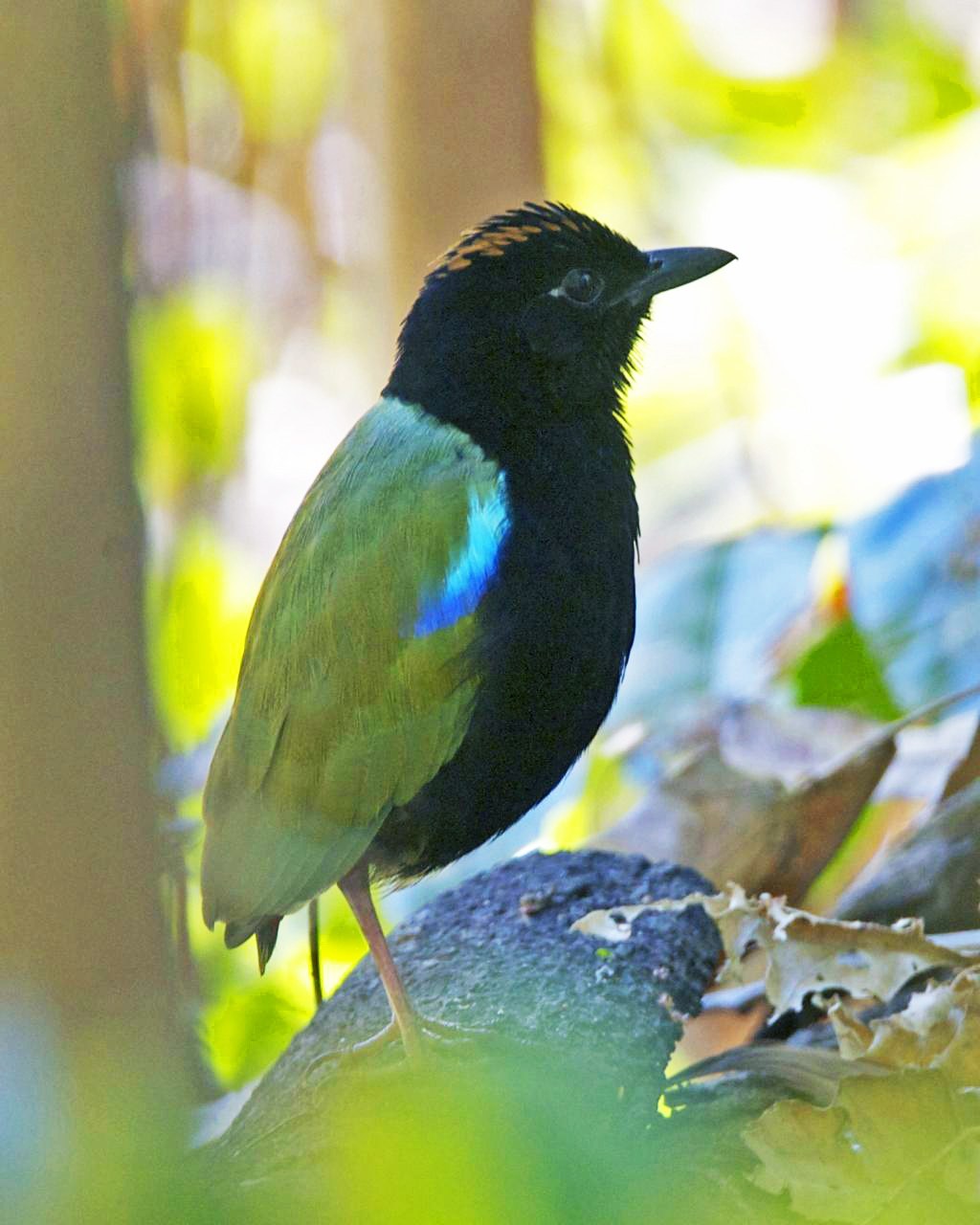
Key Field Marks
- Size & shape: A plump, short-tailed, ground-dwelling bird about 16–18 cm long, with a rounded body and long, strong pinkish legs adapted for hopping and walking on the forest floor.
- Head & underparts: Glossy black head and throat with a bright crimson-red belly and vent.
- Upperparts: Iridescent emerald-green back and mantle.
- Wings: Blackish-blue with a bright turquoise-blue shoulder patch, obvious in flight or when the wing is flicked open.
- Bill: Fairly stout and dark, used to probe leaf litter for prey.
- Tail: Very short and often held cocked upward.
Separating It From Similar Species
- Rainbow Pitta is the only pitta resident in Australia, so within its range there is little risk of confusion with other pittas.
- Its combination of black head, green back, red belly, and turquoise wing patch is distinctive from any other Australian ground bird; superficially similar-sized ground foragers such as Buff-sided Robin or scrubwrens lack any of the pitta's bold color pattern.
- Told from other pitta species found elsewhere in the region (e.g., Noisy Pitta of eastern Australia) by the black — rather than buff or streaked — head and the extent of red on the underparts.
Habitat, Range & Season
Endemic to the monsoon vine forests, gallery forest, and dense woodland of Australia's Top End and the Kimberley in northern Western Australia and the Northern Territory. Resident year-round but most vocal and easiest to detect during the wet season (roughly November to April), which coincides with its breeding period.
Behavior & Voice
Shy and often hard to see, spending most of its time hopping through dense leaf litter and understory, flicking leaves aside to find insects, snails, and other invertebrates. It typically forages alone or in pairs and freezes or slips away quietly when disturbed rather than flying far. The advertising call, given mainly at dawn and dusk in the breeding season, is a loud, distinctive whistled phrase often rendered as "walk-to-work," repeated from a low perch or the ground.
Frequently asked questions
What makes the Rainbow Pitta easy to identify?
It is the only pitta found in Australia, and its black head, iridescent green back, bright red belly, and turquoise wing patch are unmistakable once seen.
Where is the best place to find a Rainbow Pitta?
Look in dense monsoon vine forest and gallery forest of the Top End and Kimberley region of northern Australia, scanning the leaf-littered forest floor.
How can I detect a Rainbow Pitta if it's hiding in the undergrowth?
Listen for its loud, whistled 'walk-to-work' call, most often given at dawn and dusk during the wet-season breeding period, which usually reveals its presence before it is seen.
Is the Rainbow Pitta usually seen alone or in flocks?
It is typically solitary or found in pairs, quietly foraging through leaf litter rather than forming flocks.