
Purple Honeycreeper Identification Guide
A small, glittering violet-blue tanager relative of Amazonian and northern South American forests, with males showing striking yellow legs and females an all-green plumage.
Read the full Purple Honeycreeper encyclopedia entry →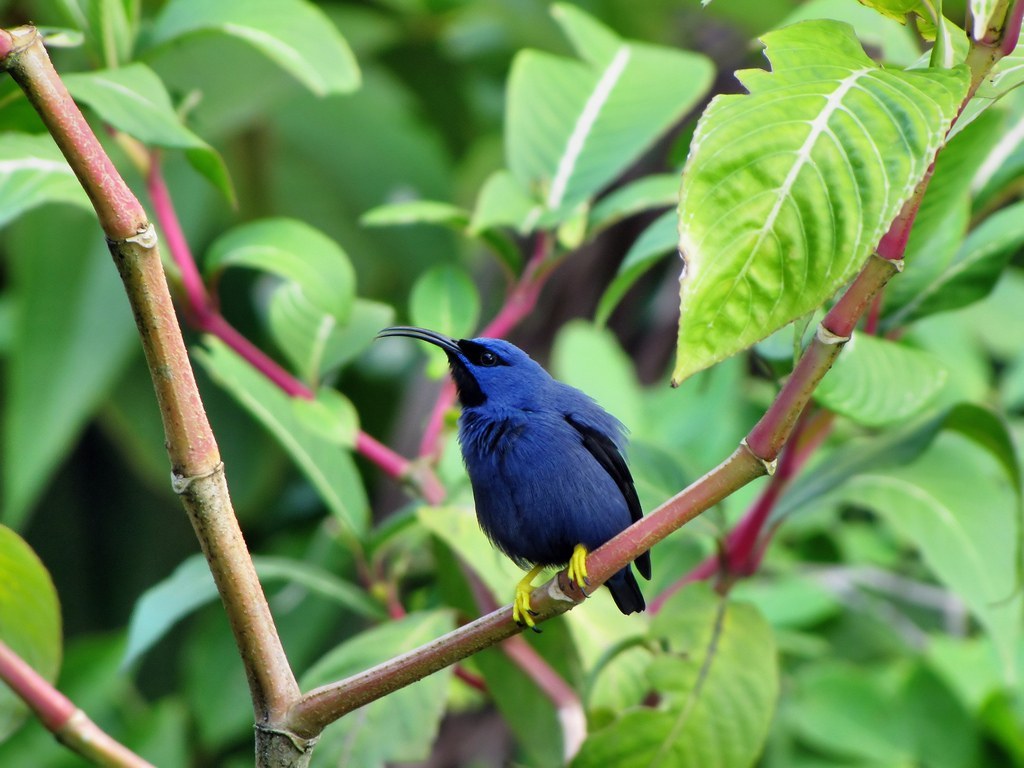
Key Field Marks
- Size & shape: Tiny (about 11–12 cm / 4.5 in), compact nectar-feeding tanager with a slim, slightly downcurved bill suited to probing flowers.
- Male plumage: Deep purple-violet body overall with a contrasting black throat/face, black wings, and bright yellow legs that stand out even at a distance.
- Female/immature plumage: Entirely different — bright green above, buffy-green below with a distinctive turquoise-blue throat patch, and duller (though still yellowish) legs; easily mistaken for an unrelated species by beginners.
- Bill: Fine, black, slightly decurved, adapted for nectar and small fruit.
- Behavior: Active and acrobatic, often hangs upside down at flowers, moves in small groups, and readily joins mixed-species canopy flocks.
Separating from Similar Species
- Male vs. other purple/blue tanagers: The combination of glossy violet body, black face/throat, and bright yellow legs is diagnostic; no other regularly occurring species shares this exact combination.
- Female vs. female Green Honeycreeper: Female Green Honeycreeper lacks the blue throat patch and has a paler, more uniformly greenish bill base; Purple Honeycreeper females show a cleaner turquoise throat contrast.
- Red-legged Honeycreeper (where ranges overlap): Male Red-legged Honeycreeper is turquoise-blue with a black back and red legs, quite different from the all-purple, yellow-legged male Purple Honeycreeper.
Where & When to See It
- Habitat: Canopy and edge of humid lowland and foothill forest, secondary growth, plantations (especially cacao and coffee with shade trees), and flowering trees.
- Range: Northern South America including the Amazon Basin, the Guianas, Venezuela, Colombia, Ecuador, and Trinidad; absent from higher Andean elevations.
- Season: Resident year-round; most easily seen visiting flowering or fruiting trees at any time of year.
Voice & Behavior Cues
- Gives thin, high-pitched "tsip" or "seet" notes, often the first clue to its presence high in the canopy before it's seen.
- Frequently forages with Green Honeycreepers, tanagers, and other canopy species at flowering trees, making mixed flocks worth scanning carefully.
Frequently asked questions
Why do male and female Purple Honeycreepers look so different?
Like many honeycreepers and tanagers, this species is strongly sexually dimorphic: males are glossy violet-blue with black markings and yellow legs to attract mates, while females are cryptic green with a blue throat patch for camouflage while nesting.
What is the easiest field mark for a male Purple Honeycreeper?
Bright yellow legs combined with an all-violet-purple body and black throat/wings are unique among South American honeycreepers and instantly diagnostic.
Where in the forest should I look for this species?
Scan the canopy and forest edges, especially flowering or fruiting trees, since Purple Honeycreepers rarely descend to the understory.
Can Purple Honeycreepers be confused with Red-legged Honeycreepers?
Only superficially by color impression; leg color (yellow vs. red) and overall body color (uniform violet vs. turquoise with black back) readily separate the two males.