
Pied Wagtail Identification Guide
A small black-and-white songbird known for its constantly bobbing tail, sharp "chizzick" call, and habit of running across car parks, rooftops, and open ground.
Read the full Pied Wagtail encyclopedia entry →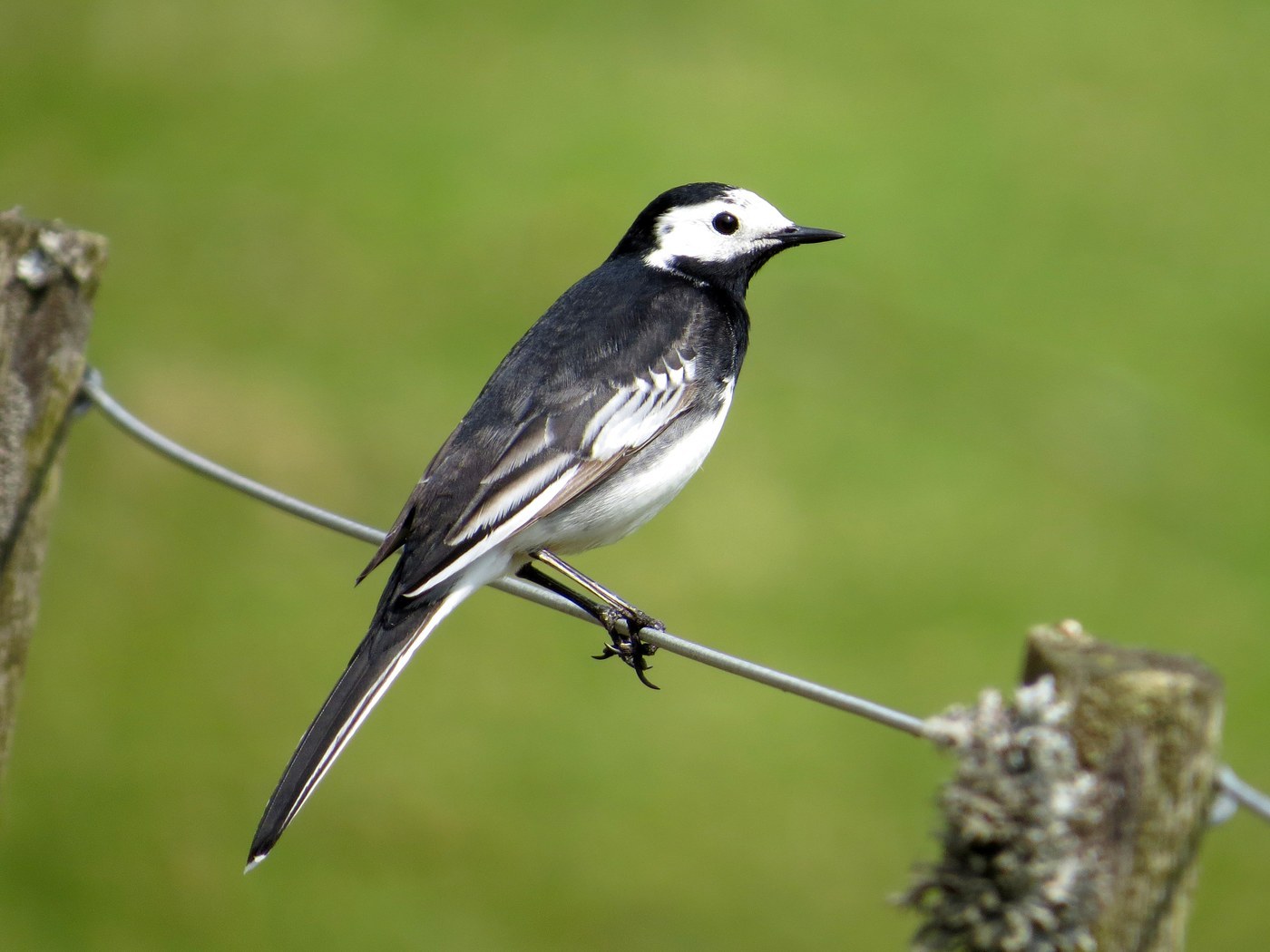
Key Field Marks
- Size & shape: A slim, long-tailed songbird about 18 cm (7 in) long, most of which is body and tail — it looks disproportionately elongated for its weight.
- Plumage (breeding male): Black cap, black back, black bib running down the throat, and a white face framed by the black cap and bib. Underparts white with grey-black flanks.
- Plumage (female): Similar pattern but with a grey (not black) back, giving a softer, less contrasting look.
- Juvenile: Duller grey-brown overall with a smudgy grey breast band instead of a clean black bib; can look confusingly plain until the head pattern is checked.
- Bill & legs: Thin, needle-like black bill; black legs.
- Constant tail-wagging: The single most useful clue at any distance — the tail pumps up and down almost continuously while the bird walks or pauses.
Behavior
Pied Wagtails forage on foot, walking and running in quick bursts while snapping up insects, often making short fluttering leaps to catch flying prey. Flight is strongly undulating (a bouncing, roller-coaster pattern), usually accompanied by the flight call. They frequently perch on rooftops, wires, and lamp posts, and can form large communal roosts in winter, sometimes in city centers on buildings or trees.
How to Tell It From Similar Species
- White Wagtail (nominate
Motacilla alba alba): The Continental European form has a pale grey back in both sexes, whereas the British/Irish Pied Wagtail race has a black back in the male. Female Pied and White Wagtails overlap more and can be very hard to separate; range and grey tone are the best clues. - Grey Wagtail: Confusingly named — it is actually yellow below, with a much longer tail, grey back, and (in breeding males) a black throat. Grey Wagtails favor fast-flowing streams and weirs rather than open ground and car parks.
- Yellow Wagtail: Olive-green above and yellow below year-round, with a shorter tail; not black-and-white like a Pied Wagtail.
Habitat & Range
Pied Wagtails are common and widespread across the British Isles and are found year-round in short-grass fields, farmyards, gardens, playing fields, car parks, and around buildings, almost always near some open ground for foraging. Northern and inland breeders often move to milder coastal areas or continental Europe/North Africa in winter, while many resident birds simply shift into towns and cities.
Voice
The flight call is a bright, disyllabic "chis-ick" or "chizzick," often given as the bird bounds overhead. The song is a simple, cheerful twittering warble, frequently incorporating the call note, usually delivered from a rooftop or wire perch.
Frequently asked questions
What is the difference between a Pied Wagtail and a White Wagtail?
They are the same species (Motacilla alba); "Pied Wagtail" is the black-backed British and Irish subspecies (M. a. yarrellii), while "White Wagtail" usually refers to the grey-backed Continental European subspecies (M. a. alba). Males are the easiest to separate by back color; females overlap more.
Why do Pied Wagtails constantly bob their tails?
The exact function isn't fully settled, but it's thought to help flush insects from the ground, signal alertness to predators, or aid balance while foraging quickly on foot.
Where is the best place to see a Pied Wagtail?
Almost any open, short-grass or paved area works — car parks, playing fields, farmyards, riverbanks, and rooftops across Britain and Ireland year-round.
How can I tell a male from a female Pied Wagtail?
Breeding males have a solidly black back; females have a grey back with only the cap and bib black, giving a less contrasty, softer appearance.
Is the Pied Wagtail the same as the Grey Wagtail?
No. Despite the name, Grey Wagtail is yellow underneath with a much longer tail and prefers fast-flowing water, while Pied Wagtail is black-and-white and favors open ground.