
Orange-winged Parrot Identification Guide
A common green Amazon parrot of tropical South America, best known by its blue-and-yellow face and the orange-and-blue flash exposed in the open wing.
Read the full Orange-winged Parrot encyclopedia entry →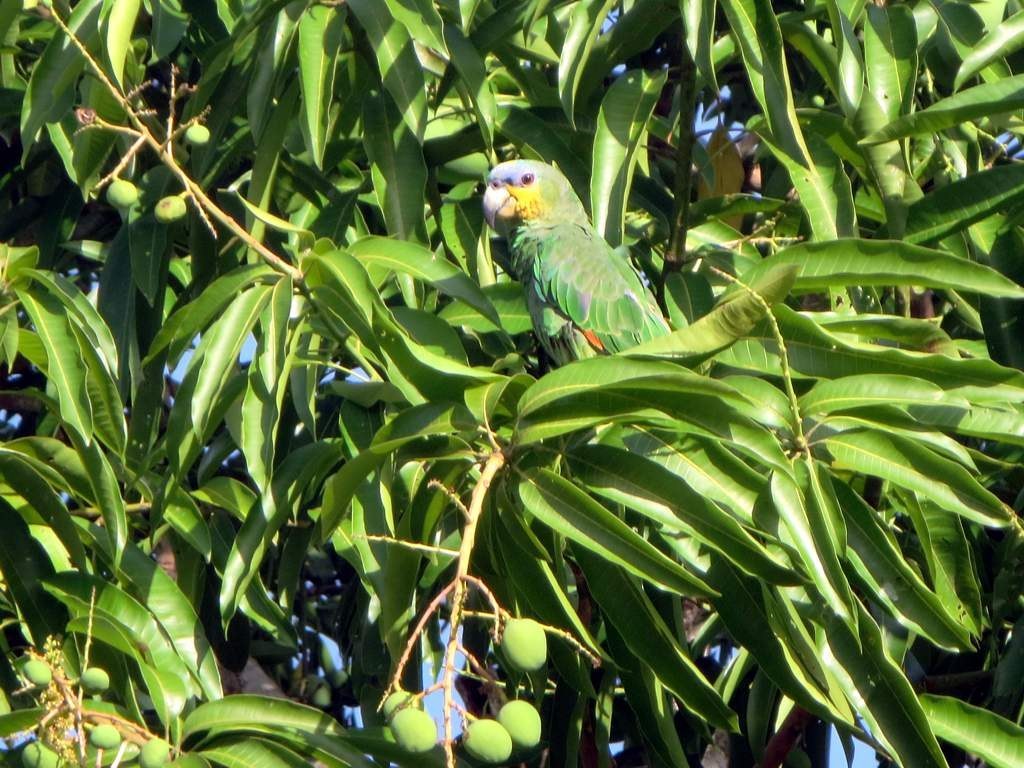
Key Field Marks
- Size & shape: A stocky, medium-sized parrot around 33 cm (13 in) long, with the short square tail and broad rounded wings characteristic of Amazona parrots — sometimes called the Orange-winged Amazon in field guides.
- Plumage: Mostly bright green body plumage, with blue feathering across the forehead and around the eyes and yellow patches on the crown and cheek that vary somewhat in extent from bird to bird.
- Wing pattern: The diagnostic orange patch sits within the flight feathers alongside a red-and-blue speculum, best seen when the wing is opened in flight or during wing-stretching displays.
- Bill & eye: Pale, horn-grey to pinkish bill (paler than several similar Amazon species) and a pale iris in adults.
- Behavior: Gregarious and vocal, typically encountered in pairs or flocks feeding in fruiting trees or flying between roost sites, with the strong, direct, shallow-beat flight typical of Amazon parrots.
Separating It From Similar Species
- Yellow-headed and Yellow-crowned Amazons: Both show far more solid yellow covering the head than the patchy blue-and-yellow pattern of this species.
- Mealy Amazon (Amazona farinosa): Noticeably larger and duller green, without the blue-and-yellow face contrast or the orange wing patch.
- Blue-fronted Amazon: Shows a more extensive solid blue forehead and typically a darker bill, lacking the pale grey-pink bill of this species.
- Confirm identification with the trio of pale bill, mixed blue/yellow (not solid-colored) face, and the orange-plus-blue wing patch seen in flight.
Habitat & Range
Common and widespread through the Amazon Basin and northern South America — including Venezuela, the Guianas, Colombia, Ecuador, Peru, Bolivia, Brazil, and Trinidad — as well as some introduced populations elsewhere. Found in lowland rainforest, forest edges, gallery forest, savanna woodland, mangroves, and increasingly city parks and plazas, where it readily adapts to people. It is resident year-round, moving locally between feeding and roosting sites rather than undertaking long migrations.
Voice
Gives loud, raucous screeches and squawks typical of Amazon parrots, particularly noisy in large gatherings at communal roosts around dawn and dusk; contact calls are harsh and far-carrying, helping locate flocks moving overhead.
Frequently asked questions
Is the Orange-winged Parrot the same as the Orange-winged Amazon?
Yes — 'Orange-winged Parrot' and 'Orange-winged Amazon' both refer to the same species, Amazona amazonica, with the name varying by region and field guide.
What field marks confirm this species over other green Amazon parrots?
A pale grey-pink bill, a face pattern mixing blue and yellow patches (rather than solid yellow or solid blue), and an orange-and-blue wing patch visible in flight.
Where is the Orange-winged Parrot most commonly seen?
Throughout the Amazon Basin and northern South America in lowland forest, forest edge, savanna woodland, and increasingly in urban parks, especially near fruiting trees.
Is the orange wing patch always visible?
No, it is mostly hidden when the wing is folded at rest and becomes visible during flight or when the bird stretches or displays its wings.