
Montezuma Oropendola Identification Guide
A large, colorful Central American icterid with a chestnut body, black head, blue-and-pink facial skin, and vivid yellow outer tail feathers, best known for its bubbling song and elaborate bowing display.
Read the full Montezuma Oropendola encyclopedia entry →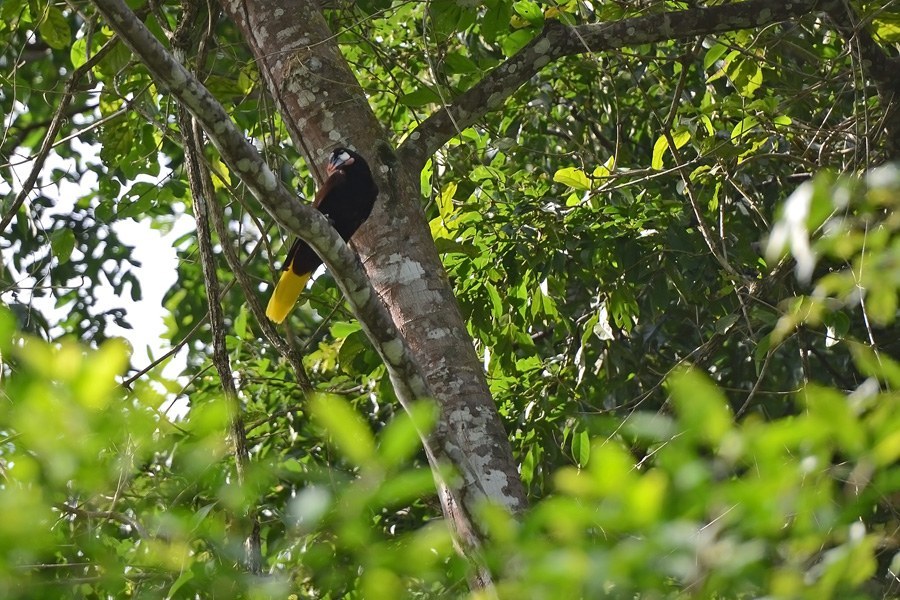
Key Field Marks
- Large icterid with strong sexual size dimorphism: males reach about 50 cm (20 in), females noticeably smaller at around 38 cm (15 in).
- Mostly rich chestnut-brown body contrasting with a black head, neck, and upper mantle.
- Bright pale blue bare facial skin patches on the cheeks and a pink to red-orange bare skin patch at the base of the bill.
- Bill is pale ivory-yellow at the tip, contrasting with the darker base.
- Bright yellow outer tail feathers are highly conspicuous in flight, contrasting sharply with the otherwise black central tail.
Separating It From Similar Species
Chestnut-headed Oropendola
- Smaller, with blue facial skin but a pale, unmarked bill lacking the red-orange tip patch of Montezuma Oropendola.
Crested Oropendola and other South American oropendolas
- Generally do not overlap in range with Montezuma Oropendola, which is restricted to Central America, simplifying identification within its range.
Behavior & Voice
- Colonial nester, building extraordinary long, hanging, woven pouch nests — sometimes up to 2 m (6.5 ft) long — clustered in isolated tall trees, often over open areas or near human settlements.
- Males perform an elaborate bowing courtship display, tipping forward off the perch with fluttering wings while giving their song, often causing the whole body to swing downward.
- Song is an extraordinary bubbling, gurgling, liquid series of notes unlike most other birds in its range, often the first clue to the species' presence.
Habitat, Range & Season
- Found in lowland tropical forest edge, clearings, and canopy from southern Mexico through Central America to Panama.
- Resident year-round within its range, though local movements track fruiting and nesting colony sites.
- Nesting colonies are most active and vocal during the dry season in much of Central America, when bowing displays and song are most frequent.
Frequently asked questions
What is the most reliable field mark for Montezuma Oropendola?
The combination of a chestnut body, black head, blue-and-red facial skin, and bright yellow outer tail feathers is distinctive and not shared by any similar species within its Central American range.
How can I find a Montezuma Oropendola colony?
Look for isolated tall trees holding clusters of long, hanging woven pouch nests, often near forest edges or clearings — these colonies are a strong indicator of the species.
What does the male's courtship display look like?
The male bows forward off his perch with fluttering wings while giving a bubbling, gurgling song, an elaborate and distinctive display.
How do males and females differ in size?
Males are considerably larger than females, one of the more pronounced size differences between sexes among songbirds.