
McCown's Longspur Identification Guide
A short-tailed, big-headed grassland songbird of the shortgrass prairie, breeding males showing a black cap, black crescent breast band, and mostly white tail with a dark inverted-T pattern (this species is now officially known as Thick-billed Longspur).
Read the full McCown's Longspur encyclopedia entry →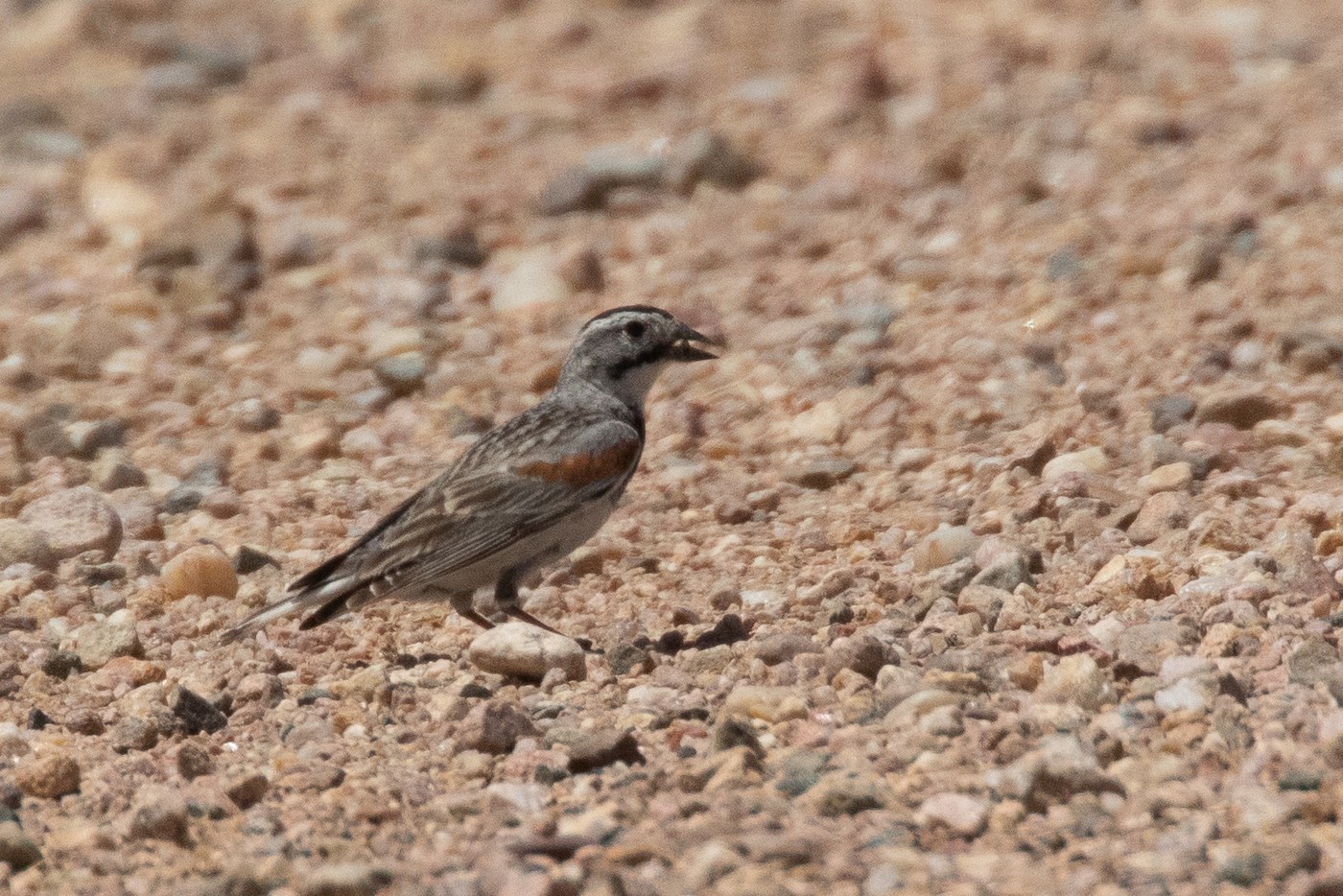
Key Field Marks
- Size & shape: A compact, short-tailed longspur about 14–15 cm (5.5–6 in) long with a notably thick, conical bill (heavier than other longspurs) and a big, rounded head.
- Breeding male: Grey-and-black head with a solid black crown patch, a black crescent-shaped breast band, grey nape, and streaky brownish-grey back; underparts otherwise pale grey-white.
- Female/non-breeding/winter birds: Much plainer sandy-brown and streaky overall, resembling a sparrow; best identified by bill thickness, tail pattern, and structure rather than plumage.
- Bill color: Thick, pale pinkish or horn-colored bill year-round — a key mark separating it from other longspurs, which have darker or thinner bills.
- Tail pattern: In flight, shows a mostly white tail with a dark, inverted-T (or dark triangle) at the tip and center — distinct from the more extensively dark-tipped tails of Chestnut-collared and Lapland Longspurs.
- Legs: Blackish legs and feet, walks/runs on the ground rather than hopping, typical longspur behavior.
Similar Species
- Chestnut-collared Longspur (Calcarius ornatus): Breeding male has a chestnut nape and black underparts (not just a breast crescent); in flight its tail shows more black restricted mainly to the central feathers with white sides, differing from Thick-billed/McCown's inverted-T pattern.
- Lapland Longspur (Calcarius lapponicus): Larger, with a thinner bill, chestnut nape patch in breeding males, and a different, more solidly dark-centered tail.
- Sparrows (winter birds): Non-breeding longspurs can suggest sparrows; the thick pale bill, short notched tail with white edges, and flight call are the best clues.
Where & When to See It
- Breeding range: Shortgrass and mixed-grass prairie of the northern Great Plains — parts of Montana, Wyoming, North Dakota, South Dakota, and adjacent southern Canada (Alberta, Saskatchewan).
- Habitat: Prefers very short, sparse grassland, often heavily grazed or naturally short prairie, more so than taller-grass specialists like Chestnut-collared Longspur.
- Winter range: Withdraws south to open shortgrass plains, agricultural fields, and prairie of the southern Great Plains, west Texas, and northern Mexico, often in mixed flocks with other longspurs and Horned Larks.
- Season: Breeds spring–summer on the northern plains; present in winter flocks on the southern plains from roughly October through March.
Voice
- Song is a short, sweet, tinkling warble given in a distinctive display flight, where the male rises steeply then glides down on stiffly held wings while singing.
- Flight call is a dry rattling or "kittle" note, useful for picking birds out of mixed winter flocks on the ground.
Note on Name
This species was renamed Thick-billed Longspur by the American Ornithological Society in 2020, replacing the earlier eponymous name; both names refer to the identical bird.
Frequently asked questions
Is McCown's Longspur the same bird as Thick-billed Longspur?
Yes. The American Ornithological Society officially renamed McCown's Longspur to Thick-billed Longspur in 2020; it is the same species under a new name.
What is the best field mark for McCown's/Thick-billed Longspur?
Its noticeably thick, pale pinkish bill combined with the white tail showing a dark inverted-T pattern near the tip, visible in flight.
How do I separate it from Chestnut-collared Longspur?
Breeding male Chestnut-collared Longspurs have solid black underparts and a chestnut nape, while McCown's/Thick-billed has only a black breast crescent and lacks the chestnut nape. Tail patterns also differ, with McCown's showing more extensive white.
Where is the best habitat to find this species breeding?
Very short, sparse shortgrass prairie, often heavily grazed, across the northern Great Plains of the US and southern Canada.