
Least Tern Identification Guide
North America's smallest tern, recognized by its tiny size, fast buzzy flight, yellow bill, and black-capped head with a white forehead patch.
Read the full Least Tern encyclopedia entry →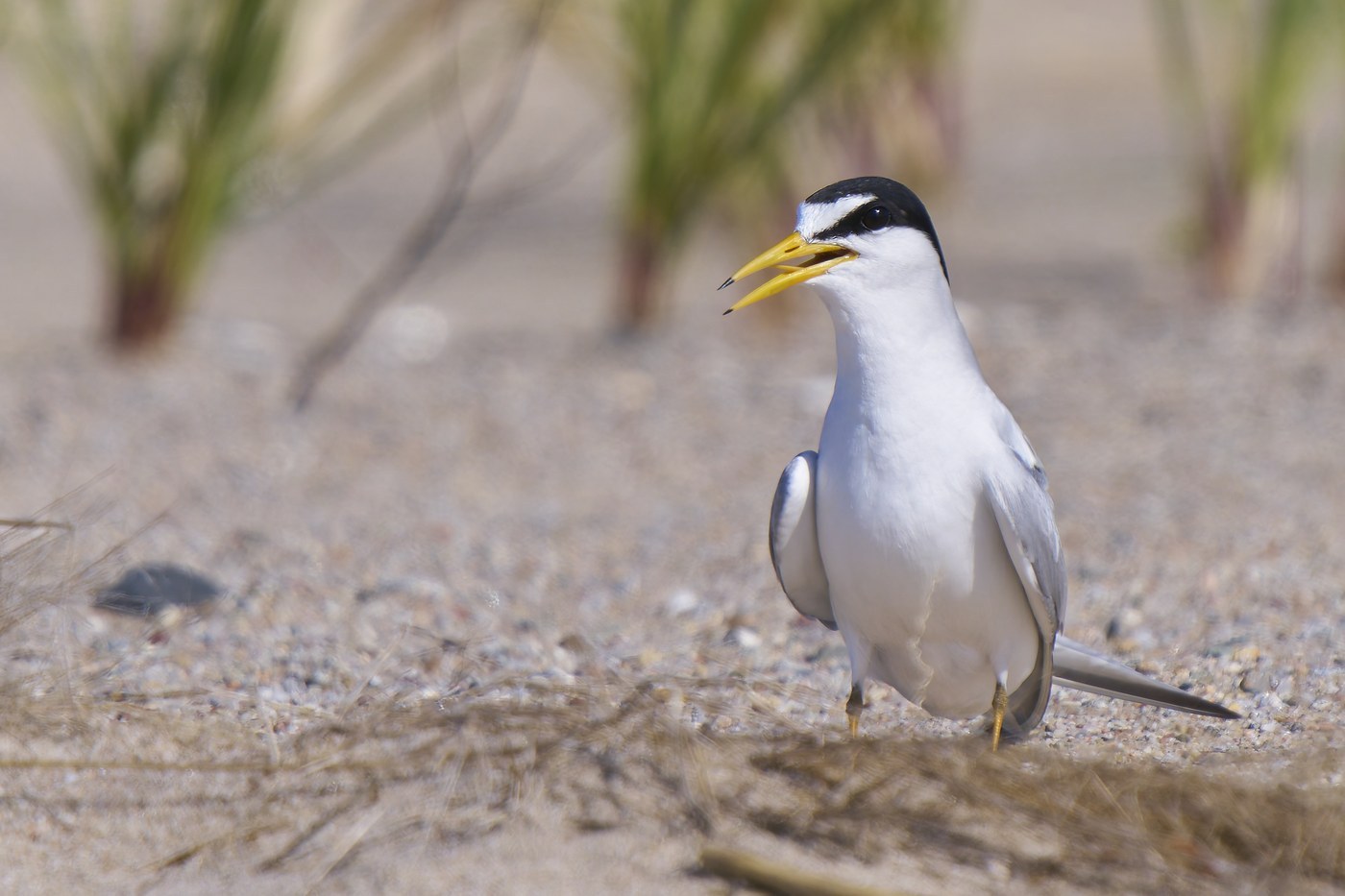
Key Field Marks
- Size & shape: Tiny, only 8.5-9.5 inches long with a wingspan around 20 inches -- noticeably smaller than any other North American tern. Slender body, narrow pointed wings, and a shallowly forked tail.
- Bill: Bright yellow with a small black tip in breeding adults; bill often looks disproportionately long and dagger-like for such a small bird.
- Head pattern: Black cap extends from the crown down through the eye, but a crisp white forehead patch separates the cap from the bill base -- a diagnostic feature in breeding plumage.
- Legs: Bright yellow-orange, short.
- Upperparts: Pale gray back and wings; outer primaries show a dark gray-black wedge that's visible in flight.
- Underparts: Clean white.
Separating from Similar Species
- Little Tern (Old World, vagrant potential): Nearly identical; Least Tern has a slightly different wing pattern and range, but the two are best separated by range and very fine plumage/vocal details.
- Common Tern / Forster's Tern: Both are much larger, lack the white forehead patch outside of winter plumage, and have red-orange (not yellow) bills.
- Black Tern (non-breeding): Larger, grayer overall, dark bill, and lacks the yellow legs.
- Overall, size alone is usually enough -- if it looks like a toy-sized tern hovering and diving over shallow water, it's likely a Least Tern.
Habitat, Range & Season
- Breeds colonially on bare sand and gravel beaches, sandbars, and dredge-spoil islands along the Atlantic and Gulf Coasts, the Pacific Coast (California), and along major river systems in the interior (e.g., Mississippi, Missouri, Red, and Rio Grande drainages).
- An interior population nests on sandbars of large rivers; coastal populations nest on open beaches, often near human recreation areas, making them vulnerable to disturbance.
- Winters mainly along coasts of Central America and northern South America; North American breeders are present roughly April through August/September.
Behavior
- Forages by hovering over shallow water and plunge-diving for small fish; flight is quick, buzzy, and erratic compared to larger terns.
- Highly colonial nester; scrapes a shallow depression directly on open sand or gravel, often with little to no lining.
- Defends colonies aggressively, dive-bombing intruders (including people) that approach nest sites.
Voice
- Sharp, high-pitched kip or zreep calls given in flight.
- Alarm calls are rapid, chattering, and given persistently when a colony is disturbed.
- Overall voice is higher-pitched and buzzier than the calls of larger tern species.
Frequently asked questions
What is the easiest way to identify a Least Tern?
Its tiny size (smaller than a robin-sized bird in flight silhouette), yellow bill, yellow legs, and a black cap broken by a white forehead patch make it distinctive among North American terns.
How does the Least Tern differ from the Little Tern?
They are extremely similar sister species; Least Tern occurs in the Americas while Little Tern is an Old World species, so range is the primary separator, along with subtle differences in outer wing pattern.
Where is the best place to see Least Terns?
Sandy beaches and river sandbars along the Atlantic, Gulf, and Pacific coasts, plus interior river systems like the Missouri and Mississippi, during the April-September breeding season.
Why are Least Terns considered vulnerable?
They nest in open scrapes on beaches and sandbars that are highly susceptible to human disturbance, predation, and habitat loss, leading to listing as endangered or threatened in parts of their range.
What does a Least Tern sound like?
It gives sharp, high-pitched kip and buzzy zreep calls, noticeably higher and squeakier than the calls of larger terns like Common or Forster's Tern.