
Green Honeycreeper Identification Guide
A striking tropical songbird whose males glow turquoise-green with a black hood, while females are entirely bright grass-green.
Read the full Green Honeycreeper encyclopedia entry →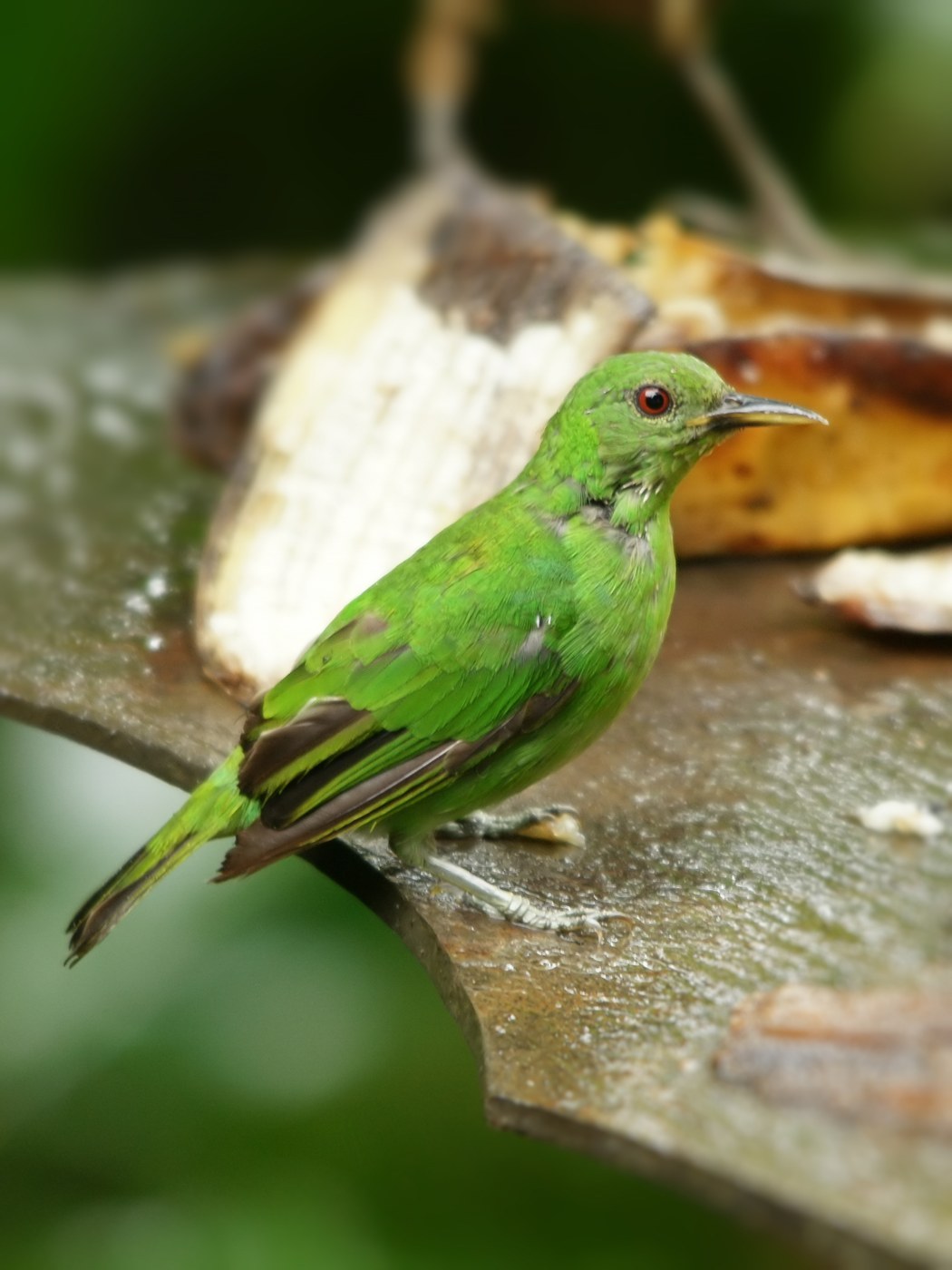
Key Field Marks
- Size and shape: A small, plump-bodied tanager-relative around 5–5.5 inches long, with a fairly long, slightly downcurved bill adapted for nectar and fruit.
- Male plumage: Brilliant turquoise-green body plumage with a contrasting glossy black hood covering the head and throat; the bill is bright yellow with a black tip, and the eye is red.
- Female plumage: Entirely soft grass-green above and slightly paler green below, without the black hood; also shows the yellow-based bill and red eye, though duller than the male's.
- Behavior: Forages actively in the mid- to upper canopy, often joining mixed-species flocks; probes flowers for nectar and gleans fruit, moving with quick, agile hops along branches.
Separating It From Similar Species
- Male vs. other green tanagers: The combination of a solid black hood against turquoise-green body is unique; no other green honeycreeper or tanager in range shows this exact pattern.
- Female vs. female Red-legged Honeycreeper: Female Red-legged Honeycreeper has duller, more olive-green plumage with a shorter bill and often shows a hint of blue on the wings or tail; female Green Honeycreeper is a more uniform, brighter green throughout with a proportionally longer bill.
- Female vs. female euphonias: Euphonias are smaller, shorter-tailed, and typically show yellow underparts rather than all-green plumage.
- The red eye is a useful mark shared by both sexes and helps separate this species from similarly colored green tanagers with dark eyes.
Where and When to See It
- Habitat: Humid lowland and foothill forest, forest edge, and secondary growth, favoring canopy and flowering or fruiting trees.
- Range: Found from southern Mexico through Central America and into much of northern and central South America, including the Amazon basin.
- Season: A non-migratory resident throughout its range, present year-round.
Voice and Song Cues
- Gives a thin, high-pitched "tsip" or "seet" contact note, often the first indication of its presence high in the canopy.
- The song is a simple, unremarkable series of thin, squeaky notes, not especially musical or far-carrying.
Frequently asked questions
How do male and female Green Honeycreepers differ?
Males are turquoise-green with a glossy black head and throat, while females lack the black hood and are entirely bright grass-green from head to tail.
What is the easiest way to tell a female Green Honeycreeper from a female Red-legged Honeycreeper?
Look at overall color and bill length: Green Honeycreeper females are more uniformly bright green with a longer bill, while Red-legged Honeycreeper females are duller olive-green with a shorter bill.
What does a Green Honeycreeper eat?
It feeds mainly on nectar and small fruits, using its slightly curved bill to probe flowers, and often supplements its diet with small insects.
Where in the canopy should I look for this species?
Check flowering and fruiting trees in the mid- to upper canopy, especially where it joins mixed-species foraging flocks with tanagers and other honeycreepers.
Is the Green Honeycreeper closely related to hummingbirds?
No, despite its nectar-feeding habits it is a tanager relative (family Thraupidae), not a hummingbird; its bill is shorter and it perches to feed rather than hovering.