
Gray-cheeked Thrush Identification Guide
A cold-toned, uniformly gray-brown boreal thrush lacking a strong eye-ring or buffy face, best separated from similar Catharus thrushes by voice and subtle plumage tone.
Read the full Gray-cheeked Thrush encyclopedia entry →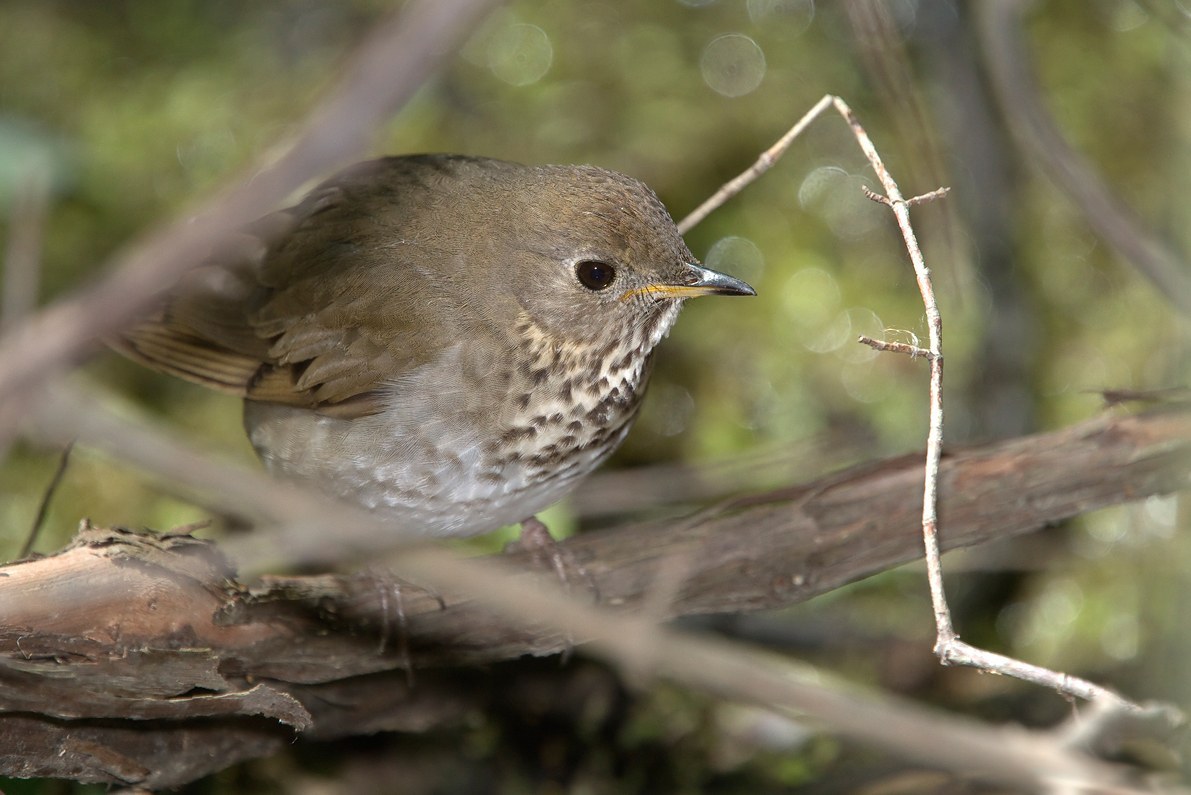
Key Field Marks
- Medium-sized Catharus thrush with uniform grayish-olive to grayish-brown upperparts, notably colder and less warm-toned than related species.
- Grayish face and cheek without a strong buffy wash or bold eye-ring; only a faint, thin, incomplete pale eye-ring is present at most.
- Underparts whitish with bold dark spotting concentrated on the upper breast, fading toward the belly.
- Grayish flanks and a grayish-brown tail without strong rufous tones.
- Overall a plain, cold-colored thrush that can look almost featureless in the face compared to its relatives.
Separating It From Similar Species
- Swainson's Thrush: shows a warm buffy wash across the face and breast with a bold buffy eye-ring and "spectacled" look, clearly warmer-toned than Gray-cheeked Thrush.
- Bicknell's Thrush: extremely similar and formerly considered the same species; Bicknell's is slightly smaller, tends to show more reddish-brown in the tail contrasting with the back, and has a different, huskier voice — the two are best separated by range, voice, and in-hand measurements.
- Veery: much warmer reddish-brown above with only faint spotting on the breast, lacking the cold gray tones of Gray-cheeked Thrush.
- Hermit Thrush: shows a contrasting reddish tail against browner upperparts and habitually pumps its tail, unlike Gray-cheeked Thrush.
Habitat, Range & Season
- Breeds in subarctic boreal forest, stunted spruce taiga, and dwarf willow/birch scrub near treeline across northern Canada, Alaska, and northeastern Siberia.
- A long-distance migrant, wintering in northern and western South America, and passing through the rest of North America mainly as a skulking migrant in spring and fall.
- During migration it favors dense woodland understory and thickets, staying low and often difficult to see well.
Behavior & Voice
- Forages on or near the ground for insects and other invertebrates, and shifts to fruit later in migration and on the wintering grounds.
- Song is thin and nasal, a distinctive descending-then-rising phrase often rendered as "wee-o, wee-o, wee-o, wee-o-titi," quite different from the upward-spiraling songs of Swainson's or Hermit Thrush.
- Flight call is a sharp, thin, descending "pheer," useful for detecting nocturnal migrants overhead.
Frequently asked questions
How do I tell a Gray-cheeked Thrush from a Swainson's Thrush?
Gray-cheeked Thrush is colder and grayer overall with little or no buffy wash on the face, while Swainson's Thrush shows a warm buffy face and a bold buffy eye-ring.
What is the difference between Gray-cheeked Thrush and Bicknell's Thrush?
They are very similar; Bicknell's is slightly smaller with more reddish tones in the tail and a huskier voice, and the two are best told apart by range, voice, and measurements rather than plumage alone.
Where does the Gray-cheeked Thrush breed?
It breeds in subarctic boreal forest and stunted taiga or scrub near treeline across northern Canada, Alaska, and northeastern Siberia.
What does the Gray-cheeked Thrush's song sound like?
A thin, nasal phrase that descends and then rises, often rendered as "wee-o, wee-o, wee-o, wee-o-titi."
Why is the Gray-cheeked Thrush hard to identify during migration?
It is a plain, cold-toned thrush lacking strong facial markings, so it closely resembles several other Catharus thrushes and is often best confirmed by voice.