
Eastern Screech-Owl Identification Guide
A small, stocky, ear-tufted owl of eastern woodlands and suburbs that comes in gray and rufous color morphs and blends perfectly with tree bark by day.
Read the full Eastern Screech-Owl encyclopedia entry →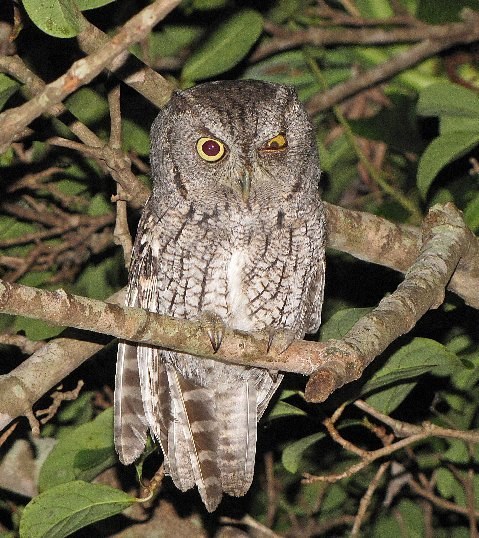
Key Field Marks
- Size & shape: A small, compact owl (about 8-9 in / 20-23 cm tall) with a large head, prominent pointed ear tufts (often held flat when relaxed), yellow eyes, and a stocky, barrel-shaped body.
- Color morphs: Occurs in two main color morphs — a gray morph with intricate gray, black, and white mottling and streaking that mimics tree bark, and a rufous (red) morph that is rich reddish-brown with similar fine patterning; both morphs show vertical streaking mixed with fine horizontal barring on the underparts, giving a cross-hatched appearance.
- Eyes: Bright yellow, a useful mark versus the dark eyes of Barred Owl.
- Camouflage roosting: By day, roosts motionless in a tree cavity entrance or against a tree trunk, often nearly invisible thanks to its cryptic, bark-like plumage.
Separating from Similar Species
- Western Screech-Owl: Very similar but has a dark bill (Eastern's bill is pale/greenish-horn colored) and occurs in the West with limited range overlap; voice differs (Western gives an accelerating "bouncing ball" trill on one pitch).
- Great Horned Owl: Much larger, with a deeper voice and different proportions — no confusion in size once seen, though calls can superficially seem similar to beginners.
- Barred Owl: Much larger, dark-eyed (not yellow), lacks ear tufts, and has a hooting "who cooks for you" call rather than a trill or whinny.
Habitat & Range
Widespread resident of deciduous and mixed woodlands, riparian corridors, orchards, parks, and even leafy suburban neighborhoods across the eastern United States, from the Great Plains east to the Atlantic, and north into southern Canada, south to Texas and Florida. Highly dependent on tree cavities for roosting and nesting (natural hollows or old woodpecker holes) and readily uses nest boxes, making it one of the more urban-tolerant owls in North America.
Seasonal Notes
Non-migratory and present year-round throughout its range. Most vocal in late winter through spring during pair formation and nesting season, but can be heard calling on mild nights throughout the year; strictly nocturnal, becoming active at dusk.
Voice
Two distinctive calls: a descending, whinnying tremolo (often likened to a horse's whinny) and a long, even-pitched trill on a single note that rises and falls slightly in volume — notably, despite the name, it does not actually "screech."
Frequently asked questions
Why is it called a screech-owl if it doesn't screech?
The name is a historical misnomer — its actual calls are a descending whinny and a soft, even trill, not a screech; early namers likely reacted to the eerie, ghostly quality of the whinny call.
What's the difference between gray and rufous morph Eastern Screech-Owls?
They're the same species with two plumage color forms — one intricately mottled gray-and-black (bark-camouflaged) and one rich reddish-brown — with intermediate birds also occurring; morph frequency varies geographically, with rufous birds more common in the humid Southeast.
How can you tell Eastern from Western Screech-Owl?
Bill color is a reliable mark — Eastern Screech-Owl has a pale, greenish-horn bill while Western Screech-Owl has a dark, blackish bill; voice also differs distinctly between the two.
Where do Eastern Screech-Owls nest and roost?
In tree cavities — natural hollows or old woodpecker holes — and they readily accept human-provided nest boxes, which has helped them thrive in wooded suburbs and parks.