
Collared Trogon Identification Guide
A quiet, jewel-colored Neotropical trogon recognized by its white breast band separating a green chest from a red belly.
Read the full Collared Trogon encyclopedia entry →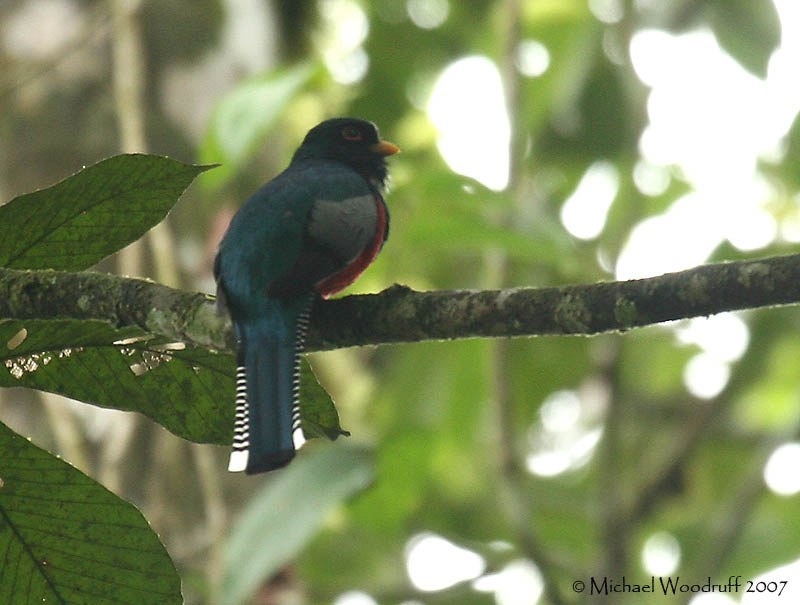
Key Field Marks
- Chunky, upright-perching bird about 24–26 cm long with a long, squared tail
- Male: iridescent green head, back, and chest; black face and throat; bright red lower breast and belly; a narrow white band (the "collar") separating the green chest from the red belly; pale yellowish-orange bill; undertail finely barred black and white
- Female: grayish-brown head, back, and chest (replacing the male's green and black); red belly; retains the diagnostic white collar; undertail barring coarser than the male's
- Yellow-orange eye-ring in both sexes
How to Tell It Apart from Similar Trogons
- Black-throated Trogon: lacks the white chest collar entirely, and has a blue (not yellow-orange) eye-ring
- Elegant Trogon: larger, with a more robust bicolored bill, a different (more finely notched) undertail pattern, and favors drier oak/sycamore canyons rather than humid lowland forest
- Baird's Trogon and other regional trogons: separated primarily by undertail barring pattern, bill color, and range — always confirm the presence of the thin white collar as the key mark for this species
Habitat, Range & Season
- Resident from Mexico south through Central America and into the Amazon basin of South America
- Found in humid lowland and foothill forest, forest edge, and shaded plantations, typically perching quietly in the mid- to upper canopy
- Present year-round; does not migrate
Voice
- A soft, repeated, slightly descending series of hollow notes, often rendered as "cow, cow, cow, cow" or "kyow-kyow-kyow"
- Generally unobtrusive and easier to hear than to see; often located by voice first
Behavior Notes
- Sits motionless for long periods on horizontal perches, then sallies out to snatch fruit or insects
- Nests in tree cavities, including old woodpecker holes and arboreal termite nests
Frequently asked questions
What is the single best field mark for Collared Trogon?
The narrow white band across the chest separating the green (male) or brownish (female) upper breast from the red belly — this collar gives the species its name and is present in both sexes.
How do I separate Collared Trogon from Black-throated Trogon?
Check for the white chest collar (present in Collared, absent in Black-throated) and eye-ring color: Collared Trogon has a yellow-orange eye-ring, while Black-throated Trogon has a blue one.
Where should I look for Collared Trogons?
Scan the mid-to-upper levels of humid forest interior and edge from Mexico through Central America into the Amazon; they perch quietly, so listening for the soft, repeated hooting call often helps locate them first.
Are male and female Collared Trogons different colors?
Yes. Males have a green head, back, and chest with a black throat; females have a grayish-brown head, back, and chest instead of green and black, but both sexes keep the red belly and white collar.