
Carmine Bee-eater Identification Guide
One of Africa's most vividly colored birds, the Carmine Bee-eater flashes brilliant crimson plumage and a turquoise crown as it hawks insects on the wing.
Read the full Carmine Bee-eater encyclopedia entry →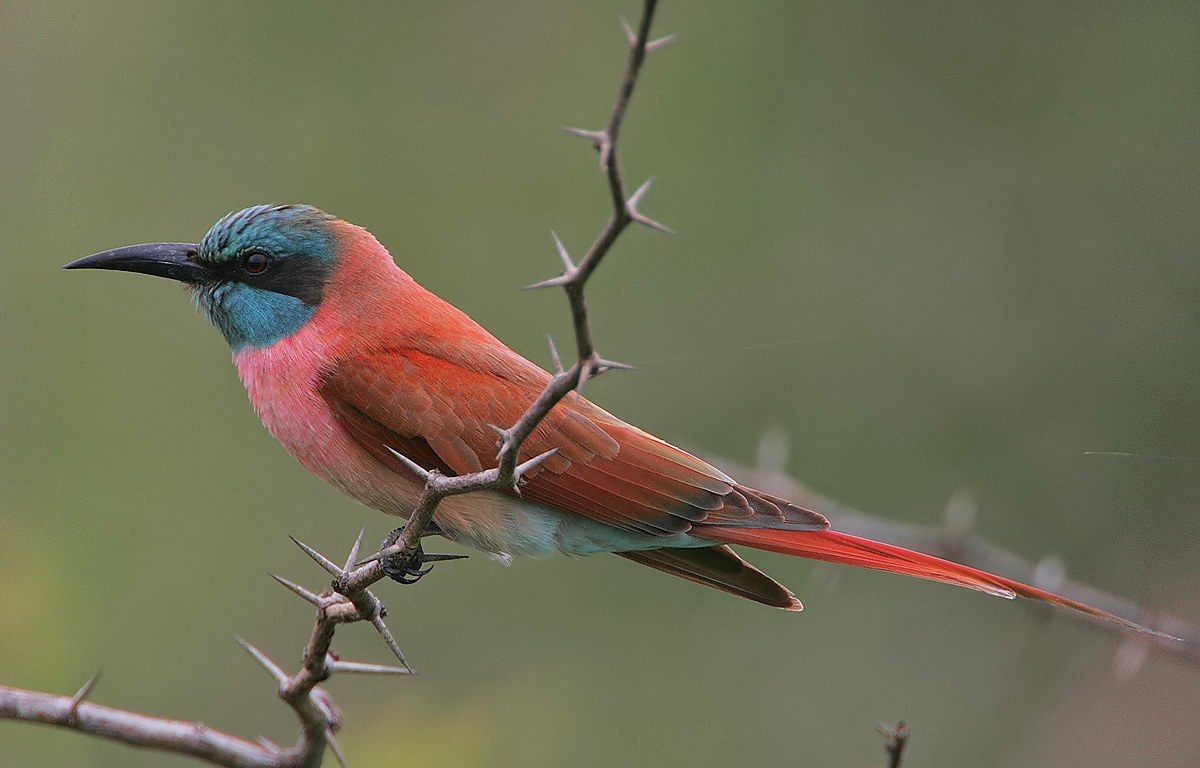
Key Field Marks
- Size & shape: A slender, streamlined bee-eater roughly 24–36 cm long including elongated central tail streamers that extend well past the rest of the tail.
- Plumage: Vivid carmine-red body plumage overall, with a contrasting turquoise-blue crown, throat, and rump (the exact pattern varies between the Northern and Southern forms).
- Face: A bold black mask runs through the eye, bordered by the blue throat/crown coloration.
- Bill & flight silhouette: Long, slightly downcurved black bill; pointed wings and a fast, agile, swallow-like flight with frequent aerial sallies.
- Behavior: Highly social, often seen in large flocks; frequently follows grazing mammals, vehicles, and even grass fires to catch insects flushed from cover, and famously rides on the backs of kori bustards and other large animals.
Separating It From Similar Species
- No other African bee-eater combines an all-carmine body with a turquoise crown and throat — European Bee-eater and White-fronted Bee-eater show green backs and yellow throats instead.
- Northern Carmine Bee-eater has a turquoise crown contrasting with a red nape, while Southern Carmine Bee-eater has a turquoise-blue crown that extends further and a green-blue rump; range is the most reliable way to separate the two where field marks overlap.
- Juveniles are duller, washed-out pink-brown with shorter tail streamers, lacking the saturated adult coloration.
Where & When to See It
- Habitat: Open savanna, riverbanks, and floodplains; nests colonially in burrows excavated into sandy cliffs, riverbanks, and road cuttings.
- Range: Sub-Saharan Africa — the Northern Carmine Bee-eater occupies a band from Senegal east to Ethiopia and Kenya, while the Southern Carmine Bee-eater is found from Angola and Zambia south to Botswana, Zimbabwe, and Mozambique.
- Season: Strongly migratory/nomadic within Africa, tracking rainfall and insect abundance; large breeding colonies form on sandbanks and cliffs during the dry season, making this the best time to see spectacular concentrations.
Voice & Song Cues
- Gives sharp, rolling, chattering calls in flight, often a repeated "terk terk" or "pruik" note, especially noisy around breeding colonies.
- Flocks in flight produce a constant chorus of these calls, which often reveals a colony or feeding aggregation before it is seen.
Frequently asked questions
How can I tell a Northern from a Southern Carmine Bee-eater?
Range is the most reliable clue — Northern occurs from West Africa to the Horn of Africa, Southern from Angola to Mozambique — combined with subtle differences in how far the turquoise crown extends and rump color.
Why do Carmine Bee-eaters ride on the backs of large animals?
They perch on grazing mammals or large birds like kori bustards to catch insects stirred up as the animal moves, an efficient foraging strategy also used at grass fires.
Where do Carmine Bee-eaters nest?
They dig nesting burrows in large colonies on sandy riverbanks, cliffs, and similar exposed sandy or earthen banks, often forming dense, conspicuous colonies of hundreds of birds.
What time of year are Carmine Bee-eater colonies most visible?
Breeding colonies are most spectacular during the regional dry season when birds concentrate on exposed sandbanks and cliffs to nest.