
Broad-billed Motmot Identification Guide
A quiet, rufous-headed motmot of Neotropical forest understory, best recognized by its broad flattened bill, blue crown border, and slow, pendulum tail-swinging habit.
Read the full Broad-billed Motmot encyclopedia entry →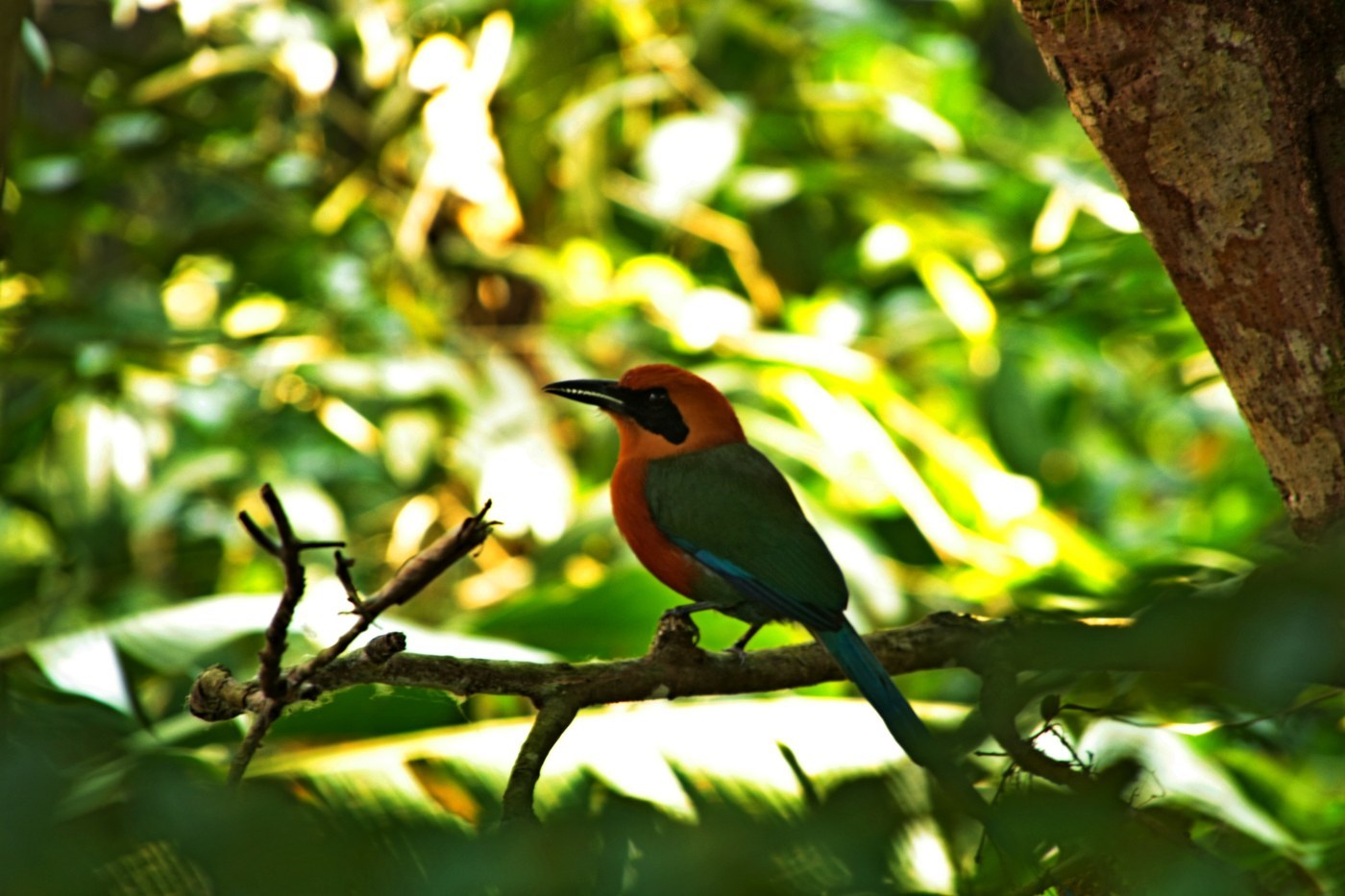
Key Field Marks
- Size & shape: A medium-sized motmot, roughly 33–37 cm including its long tail, with a notably broad, somewhat flattened bill compared to other motmots.
- Plumage: Rich rufous-cinnamon head and underparts, greenish back and wings, a turquoise-blue band bordering the crown, and a black mask through the eye.
- Throat & tail: A small black spot on the throat bordered by blue; long greenish-blue tail, often with weakly racket-tipped central feathers (less pronounced than in some other motmot species).
Separating from Similar Species
- Other Neotropical motmots: The combination of an all-rufous head (lacking a contrasting black crown patch found in some relatives) and a distinctly broad, flattened bill helps separate this species from similar sympatric motmots.
- Rufous Motmot: Larger overall with even more extensive rufous underparts and lacking the strong blue crown border seen on Broad-billed Motmot; range and voice also help distinguish the two where they co-occur.
- Bill shape is a particularly useful mark up close — broader and flatter than the more evenly tapered bills of most other motmot species.
Habitat, Range & Season
- Found in the understory of humid lowland and foothill forest, from Honduras south through Central America into western Amazonia in South America.
- A non-migratory resident throughout its range, typically encountered singly or in pairs in shaded, undisturbed forest interior.
- Often perches quietly on low to mid-level branches, making it easy to overlook despite its bright plumage.
Voice & Behavior
- Call is a low, resonant, hooting "hoo-hoo" or nasal croaking note, often given at dawn and dusk.
- Characteristically sits still for long periods, periodically swinging its long tail side to side like a pendulum — a signature motmot behavior useful for locating otherwise well-camouflaged birds.
- Feeds on large insects and small vertebrates, sallying from a perch to catch prey before returning to the same spot.
Frequently asked questions
What is the best way to identify a Broad-billed Motmot?
Look for an all-rufous head bordered by a turquoise-blue crown band, a black eye mask, and especially a notably broad, flattened bill compared to other motmots.
Why does the Broad-billed Motmot swing its tail?
Like other motmots, it periodically swings its long tail side to side in a pendulum motion, a behavior thought to signal alertness to predators; this movement often helps birders locate an otherwise still, camouflaged bird.
Where does the Broad-billed Motmot live?
In the understory of humid lowland and foothill forest from Honduras through Central America into western Amazonia in South America.
What does a Broad-billed Motmot sound like?
A low, resonant hooting or nasal croaking call, often given around dawn and dusk from a perch within the forest interior.