
Blue-winged Warbler Identification Guide
A bright yellow warbler of eastern shrublands, told by its blue-gray wings, white wingbars, and thin black eyeline.
Read the full Blue-winged Warbler encyclopedia entry →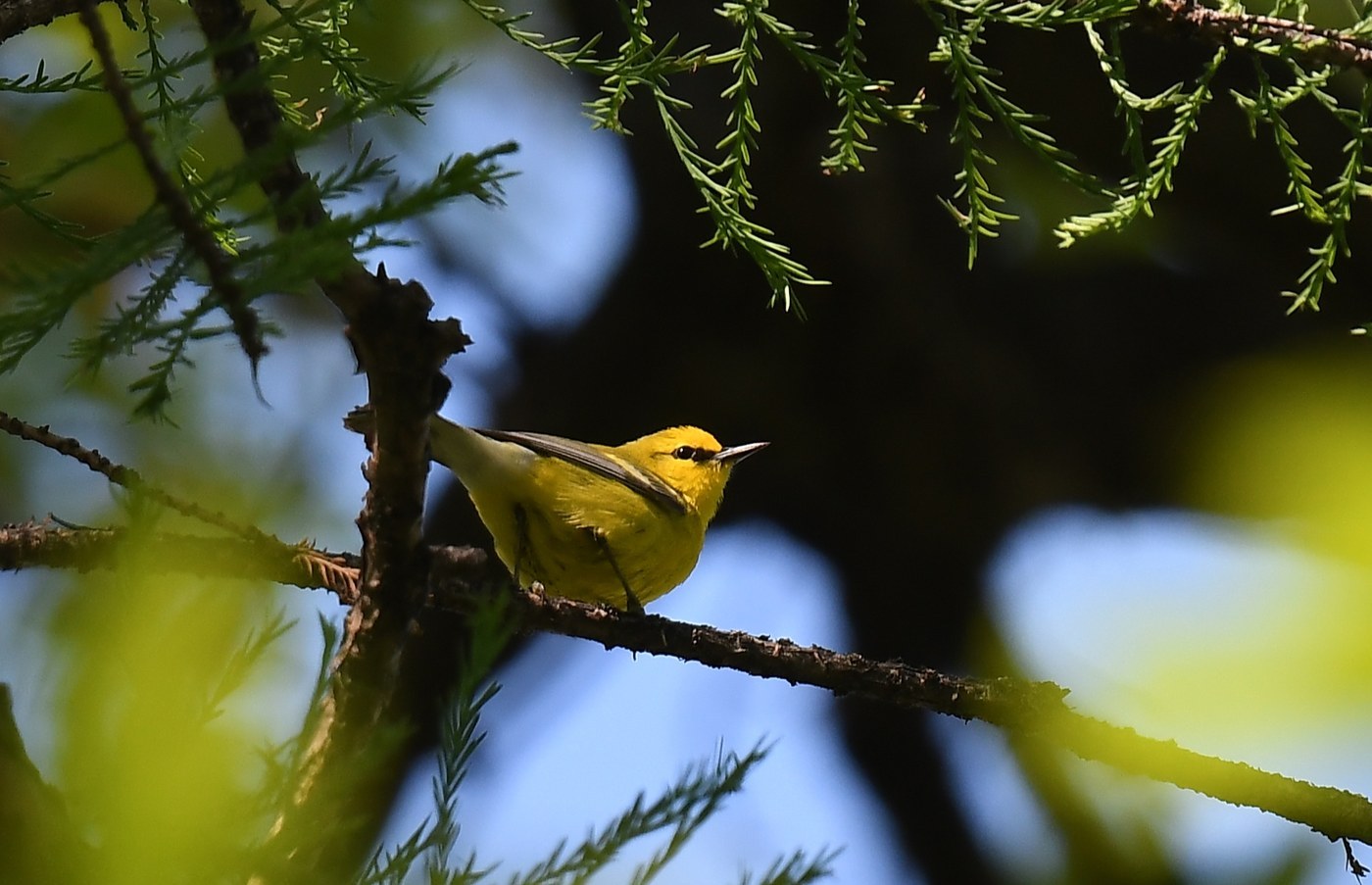
Key Field Marks
- Size & shape: A small, fairly thin-billed warbler with a slim, pointed bill — slightly longer and more pointed than most warblers.
- Plumage: Bright lemon-yellow crown, face, and underparts; blue-gray wings crossed by two crisp white wingbars; olive-green back.
- Face pattern: A thin black eyeline runs through the eye (not a full mask), giving the face a clean, open look compared to many warblers.
- Bill & legs: Thin, dark, pointed bill; gray legs.
- Behavior: Forages actively and often low in dense shrubs and saplings, gleaning insects and sometimes hanging upside down like a chickadee.
Separating It From Similar Species
- Golden-winged Warbler: Close relative that hybridizes with Blue-winged. Golden-winged has a gray body, black throat and mask, and yellow wing patch (not wingbars). Hybrids include the yellow-bodied Brewster's Warbler (pale, whitish belly, faint wingbars) and the rarer Lawrence's Warbler (yellow body with Golden-winged's black throat/mask) — both show mixed traits and are worth documenting carefully.
- Yellow Warbler: All-yellow including wings, no white wingbars, no black eyeline, and often shows reddish breast streaking on males.
- Pine Warbler: Grayer/olive above with white wingbars but lacks the vivid yellow head and black eyeline; has white (not yellow) belly and undertail area.
- Prothonotary Warbler: Deeper golden-orange head, blue-gray wings but no wingbars, and favors wooded swamps rather than dry shrubland.
Where & When to See One
- Habitat: Overgrown fields, shrubby forest edges, regenerating clearcuts, and power-line cuts with scattered saplings and dense low cover.
- Range: Breeds across the eastern and midwestern United States, generally north and west of Golden-winged Warbler's range but overlapping and slowly displacing it in many areas.
- Season: Present on breeding grounds late April through August; winters in Central America and parts of Mexico, so it is absent from North America outside the breeding season.
Voice
- Song is a distinctive lazy, buzzy two-parted "bee-BUZZ," rising then dropping in pitch — often likened to an insect sound rather than a typical bird song.
- Call note is a sharp, dry "chip."
Frequently asked questions
What is the easiest way to tell Blue-winged Warbler from Golden-winged Warbler?
Look at the body color and wing pattern: Blue-winged has an all-yellow head and body with two white wingbars, while Golden-winged has a gray body, black throat/mask, and a solid yellow wing patch instead of wingbars.
What do Brewster's and Lawrence's Warblers mean for identification?
They are hybrid offspring of Blue-winged x Golden-winged Warblers. Brewster's is pale/whitish with faint wingbars and a hint of yellow; Lawrence's has a yellow body paired with Golden-winged's black throat and mask. Either combination confirms hybrid ancestry.
Where should I look for Blue-winged Warblers?
Search shrubby, overgrown fields and forest edges with scattered saplings rather than mature forest — they favor early successional habitat, often the same fields being colonized after logging or farm abandonment.
What does the Blue-winged Warbler's song sound like?
A lazy, insect-like two-note buzz, often transcribed as 'bee-BUZZ,' with the second note dropping in pitch — quite different from the more musical songs of most warblers.