
Bearded Bellbird Identification Guide
A striking South American forest bird whose white-headed, brown-bodied male dangles bizarre black wattles from its throat and delivers one of the loudest, most metallic songs of any bird.
Read the full Bearded Bellbird encyclopedia entry →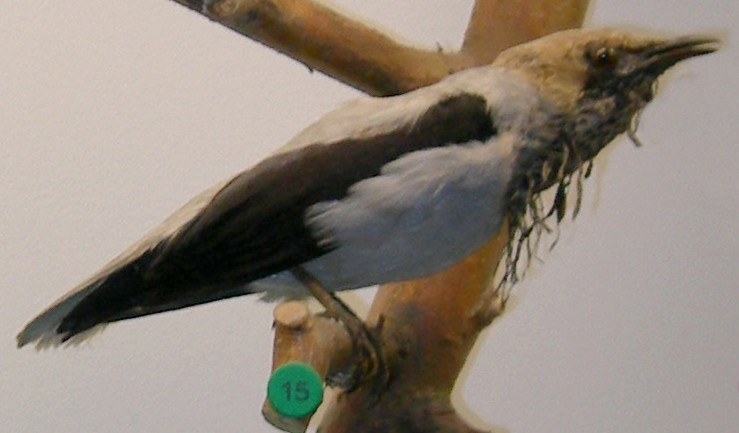
Key Field Marks
- Size & shape: Medium-large, stocky cotinga (25–30 cm) with a large head and stout bill relative to body size.
- Male plumage: Distinctive white head and neck contrasting with a rich chestnut-brown body and wings; the throat and lower face bear a cluster of thin, dangling black wattles ("beard") that can number a dozen or more and swing as the bird calls.
- Female/immature plumage: Entirely different — olive-green above with yellow-streaked underparts, lacking any white head or wattles, and easily mistaken for an unrelated species if not for the shared habitat/voice.
- Bill: Stout, blackish, adapted for swallowing large fruit whole.
- Behavior: Males perch conspicuously on high, exposed dead branches in forest canopy to sing and display, often returning to the same favored perch repeatedly over years; frugivorous, feeding on large forest fruits.
Similar Species
- Other bellbirds (e.g., Bare-throated Bellbird, White Bellbird): Different ranges (Bare-throated Bellbird in southeastern South America; White Bellbird in the Guianan region/Amazon) and different degrees of bare skin/wattle development — Bearded Bellbird is the only bellbird with numerous thin dangling wattles combined with a brown (not white) body.
- Female Bearded Bellbird vs. other cotingas: Best identified by range, habitat, and association with calling males, since female plumage alone (olive with yellow streaking) is not highly distinctive.
Habitat & Range
Found in humid forest canopy and forest edge in northern South America, including Trinidad, Tobago, Venezuela, Guyana, and northern Brazil; favors mid- to upper-canopy of tall forest with large fruiting trees.
Best Time to See
Resident year-round; males call persistently through much of the year, especially during the breeding season, making them relatively easy to locate by ear even when perched high and partly obscured; look up into canopy gaps and along ridge tops where males favor exposed singing perches.
Voice
One of the loudest bird calls in the world — a series of extremely loud, sharp, metallic "bonk" or "bock" notes, likened to a hammer striking an anvil or bell, audible from very long distances through the forest; delivered with an open-mouthed, head-thrown-back display that swings the throat wattles.
Frequently asked questions
What is the most distinctive feature of the male Bearded Bellbird?
A white head and neck contrasting with a brown body, plus a cluster of thin, dangling black wattles hanging from the throat, unique among the bellbirds.
Why is the Bearded Bellbird's call so famous?
It gives an extremely loud, sharp, metallic 'bonk' call likened to a hammer on an anvil, among the loudest sounds produced by any bird, audible over long distances in the forest.
Do male and female Bearded Bellbirds look alike?
No, females and immatures are olive-green above with yellow-streaked underparts and lack the white head and wattles entirely, looking quite different from the striking male.
Where is the Bearded Bellbird found?
Humid forest canopy in northern South America, including Trinidad and Tobago, Venezuela, Guyana, and northern Brazil.