
Arctic Loon Identification Guide
A sleek, gray-headed loon of the Old World best known from its close look-alike Pacific Loon by a bold white flank patch showing above the waterline.
Read the full Arctic Loon encyclopedia entry →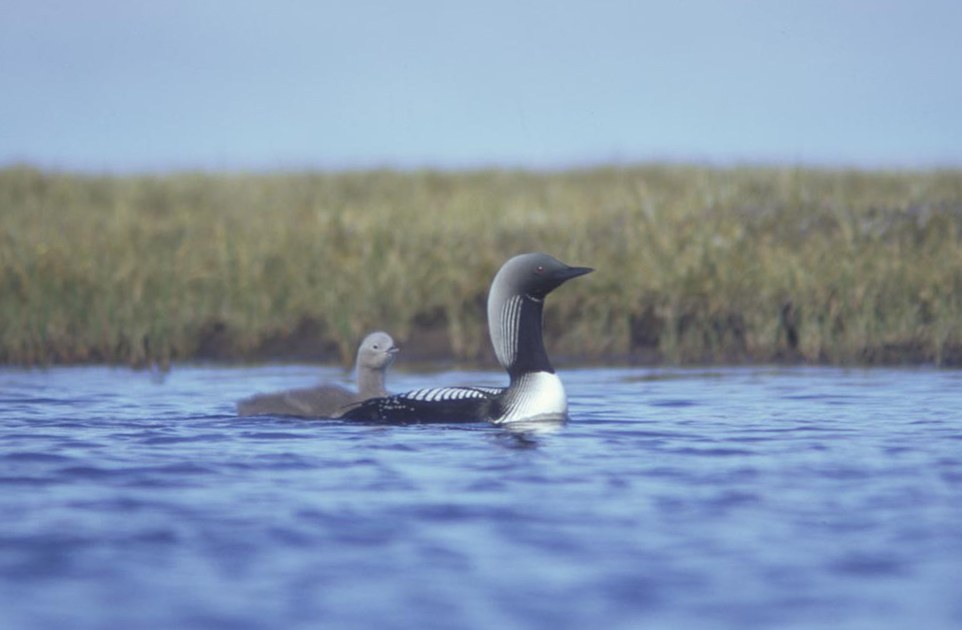
Key Field Marks
- Medium-sized loon, intermediate between Pacific Loon and Common Loon in bulk, with a fairly straight, medium-length bill often held level or slightly uptilted.
- Breeding adult: pale gray crown and nape, black throat glossed with purple and green, and a checkerboard pattern of black-and-white squares on the back.
- The most reliable mark on swimming birds: a bold white patch on the flank/side, visible as a white flash above the waterline near the rear of the body — this patch is the key difference from the very similar Pacific Loon.
- Non-breeding (winter) birds are dark gray-brown above and white below, with a fairly sharp, clean line dividing the dark hindneck from the white foreneck.
- Neck appears slightly thicker and the head shape blockier than Pacific Loon.
Separating from Similar Species
- Pacific Loon: extremely similar and the main identification challenge; Pacific Loon lacks the white flank patch (or shows at most a thin sliver), typically shows a more contrasting dark chinstrap in breeding plumage, and has a thinner, more delicate bill and rounder head. Pacific Loon is also much more numerous in North America.
- Common Loon: notably larger and bulkier with a thicker, dagger-like bill, more extensively white-spotted (not neatly checkered) back, and lacks the clean gray hood of Arctic/Pacific Loon.
- Confirming the white flank patch on a swimming bird is the single best way to separate Arctic from Pacific Loon in the field.
Habitat & Range
- Breeds on freshwater tundra and taiga lakes across northern Eurasia, with a small breeding presence in western Alaska where its range approaches that of the much commoner Pacific Loon.
- Winters along temperate coastlines, mainly in Europe and Asia, on sheltered bays and nearshore marine waters.
- In North America it is a rare bird, chiefly recorded in western Alaska and as a vagrant elsewhere along the Pacific coast.
Voice
- Similar to other loons: wailing and yodeling calls on the breeding grounds, plus low croaking notes; largely silent in winter away from breeding territories.
Frequently asked questions
What is the best way to separate Arctic Loon from Pacific Loon?
Look for a bold white patch on the flank visible above the waterline on a swimming Arctic Loon; Pacific Loon lacks this patch or shows only a thin sliver.
Is the Arctic Loon common in North America?
No, it is rare in North America, occurring mainly as a scarce breeder in western Alaska while the closely related Pacific Loon is far more widespread.
How does Arctic Loon differ from Common Loon?
Arctic Loon is smaller and slimmer-billed with a clean gray hood and checkered back, while Common Loon is bulkier with a heavier bill and more spotted back pattern.
What does a non-breeding Arctic Loon look like?
Dark grayish-brown above and white below, with a fairly sharp demarcation between the dark hindneck and pale foreneck.