
American Flamingo Identification Guide
The brightest pink of the world's flamingos, a tall wading bird with a black-tipped, down-curved bill and black flight feathers, found in tropical coastal lagoons and salt flats.
Read the full American Flamingo encyclopedia entry →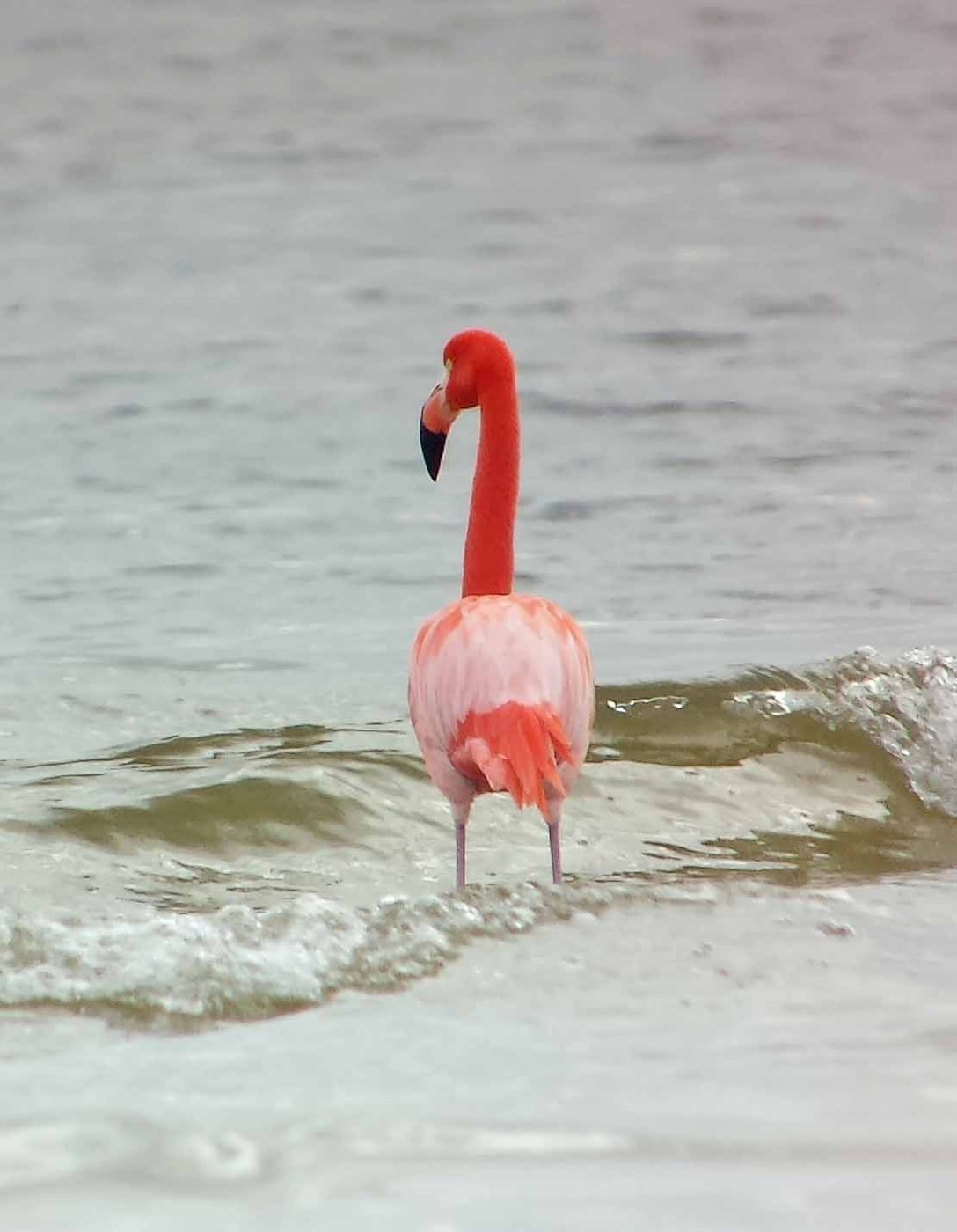
Key Field Marks
- Size: Very large wading bird, about 120–145 cm (47–57 in) tall, with an extremely long neck and legs.
- Plumage: Deep pink to reddish-orange overall — the most vividly colored of all flamingo species — with black primary and secondary flight feathers visible mainly in flight or when wings are spread.
- Bill: Large, thick, sharply downturned (kinked) partway along its length; pale pink or whitish at the base with a bold black tip.
- Legs: Very long and bright pink to reddish, unbroken in color (no contrasting joints).
- Behavior mark: Frequently stands on one leg, often with the neck curled back and the bill tucked into the back feathers while resting.
Separating Similar Species
- Greater Flamingo: A separate Old World species; paler pink overall with a mostly pale bill showing only a small black tip. Not expected in the Americas outside of rare escapes/vagrancy.
- Chilean Flamingo: Paler, more grayish-pink body, and shows gray legs with contrasting red "knee" joints — American Flamingo's legs are uniformly pink/red without that contrast.
- Roseate Spoonbill: Also bright pink and often seen in similar coastal habitats, but has a flat, spoon-shaped bill (not down-curved), a shorter neck, shorter legs, and lacks black flight feathers; spoonbills fly with the neck extended, while flamingos also fly with neck and legs extended but have a very different silhouette due to bill shape and overall structure.
Habitat, Range & Season
Found year-round in coastal lagoons, hypersaline lakes, salt pans, and mangrove-fringed flats across the Caribbean, Yucatan Peninsula, Bahamas, and northern coastal South America. In recent decades, American Flamingos have become an increasingly regular sight in Florida Bay and other parts of southern Florida, sometimes reaching further north and inland after storm events, though core breeding populations remain in the Caribbean/Yucatan region.
Behavior & Voice
Highly gregarious, gathering in flocks that can number in the hundreds to thousands at favored lagoons and salt pans. Feeds by wading through shallow water with its head lowered and bill held upside-down, sweeping it side to side while pumping its tongue to filter small invertebrates, algae, and organic matter from the water and mud.
- Calls: Goose-like honking, grunting, and nasal cackling notes, often given by groups in flight or while foraging together.
Frequently asked questions
Are American Flamingos native to Florida?
American Flamingos historically occurred in Florida and have become increasingly regular there in recent decades, especially in Florida Bay, though the species' core range and breeding grounds remain in the Caribbean, Yucatan Peninsula, and Bahamas.
How can I tell an American Flamingo from a Roseate Spoonbill?
Bill shape is the clearest difference: flamingos have a thick, down-curved bill with a black tip, while spoonbills have a flat, spoon-shaped bill. Flamingos also have much longer legs and neck and show black flight feathers that spoonbills lack.
Why are American Flamingos so brightly colored?
Their vivid pink coloration comes from carotenoid pigments in the small crustaceans, algae, and other invertebrates they filter-feed on; diet directly affects the intensity of their color.
Why do flamingos stand on one leg?
Standing on one leg is thought to help conserve body heat by tucking one leg up against the body, and it also appears to require little muscular effort thanks to the leg's joint structure, making it an efficient resting posture.