Order: Anseriformes; Family: Anatidae
Bufflehead
Bucephala albeola
Small, active diving ducks with large, rounded heads. They are constantly diving for food and are known for their energetic take-offs from the water surface.
Explore Bufflehead in the encyclopedia →Identify your own birds.
Get a report just like this from any photo or call, free.
Plumage & appearance
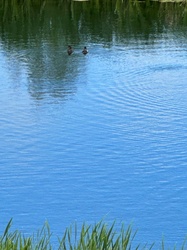
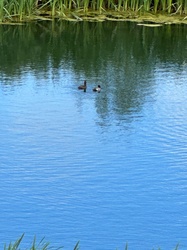
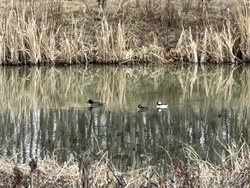
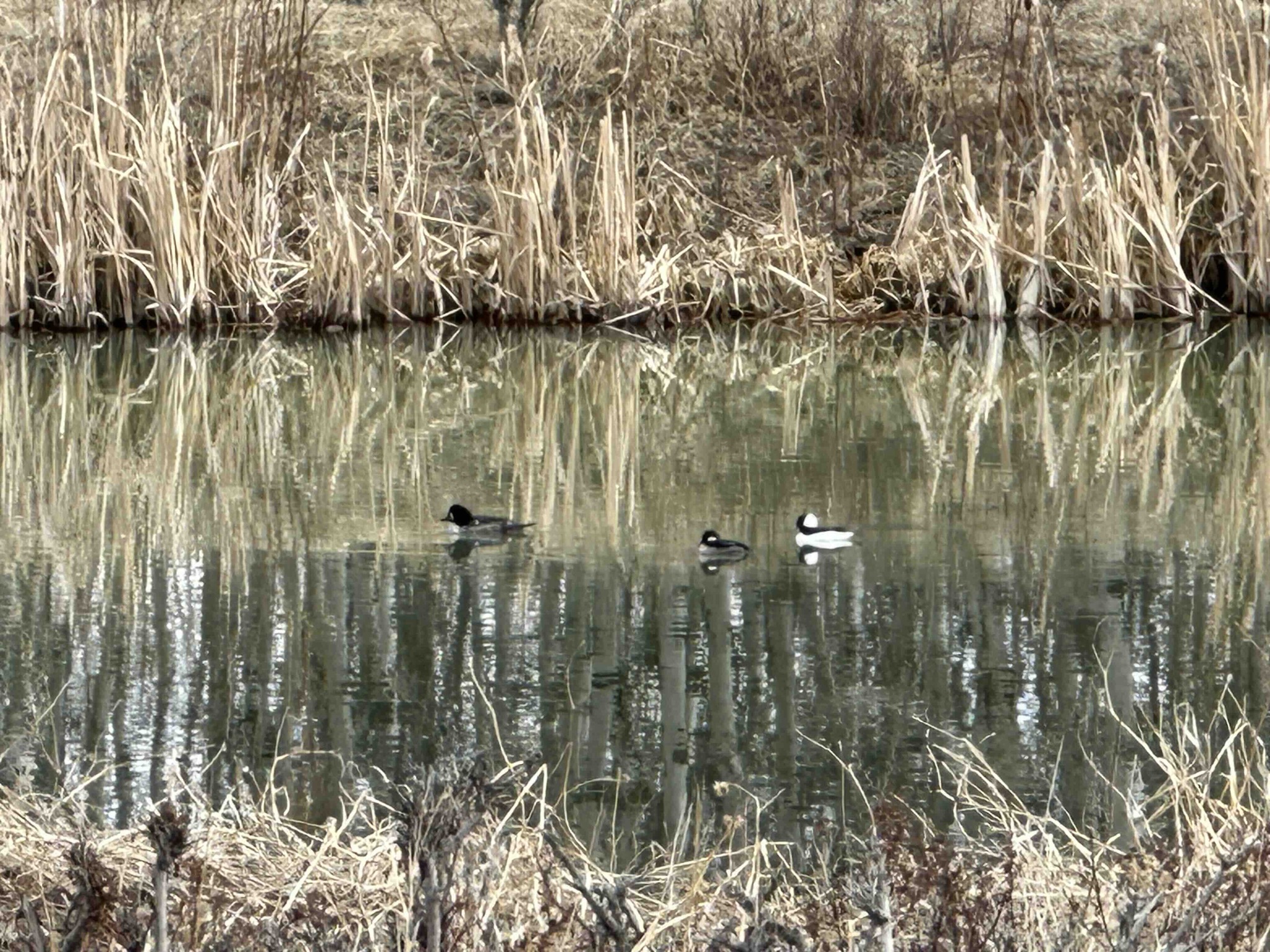
Adult males (the rightmost bird) have a large white patch on the back of the head, contrasting with a dark iridescent (purple-green) head, a white breast, and black back. Females (the two birds on the left) are mostly drab gray-brown with a distinct oval white patch on the cheek.
Key field marks
Small size; disproportionately large 'puffy' head; male has a large white wedge on the head; female has a small white oval on the cheek below the eye.
Size & weight
Length: 32-40 cm; Wingspan: 55 cm; Weight: 270-450 g. One of the smallest diving ducks in North America.
Voice — call & song
Usually silent, but males make a squeaky, high-pitched growling 'kew-err' during courtship; females make a soft 'quack'.
Diet & foraging
Aquatic invertebrates (crustaceans, mollusks, insects) and some seeds or vegetation, found by diving underwater.
Habitat
Breeds near small lakes and ponds in boreal forests; winters in sheltered coastal waters, estuaries, and inland lakes/rivers.
Migration & movement
Migratory. They move from northern boreal forests to southern and coastal North America as waters freeze.
Nesting & breeding
Cavity nesters. They almost exclusively use abandoned holes of the Northern Flicker in trees near water. Clutch size is typically 6-11 eggs.
Similar species
Hooded Merganser (male has a black border on the crest and a thin bill); Barrow's Goldeneye (larger with a crescent-shaped white face patch).
Ecological significance
They help control aquatic insect and crustacean populations and serve as prey for raptors like Bald Eagles. They are secondary cavity nesters, relying on old Northern Flicker holes.
Conservation status
Least Concern (IUCN); population trend is currently increasing.
Observation tips
Look for them in sheltered bays, estuaries, and small ponds. They are very active; if you lose sight of one, it has likely just dived and will resurface nearby within 15-25 seconds.
Interesting facts
The Bufflehead is the only North American duck that is small enough to fit inside the nesting cavity made by a Northern Flicker. They are highly monogamous, often staying with the same mate for several years.
More like this