Order: Passeriformes; Family: Corvidae
Azure-winged Magpie
Cyanopica cyanus
A slender and graceful corvid known for its striking blue wings and very long tail. They are highly social and often seen in noisy flocks, gliding between trees with a distinctive undulating flight.
Explore Azure-winged Magpie in the encyclopedia →Identify your own birds.
Get a report just like this from any photo or call, free.
Plumage & appearance
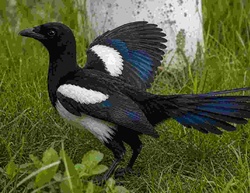
Adults have a glossy black cap, a light greyish-fawn or light brown back, and azure-blue wings and tail. The throat and underparts are primarily white or pale grey. Sexes are similar in appearance.
Key field marks
Long azure-blue tail, black cap reaching below the eyes, and soft grey-brown body plumage.
Size & weight
Length: 31-35 cm (including tail); Wingspan: 38-44 cm; Weight: 65-118 g
Voice — call & song
A loud, raucous, and nasal 'zhee-zhee' or 'kree-kree' call, typical of many corvids.
Diet & foraging
Omnivorous; feeds on acorns, pine seeds, fruits, berries, insects (and their larvae), and occasionally small mammals or young birds.
Habitat
Coniferous and broadleaf forests, parks, orchards, and urban gardens with ample tree cover.
Migration & movement
Non-migratory resident; they remain in their range throughout the year.
Nesting & breeding
They build open cup nests made of twigs and lined with moss or wool. Typically found in colonies, with a clutch size of 6-8 eggs; communal breeding is common.
Similar species
Iberian Magpie (Cyanopica cooki) is very similar but found only on the Iberian Peninsula; it lacks the white tip on the tail found in some Asian populations.
Ecological significance
As omnivores, they play a role in seed dispersal and control insect populations. They are also known for cooperative breeding, where non-breeding individuals help raise the young of others.
Conservation status
Least Concern (IUCN); Population is stable
Observation tips
Look for them in parks, gardens, and light woodlands. They are social birds that travel in groups of 15 to 30, so if you see one, look for others nearby. Listen for their distinctive nasal calls.
Interesting facts
The Azure-winged Magpie has a remarkably disjunct distribution, with one population in East Asia and a closely related species in Spain and Portugal, with a gap of 9,000 km between them.
More like this