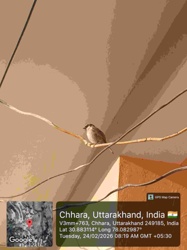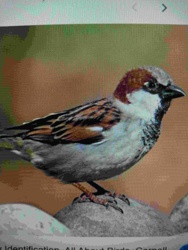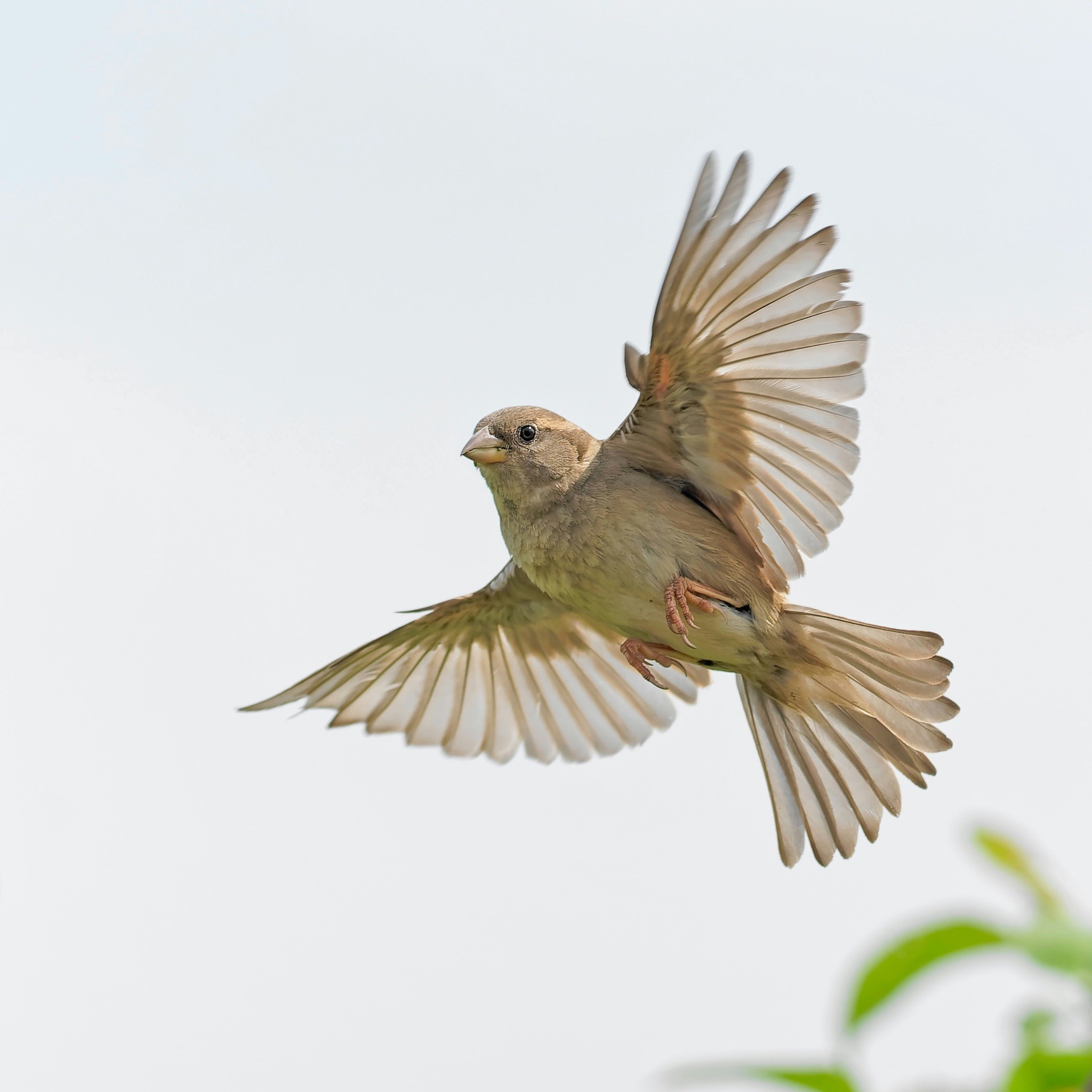
Order: Passeriformes; Family: Passeridae
House Sparrow
Passer domesticus
A small, chunky songbird known for its sociability and close association with human dwellings. It has a round head, short tail, and a stout, seed-eating bill.
Explore House Sparrow in the encyclopedia →Identify your own birds.
Get a report just like this from any photo or call, free.
Plumage & appearance
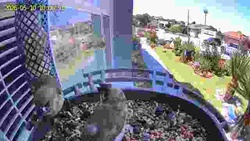
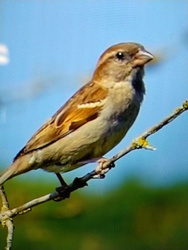
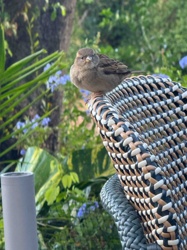
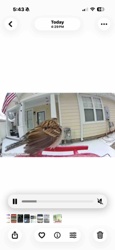
Sexual dimorphism is present. Males have a gray crown, black bib, and rufous neck. Females (like the one pictured) and juveniles are consistent dusty brown and gray throughout, with a pale buffy eye stripe and streaked backs. Legs are pale pinkish-brown.
Key field marks
Small size, stout bill, plain grayish-brown underparts, pale 'eyebrow' stripe (supercilium), and a lack of heavy streaking on the breast.
Size & weight
Length: 5.5–7.1 in (14–18 cm); Wingspan: 7.5–9.8 in (19–25 cm); Weight: 0.8–1.4 oz (24–39.5 g).
Voice — call & song
A series of simple, metallic 'chirp' or 'cheep' notes. They do not have a complex melodic song.
Diet & foraging
Primarily granivorous (seeds and grain), but also eats discarded human food, berries, and insects (especially for feeding chicks).
Habitat
Urban, suburban, and agricultural areas. They avoid undisturbed forests, deserts, and grasslands, preferring to stay near humans.
Migration & movement
Permanent resident. They rarely move far from where they were hatched.
Nesting & breeding
Builds bulky, dome-shaped nests made of grass, straw, and debris, often in cavities, under eaves, or in birdhouses. They are prolific breeders, often raising up to 4 broods per year.
Similar species
Eurasian Tree Sparrow (has a chocolate cap and black cheek spot), Chipping Sparrow (thinner bill and distinct black eye line), and female House Finch (more heavily streaked underparts).
Ecological significance
As an invasive species in many regions, it competes with native cavity-nesting birds for nesting sites and food. They help in controlling some insect populations during the breeding season.
Conservation status
Least Concern (IUCN), although populations have seen significant declines in some native European urban areas.
Observation tips
Look near human structures, gardens, and farms. They are very comfortable around people and can often be seen at bird feeders or hopping on the ground in urban parks.
Interesting facts
The House Sparrow was intentionally introduced to Brooklyn, New York, in 1851 to control lime-tree pests; since then, it has become one of the most widely distributed birds in North America.
More like this